
The many lives of the NEGRONI
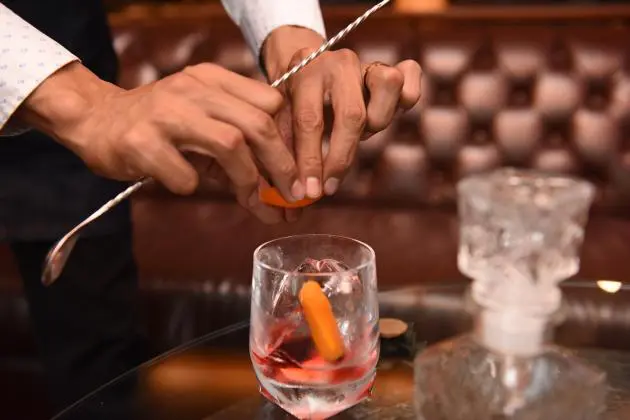


A cocktail with a week dedicated to it surely warrants some investigative reporting
BANGKOK FANS of one particular cocktail were in a state of bliss during Negroni Week last week, celebrated at several venues around town as part of a global event initiated in 2013 by Imbibe magazine and Campari. The blessed negroni and its many creative variations were on offer, with all proceeds destined for charitable causes.
After sampling a few unusual combinations, we met up with Ron Ruede Ramirez, the “group mixologist for Anantara Cluster”, at the Elephant Bar of the Anantara Bangkok Riverside Resort & Spa. According to our barely decipherable notes, he talked about the cocktail itself and the art of mixology in general.
“The negroni is one of the legendary classics,” Ramirez pointed out. “No matter what happens, it will never be erased from cocktail history. It’s a simple cocktail that cleanses the palate, increases your appetite and goes well with most types of cuisine.
“It’s very flexible – that’s why it has been such a favourite for so long. Drinkers like it because it’s simple and nice, and we mixologists like it because it’s easy to make, it showcases the spirits and it’s elegant.”
While the drink’s actual origin is unknown, the most widely reported account is that it was invented in Florence, Italy, in 1919, at Caffe Casoni, which is now called Caffe Cavalli.
Count Camillo Negroni asked the bartender to strengthen his favourite cocktail, the Americano, by adding gin rather than soda water. The bartender also swapped the lemon garnish for a slice of orange to help differentiate the two drinks.
And, of course, they named the drink after the count.
Like Ramirez said, it’s easy to make. Grab a glass, fill it with ice and pour in equal parts of gin, vermouth rosso and Campari, and then garnish with an orange peel. There’s your thirst-quenching negroni in under a minute.
“One great thing about a three-ingredient cocktail is that it has such a unique combination of flavours that’s easy to become familiar with,” Ramirez said. “In this case it’s just gin, vermouth and Campari. Any bar in the world would be able to make a decent negroni. Whenever I go to a new bar and I don’t like their signature cocktails, I’ll just get a negroni – because I know exactly what I’ll get.”
Classic cocktails, especially if they’re as simple to make as a negroni, become blank canvases for aspiring mixologists. You often see a variation that’s wandered very far from its inspiration, but Ramirez says there are only three “divisions” in current mixology.
You’ve got your classics, you’ve got your contemporary or “artisan cocktails” with all the fancy ingredients, and then you’ve got the currently trendy “culinary cocktails” with edible ingredients, like jelly or foam, or which otherwise rely on kitchen techniques.
“In this classification – useful for when you’re pairing cocktails to food, the rules of thumb are to use the same flavours throughout the meal and go easy on the alcohol, because you don’t want the drinks to overwhelm the food – or for the guests to be too drunk to finish their dessert.”
Ramirez then demonstrated how a simple negroni can dare to venture into all three divisions. For an “artisan” negroni he used rosemary-infused Campari, which already has a herbaceous tone, to add an earthy aroma. The resulting cocktail was a bit more serious, though not too sombre thanks to its bright orange rind.
The culinary twist was done with the three ingredients forming a chewy jelly on a stick, served on an orange slice resting on a bed of crushed ice. You eat the jelly and then squeeze out the orange juice into your mouth so all the flavours and aromas mingle. What a fun way to enjoy a negroni!
We even picked up a tip for “customising” the classic negroni.
“You can choose which spirit to bring forward,” Ramirez explained. “If you like your negroni a bit bitter, put the gin in first and stir well with ice to release the flavour and aroma of the spirit.
“If you like it a little sweet, put the vermouth rosso in first. If you get a sweeter negroni at a bar, that’s probably how the bartender made it. And, if you want a negroni to taste more like Campari, stir in the Campari with ice first before putting in anything else. There’s no need to add more to taste more!”
