
Toward a Safer future


Fear of natural disasters has guided researchers at King Mongkut's University of Technology to findings that could save lives
THE EARTHQUAKES that wrought death and destruction in large swathes of Nepal on April 25 and May 12 provided ample proof yet again that it’s not the tremors that kill so much as buildings too weak to withstand the shaking.
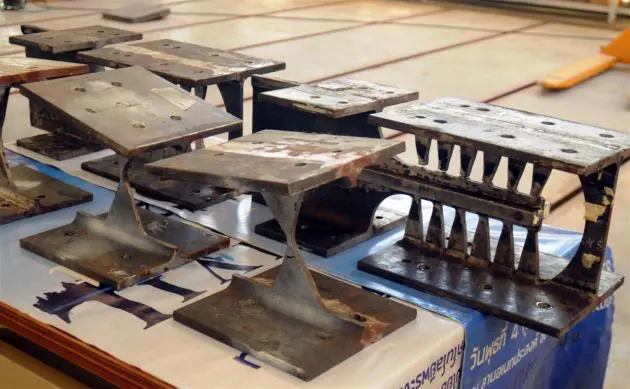
Now three reports from researchers at King Mongkut’s University of Technology Thonburi pinpoint the specific flaws in manmade structures that are directly responsible for fatalities in quakes – along with the means to correct them.
Highly technical in their content but potential lifesavers, the reports are titled “Cyclic Testing of Post-tensioned Flat Plates with Headed Shear Studs”, “Teflon-coated Steel Buckling Restrained Brace (SBRB)” and, from research still underway, “The Development of Ductile Shear-yielding Panels Based on Low-yield Steel Using Heat Treatment Process”.
Associate Professor Dr Sutat Leelataviwat, head of the university’s Department of Civil Engineering, emphasises that people are killed during earthquakes – as happened in Nepal and in Chiang Rai last year – purely because the buildings are unsafe.
“Fortunately strong earthquakes are rare in Thailand, but the urgency has been significantly raised in discovering how the design and construction of buildings can be improved,” Sutat says.
The country has had many buildings erected atop post-tensioned concrete slabs over the past 20 to 30 years, he notes. The concrete is reinforced through compression and its bracing steel grids have built-in tension. The technique is common because it’s cheap, fast and comparatively easy. “These buildings are safe if the design and construction are done correctly, according to modern building codes and the law, but older buildings are highly susceptible to collapse during seismic events.
“The main problem with post-tensioned concrete in earthquakes, is there might not be enough distance between the supporting beams on each floor, so if one floor collapses, the lower levels could collapse in ‘sandwich’ fashion,” ” Sutat warns. “The damage can be catastrophic, although, with beam construction, there are counterbalances that create spaces for anyone trapped inside. The victims can survive while waiting for rescue.”
Sutat and his colleagues – backed by the Thailand Research Fund and local manufacturers – have been examining the efficacy of using headed shear studs to further reinforce post-tensioned slabs, as is commonly done in some countries. Can the high cost of inserting shearing-resistant studs be justified? They tested the claim in the laboratory, simulating seismic forces.
“Post-tensioned concrete flat slabs are widely used in mid- to high-rise buildings in Thailand, and the headed shear studs are designed to ‘carry’ the forces generated due to the movement of the building in an earthquake. Our tests looked at whether the shear studs could improve the behaviour of the concrete and reduce the risk of building collapse in an extreme-load case.
“The model was subjected to force applied through a hydraulic actuator that moved it slowly in a cyclical manner. The studs were produced by a local supplier who’s developed a cost-effective way of making them.”
What they determined was that concrete slabs containing shear studs can “sustain larger deformation without collapse”. The studs also simplify the making of the slabs, though it requires a trained engineer to calculate how to position the studs and how many to use in a given building. Your local builder might not be able to calculate that crucial information.
Meanwhile the SBRB – the Steel Buckling Restrained Brace – can absorb the fury of the quake, dissipating its energy, and can be installed in existing buildings, making it increasingly popular in tremor-prone areas.
Ductile shear-yielding panels affixed to construction beams also allow for much greater deformation, again by absorbing the force of the quake and protecting other parts of the building, thus adding to the structure’s overall stability.
The university has further proposed that the results of its research on integrated water-resource management be incorporated into national policy with an eye to reducing the impact of flooding, drought, landslides and erosion.
It has even calculated fair amounts in insurance and compensation for victims using mathematical models, but first, says Professor Dr Chaiyuth Chinnarasri, the prediction of disaster risk must become more reliable.
“Extensive research has been presented that can be effectively applied in practice, publicly, to determine policy and strategy, both at the community and the national level,” he says. Thailand has in recent years witnessed a growing threat from water-related disasters, particularly erosion, with Bangkok, Samut Sakhon and Samut Prakan being high-risk zones.
“The Gulf coast is eroding by about five metres a year,” Chaiyuth notes. “At the same time the sea level is severely increasing. Think what it will be like in another 10 years. The situation is quite serious, especially for construction in the area.
“We have carried out a great many studies aimed at resolving these problems by improving the capacity of water-force reduction, such as by using barricades of bamboo and red mangrove or buoys and concrete.” The team also looked at minimising the impact of erosion in the event that dams are destroyed in natural disasters.
The researchers concluded that all of the protective methods they studied both suit the country’s infrastructure development and are essential if the loss of life and property damage are to be avoided. With disasters like earthquakes and tsunamis virtually impossible to forecast and large-scale erosion continuing despite the best-laid plans, the challenge for engineers is to find the right balance between structural soundness and cost effectiveness.
