
Too much of a good thing


Play
While infants need protein to develop, too mcuh of it is likely to lead to obesity later in life
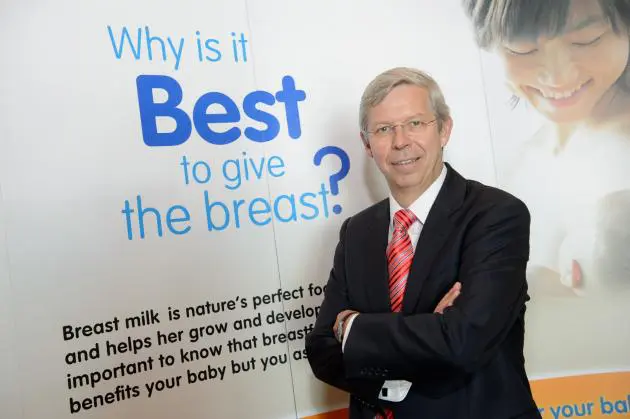
Dr Berthold V Koletzko of the Department of Paediatrics at Ludwig-Maximilians-University of Munich, Germany has an important message for parents of young children: Breastfeed your babies because too much protein during infancy is likely to cause obesity and chronic disease in later life.
Koletzko, who was in Bangkok recently at the invitation of the Nestle Nutrition Institute, adds that feeding only breast milk during the first six months is best for babies, as it can help reduce the risk of obesity by 15 to 25 per cent.
He emphasises that nutrition in early life is of greater importance than at any other time.
“Babies gain weight very rapidly. They need high nutrients for brain function, mental and physical development as their bodies have less storage. The brain grows the fastest during the first 24 months and develops to 80 per cent of its adult size by the age of three. Babies consume a single food so it must meets all their needs.”
A study of 1,600 European infants and children under the European Childhood Obesity Project discovered that children who were breastfed were 15 to 25-per-cent less likely to be obese than those who consumed milk powder. In addition, infants who received infant formula containing a higher protein content than breast milk, were prone to obesity when they grew up, compared to the infants fed with infant formula that had an optimised quantity of high-quality protein that is similar to breast milk.
“Globally, obesity is the fifth leading cause of death today and much of that is related to how a child is fed in early life. If a mother is obese or has diabetes, she is likely to pass on the obesity to her child because the baby will receive high glucose, fatty acids, and so. Rapid weight gain in infancy is accountable for 30 per-cent of the obesity risk. Having baby take that extra spoonful is completely unnecessary and wrong,” he adds.
Paediatric nutrition experts say the time has come to foster understanding among parents that children’s eating habits from birth to two years must change. This early life care will lead to a healthy adulthood. On the other hand, consuming too much protein when very young leads not just to a higher risk of obesity but to a greater likelihood of developing diabetes and cardiovascular diseases, as well as having a generally reduced quality of life.
Koletzko has studied the relationship between weight gain of infants due to higher protein content relative to lower protein content and the weight of breastfed infants.
“The sample group was comprised of 1,678 infants in Europe with an average age of two weeks |to one year old. They were categorised into three groups: breastfed infants, higher-protein content |formula fed infants, and lower-protein content formula fed infants. Height was not different between groups, but weight (weight-for-length) and Body Mass Index (BMI) were clearly higher in the high-|protein group,” he says.
“With a high-protein formula that exceeds protein requirements in infancy, the metabolic system produces more insulin and more fat accumulates in the body. This leads to long-term negative health effects. Infants fed breast milk and infants fed reduced-protein content with protein similar to breast milk were both less likely to experience excessive weight or obesity at six years old. Mothers must avoid feeding their babies unmodified cow’s milk during the first year since it has three times more protein than breast milk.
Associate Professor Dr Sungkom Jongpiputvanich from the Department of Paediatrics at Chulalongkorn University’s medical faculty and chairman of the Society of Paediatric Nutrition of Thailand, says he’s concerned at the increase in the numbers of overweight Thais.
Local studies have shown that in the two to five age group, this increased from 5.8 per cent in 1996-1997 to 7.9 per cent in 2001 and to 8.5 per cent in 2008-2009. For school-age children, the number increased from 5.8 per cent in 1996-1997 to 6.7 per cent in 2001 and 9.7 per cent in 2008-2009.
Children in Bangkok are most likely to risk obesity than children living in other regions, while youngsters living in a municipality are 1.6 to 1.8 times more likely to be obese than children living outside.
The study also showed that 10 to 20 per cent of overweight infants were likely to become overweight children. This follows on into adolescence and into adulthood, with 80 per cent of overweight teenagers running the risk of becoming overweight adults.
Both paediatricians stress that prevention must start in infancy. Breastfeeding is recommended for at least six months and should continue for as long as possible. If a mother cannot breastfeed, the infant formula used should have an optimised quantity of high-quality protein that is similar to breast milk.
