
How our ancestors lived


Play
Two museums, one of Lop Buri, the other in Pathum Thani, pay testament to the ancient way of life
THE HISTORICAL parks of Ayutthaya and Sukhothai have long been attracting tourists, both Thai and foreign, yet the ancient Dvaravati resettlement of Sub Champa in Lop Buri province, itself a fascinating historical site, is barely known outside the area.
Located in the Lop Buri-Pasak valley and a mere two hours by car from Bangkok, Sub Champa is a moated site that was a thriving Dvaravati city more than a millennium ago as well as a major trading centre in the central highlands.
Run today by the Subdistrict Administrative Organisation, it is promoting itself as a prototype local learning centre, one that encapsulates the Sub Champa Historical Site, the Sub Champa Museum and the Sirindhorn White Champak Forest. The site was discovered quite by accident back in 1970 during a pest eradication inspection by the Ministry of Agriculture and Cooperatives and excavation started soon afterwards with an impression collection of artefacts, skeletons and ruins unearthed over the years.
We are taken to see the sights by the head of the SAO, Netnarin Kumruengboon, travelling in a “shuttle bus” that’s been cleverly adapted from an old tractor.
Surrounded by tropical forest and agricultural land, the ancient kingdom occupies 350-rai. All that can be seen today of this well-designed oval-shaped city are the ruins of double-layer earthen walls with a trench in between them, designed to catch water running down from the mountains and prevent flooding.
“Sub Champa village was home to a major criminal gang some 40 years ago. Once the police cleared them out, a pest eradication unit from the Agriculture and Cooperatives Ministry came to help develop the land for agriculture and accidentally discovered the remains of ancient city scattered around the village during their survey,” Netnarin says.
There are four mounds outside the earthen city walls, which served as fortresses, as well as an irrigation system that is similar in the way it was used to the dams we build today.
Over the years, villagers ploughing their fields have also unearthed up a range of stone items, Buddha images, earthenware, stone beads and stone bracelets that pay testament to the Dvaravati kingdom’s Buddhist beliefs and the influence of the Indian culture.
To the north stands a ruined pagoda, once a place of worship for spiritualists, Brahmans and Buddhists. Today in a touching ceremony held on the first day of the fourth waxing moon, local residents gather at the site to make merit for their village and ancestors.
Netnarin points towards a piece of land under which skeletons with the status of a Buddha image were buried. These, he says, were stolen and sold to a gallery in the US.
Another highlight was the discovery by a local resident of the head of a Buddha image made from green stone in 2005. The Fine Arts Department surmise its dates back to seventh or eighth century and it is now displayed in the Somdej Phra Narai National Museum.
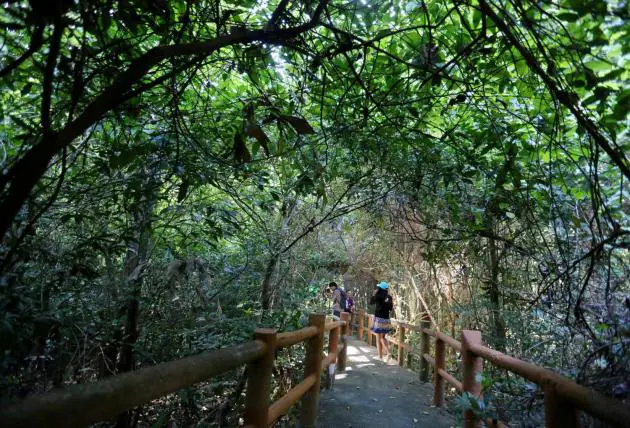
Located at Ta Luang Wittayakom School, the Sirindhorn White Champak Forest – or Champi Sirindhorn Forest as it is known locally – extends over 96-rai. It’s home to rare fauna and flora including the Asian leaf turtle, spiny rock crab, cork tree, ficus callosa wild and horsfieldia as well as 570 old champak trees named after Her Royal Highness Princess Maha Chakri Sirindhorn that are unique to this area.
With support from the Institute of Innovative Media for Learning, the SAO has invested Bt1.2 million investment into adapting an old building into the Sub Champa Museum.
Divided into four zones, the museum traces back the history of the village with a large board detailing archaeological information from the Stone, Bronze and Iron Ages to Dvaravati, the Khmer Kingdom and Siam.
The artefacts section boasts broken pieces of ancient axes made from green sandstone and granite as well as earthenware household goods, sculptures, stone spindle whorls, stone beads and stone jewellery. A stone pillar marks the spot where the Wheel of Dharma was placed.
The history of Sub Champa village and other archaeological sites is explained in the “Discover Lopburi from 3,500 Years Back Until Today” exhibition at the Somdej Phra Narai National Museum in Lop Buri.
The artefacts on show include an elaborate head of a Buddha image created in the sixth to seventh century along with ancient tools chisels, sickles, arrowheads, and harpoons fashioned from iron.
Lop Buri, though, is far from the only province to be dwelling on ancient times.
A little further south in Pathum Thani, the Southeast Asian Ceramics Museum is showcasing a collection of more than 16,000 ancient Asian ceramics and porcelains, donated by Surat Osathanugrah, Bangkok University’s founder.
Located on Bangkok University’s Rangsit Campus, this museum was officially opened in 2002 to commemorate the university’s 40th anniversary. Modern and spacious, it’s designed in the form of an ancient underground Thai kiln, winning it awards and accolades as an outstanding green building.
The single-storey building is home to a wide selection of antique ceramics, mostly made at kilns in Thailand, China, Vietnam, Cambodia and Myanmar and dug out of shipwrecks and kiln sites in Southeast Asia and the Thanon Thongchai Mountain Range.
The Thai ceramics were mostly made in the Sukhothai and Si Satchanalai kilns. They include stoneware baked at more than 1,000 degrees Celsius, simple clay earthenware and porcelain made with white clay from Lampang.
“The museum explores the development of Southeast Asian ceramics and demonstrates the importance of sea trade. China was a leading ceramic manufacturer and exported its wares all over Asia. Our ceramics were influenced by Chinese pottery but we developed our own designs to match what we needed in daily life,” museum educator Burin Singtoaj says.
The display includes China’s famed blue-and-white ceramics, classic celadon from Thailand and Khmer pottery glazed with plant ash that gives it its brown hue.
Among the most prized items are an elephant Celadon figurine and two-coloured glazed jar with cover made in the 15th and 16th century in the Si Satchanalai kiln, a blue-and-white dish created in the mid-14th century from the Jingdezhen kiln and a white-glazed ewer produced in the 11th to 12th century at the Xicun kiln.
SEE AND LEARN
>>Sub Champa Museum, Historical Site office and the Sirindhorn White Champak Forest are part of Tha Luang Wittayakom School. Admission is free. The site is open Monday to Friday from 8.30am to 4pm. Call (036) 461 922, (036) 788 101.
>>Southeast Asian Ceramics Museum is at Bangkok University’s Rangsit Campus. It’s open Monday to Saturday from 9am to 4pm. Admission is free. Call (02) 902 0299 extension 2890.
>>Museum Siam is offering a Muse Pass for Bt199 that allows holders free entrance to 32 museums and learning centres around the country through December. Find out more by calling (02) 225 2777 extension 123 or visit www.MuseumSiam.org.
