
Cashing in on care


Play
With owners of domestic animals now spending millions of baht on their furry friends every year, designers are turning to their drawing boards to come up with innovative pet-friendly accessories
AN AMERICAN news channel recently reported that US citizens are currently spending US$56 billion – that’s Bt1.9 trillion – annually on pet care. Britons are equally as barking mad, dishing out more than 4 billion pounds (Bt212 billion) in 2014 on food, beauty treatments and accessories for man’s best friends.
While the figures are nowhere near as high in Thailand, annual spending on pet care is growing by 10 to 15 per cent a year and according to a recent survey by the Thai Pet Product Industries Association topped Bt1.5 million last year.
Little wonder then that product designers are turning to the lucrative pet accessories market to ensure owners and their canine and feline companions live in purr-fect harmony.
“Pet owners today are willing to spend on their animals, who they regard as family members. They are increasingly concerned about nutrition and hygiene but are also interested in functional pet supplies and accessories. Dogs, cats and ornamental fish lead Thailand’s pet preferences,” says the association’s president Siriyapat Tienrungsri.
Architect Supakorn Komesmalai is a case in point. Unable to find a collar and leash for his Siberian Husky of the same quality as those he had seen in the UK, he decided to make his own by following instructions on YouTube. He enjoyed the handiwork so much that three years ago he launched the brand Sit.Stand.Stay on Facebook. Word quickly spread through the social media and his customer base jumped from just a few friends to hundreds of buyers.
“I focus on hand-made collars and leashes because they’re about the safety of our pets. These products are worn by our four-legged friends so should look nice and be
comfortable at the same time, as well as serve as tools of communication between owners and pets. We are passionate about the details. There are as many as 15 steps in making a leather collar,” says Supakorn whose products were recently shown at Tokyo’s Interpets International Fair for a Better Life with Pets.
His first collection, “The Classic” is made of local premium vegetable-tanned leather with imported solid brass hardware. The leather is conditioned with a natural mixture of beeswax, mink oil and pine pitch to make it water repellent and the edges are dyed, polished, burnished and waxed by hand to ensure they don’t chaff the skin. Five colours, each obtained from a natural dye, are available – natural, espresso, caramel, pumpkin and cherry – and the collars come in six sizes, making them ideal for all breeds.
Supakorn’s second collection “Le Noir” was launched last year and is made with imported strong leathercalled harness, which is also used to craft saddles. The leather is treated, drum dyed and stuffed for maximum strength and longevity.
“As we gained more knowledge about leather, we decided to bring in harness leather from the world’s most renowned tanneries, Hermann Oak in the US and Chahin Leather from Mexico. We combine the imported dark-tone leather with the local vegetable-tanned one and solid brass hardware. This is a luxury collection and popular with pet owners who like to show off their companions,” he says.
Designed for the more adventurous owner and his dog, the “Folk” collection is made from waxed cotton from British Millerain. Waterproof and tough, the fabric is designed for military use and cracks over time, resulting in a unique vintage look.
“Pet owners treat their pets like children. They look for products that are not only functional, but also well designed so they won’t look out of place in the home. There’s still room to move in the pet product market, but designers must be straightforward in their business dealings,” Supakorn says.
After failing to convince his Beagle to finish his food before the ants moved in, architect Piyanat Ratanawongsarot came up with an ant-free ceramic pet bowl called Geowl, which recently won a Design Excellence Award (DEmark) from the government’s Department of International Trade Promotion.
The polygon-shaped Geowl features two bowls stacked one of top of the other with the lower one filled with water to prevent insects laying their eggs. An anti-skid rubber base prevents the bowl from moving while your pet is eating. It’s dishwater safe and microwaveable too.
“It’s made from the same grade ceramic as the bowls we use. I personally don’t like plastic pet feeding bowls in fancy colours or with cartoon patterns. Geowl is not only safe but it looks good in any kitchen,” says Piyanat, an architecture graduate from Chulalongkorn University.
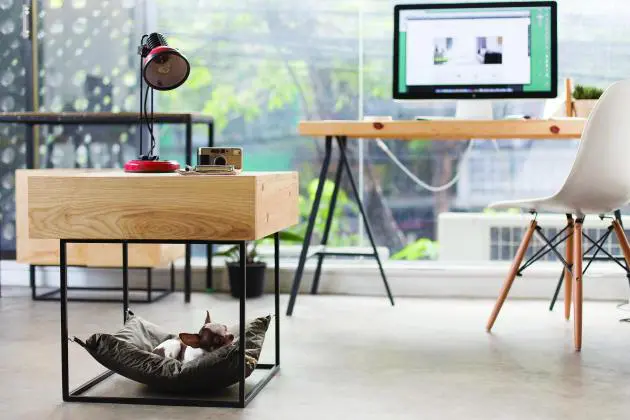
In business for three years, his design company Barketek also offers pet accessories and furniture in minimalist styles. They include stainless steel bowls on wooden stands, wooden beds with soft cushions, and pet canvas cushions with a handle.
Stack is a wooden side table with a pet hammock underneath for a small dog or cat. Cube is another wooden side table with a pet cushion underneath and will look good in any room.
Anchana Thongpaitoon, owner of Mha Dog and Living, offers a portable indoor tent for dogs that can be folded up and taken wherever the two of you go. The structure is made from lightweight parawood that is easy to assemble and can be flat packed for easy transport and storage. The denim tent cover and the included cushion can also be machine washed.
“I wanted to create a portable and safe kennel for my Miniature Schnauzer. The tent gives him his much-needed own territory and it also means we can travel in style,” says Anchana, a graduate in decorative arts from Silpakorn University.
She started the brand three years ago after word of her tent creation spread. She also offers beds and mattresses, soft cushions boasting a charcoal drawing of a dog telling the world “Dogs are friends, not food”, as a protest against the dog meat trade, and for the fashion-conscious pooch or puss, a triangular scarf with a set of three iron-on embroidered appliques.
“It’s not a ready-to-wear scarf but allows owners to participate in making a fashion statement for their pet,” says Anchana.
Designed for cat lovers looking to reclaim their homes from claw marks, Kwanchanok Amorntananuban’s Kafbo brand offers scratching posts in various designs that look good while providing hours of entertainment for a feline friend.
Her materials are the leftover corrugated cuts from the family-run pallet cardboard business, and these she turns into accessories perfect for scratching, napping and playing.
Her first collection, which was inspired by cats having nine lives, was called “9 Lifers” and featured nine recyclable scratchers in the shapes of a whale, snail, fox, walrus, bird, frog, rooster, mouse and hippo.
“The machinery in the family factory allows me to make durable scratchers in dense cardboard. I use organic glue to avoid any toxins,” she says.
“You can’t curb a cat’s natural instinct to sharpen its claws and assert its dominance but you can treat it to a scratcher that also includes an organic catnip leaf. It will not only make your feline companion happy but looks nice too,” says Kwanchanok, a fine arts graduate from Academy of Art in San Francisco.
Her new collection “Home” features eight scratchers in geometric forms that can stand individually or be turned into a stackable cat fortress or, even better, a bookshelf.
PAMPERED PETS
>>> Sit.Stand.Stay: “sit.stand.stay” on Facebook, www.SitStandStay.com, (086) 770 8989.
>>> Barketek: The Selected store at Siam Center, Anyroom store at the Jam Factory, “barketek” on Facebook, www.Barketek.com, (080) 212 2026.
>>> Mha Dog and Living: The Selected store at Siam Center, “Mha” page on Facebook, (092) 448 2525.
>>> Kafbo: “Kafbo” on Facebook, www.Kafbo.com, (086) 881 7433.
