
Beyond hula


Play
In Hawaii, dance, music and theatre traditions coexist in one of the world's favourite island destinations
A recent vacation in Bali showed me how difficult it can be to watch a performance that has nothing to do with tourism and thus my record of watching dance and theatre performances in every country I visit was broken.
The opposite, however, turned out to be true in Hawaii. For that I have to thank the East-West Centre, University of Hawaii at Manoa Outreach College and the Department of Theatre and Dance, organisers of the biannual Asia Pacific Dance Festival, which this year kicked off July 14 and ends today.
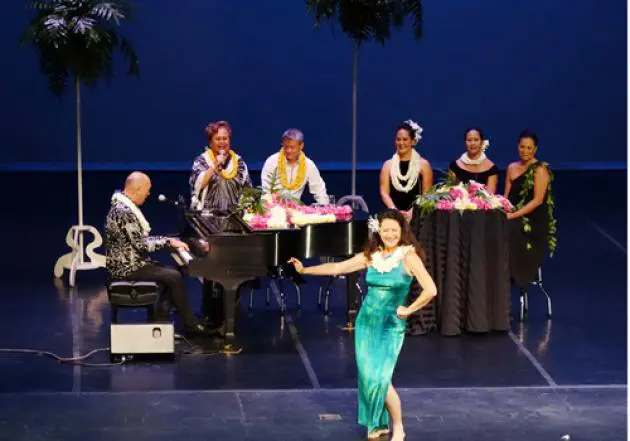
The first performance on July 16 was “Living the Art of Hula”, a dance dialogue between hula scholar Michael Pili Pang and four renowned female hula performers, namely Kanoe Miller, Debbie Nakanelua Richards, Pi‘ilaniwahine Smith and Nani Dudoit. They were accompanied by composer and pianist Robert Cazimero as well as singer Marlene Sai. Juxtaposing informal, yet informative, conversation with performances in a setting that looked like a bar along Waikiki, the two-hour performance was thoroughly pleasant and proved why hula is truly the spirit of Hawaii. It also reminded me that the music and lyrics are as important as the dance and showed how hula keeps evolving with new compositions and choreography. As much cultural heritage as tourist attraction, hula faces a similar problem to performing arts cultures on many shores – it’s frequently the patron or the hirer, not the artists themselves, who defines the style and content of each performance.
The following Sunday afternoon, “Local Motion!” presented a myriad of dance traditions and styles by local professionals and students – ranging from Topeng, traditional Balinese masked dance and Nihon Buyo, traditional Japanese dance, to a pas de deux from the classical ballet “Flames of Paris”, contemporary dance works both with and without Hawai’i related themes and a magic show whose performer knew how to move. My personal favourite was “Kunjan Sabakui” in which Yukie Shiroma based her choreography on a traditional Okinawan song and modified it with her dancers. It’s an example of a tradition-based work that didn’t fail in communicating and charming the contemporary audience.
As much as I enjoyed such diversity and loved the fact that the company could present any representative work that fit the time slot given by the festival, I couldn’t help wishing there had been a kind of curatorial trajectory underlining this programme to take the audience on a specific journey.
After the performance in the theatre, some audience members walked over to the Manoa stream behind Jefferson Hall to watch site-specific performance “Flood: Turn the Tide” by Body Portal Theatre. Led by Taipei-born, Honolulu-based dancer and choreographer Sheenru Yong, who co-created this enticing and meditative work with local dancers, it not only saw the performers blending with the nature as they slowly moved down the stream, but also reminded us of the importance of our environment.
Apart from performances at Kennedy Theatre, the festival also hosted dance classes and lectures by participating companies as well as a dance critics’ workshop, thus making sure that knowledge and skills were shared and exchanged. This is all too sadly lacking in many festivals where foreign artists land in UFOs and disappear without any trace.
The writer’s trip was supported by East-West Centre, University of Hawai’i at Manoa Outreach College and Department of Theatre and Dance as well as Shangri La: Centre for Islamic Arts and Cultures.
On the Web:
www.facebook.com/APDanceFest
