
Stories from the Pacific
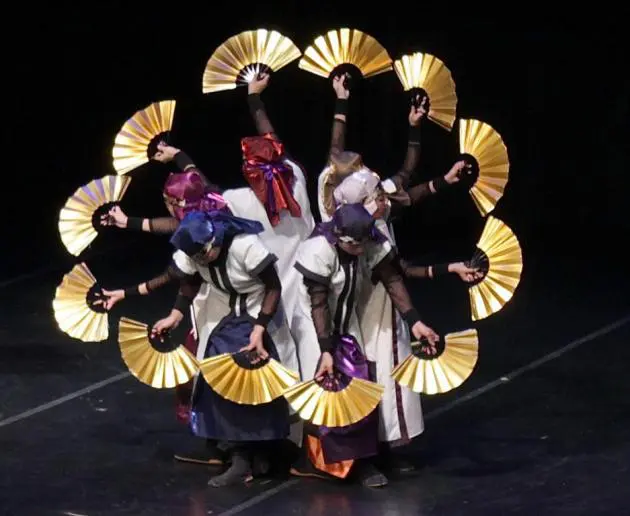


Four dance companies from four countries use their time on stage to tell stories of their cultures through dance and music
The third edition of the biannual Asia Pacific Dance Festival, organised by the East-West Centre, University of Hawai’i at Manoa Outreach College and Department of Theatre and Dance, enjoyed a busy second week with four dance concerts presented to the public on four consecutive days.
Returning to Hawai’i after only four years, the Okinawan drum and dance troupe Churasa had its own evening-length programme in which performers ranging from the age of eight to early 40s showcased their music and dance skills. Each scene was brief and entertained the packed house with familiar tricks including audience participation, an example of how traditional performing arts have been reworked, or repackaged, for the contemporary international audience.
The following evening, the festival’s welcoming ceremony served as a preview of the two main concerts scheduled for the next day as three companies in residence, namely Ballet Philippines, Halau I Ka Wekiu and Oceania Dance Theatre, performed short pieces, interspersed with official speeches.
The number of works in each concert was staggering – on Saturday “Stories I” had 18, and on Sunday “Stories II” had 16, most of which were more experimental than those of the first – and the two hours flew by without the audience realising it. That was not only thanks to the dancers’ skills and the choreographers’ creativity, but also their sheer passion, which could be felt throughout the John F Kennedy Theatre. There was no curatorial arc to link one work to the next and the order of each concert was based mainly on how much time each of the three companies needed to change their clothes and catch their breath before they could perform the next work. Still, the audience witnessed a number of representative works from each company.
Local company Halau I Ka Wekiu’s “Ha‘awina He‘e Nalu”, an award-winning work in which hula movements merge with those of surfing, showed how this traditional form of performing arts keeps evolving and relating to contemporary Hawai’i while staying truthful to the original spirit.
Meanwhile, Fiji-based Oceania Dance Theatre demonstrated the sheer diversity of the vast Oceania and reminded the audience of the significant Indian population in Fiji by performing Bollywood dance on both days.
The only company who didn’t perform any work that could be classified as purely traditional was the Ballet Philippines, who excelled in neo-ethnic dance works like internationally acclaimed choreographer Agnes Locsin’s “Moriones” and “Moslem”. In addition to showing traces of the multiplicity of traditional culture of the country’s archipelago and the various degrees of influence from colonisation, these works showed how, in the hands of a good chef, experimenting, mixing and blending was natural and the resulting fusion delectable.
In addition to connecting the local Hawaiian audience with the wider Pacific region and introducing them to dance traditions and styles with which they were not familiar, the festival also had educational merit. Students from many universities enrolled in classes to work hands on with the guest artists as well as study the socio-cultural contexts on which their works were based.
The two critics-in-residence, New York based Elizabeth Zimmer and myself, conducted a four-session dance criticism workshop. Many members of the audience also turned up for the Humanities Forum, immediately following “Stories II” to talk further with the dance companies’ artistic directors, all of whom are of Filipino descent, and the critics.
And so this small yet significant festival set a good example for many universities. I only wish the participating artists had been given more time to collaborate and create a new work, rather than learning some hula movements for the finale of the two main concerts.
The writer’s trip was supported by the East-West Centre, University of Hawai’i at Manoa Outreach College and Department of Theatre and Dance as well as Shangri La: Centre for Islamic Arts and Cultures.
