
The Chiang Rai less travelled


Play
The east of the province has sultry mists, welcoming hilltribes and unforgettable mountain views
VISITORS TO northern Chiang Rai province tend to veer to the west – Doi Tung, Mae Salong and Mae Sai are all popular attractions along the Myanmar border. Yet to the east are Thoeng, Wiang Kaen and Chiang Khong abutting Laos, whose natural wonders are all too often overlooked.
Phu Chi Fa in Thoeng offers spectacular misty panoramas, and from the tops of Doi Pha Tang and Phu Chi Dao in Wiang Kaen you can gaze across the Mekong River at its most serene stretch.
“To get a full view of Chiang Rai with all its rich, multicultural and natural allure, I suggest starting in the east at Phu Chi Fa and then heading to Phu Chi Dao, Pha Tang and Gaeng Pha Dai in Wiang Kaen,” says Wiang Kaen district officer Tusanai Sutapot.
“After that you can get a glimpse of the mighty Mekong at Chiang Khong and Chiang Saen before rejoining the familiar western route to Mae Sai.”
At Wiang Kaen, 160 kilometres from downtown Chiang Rai, Himalayan cherry blossoms (phraya sue krong) paint the valleys pink in late December or early January. Most mornings on the hilltops are shrouded in fluffy mist.
Doi Pha Tang is home to around 2,000 ethnic people, including Hmong, Yao and the Chinese Haw descended from Kuomintang soldiers retreating from Yunnan during the communist take-over of China.
The road up Doi Pha Tang isn’t as rough and curving as some in the North, but our van driver drove as if he were auditioning for a role in “Fast and Furious”, leaving his passengers fending off motion sickness.
Fortunately we had a late lunchtime pit stop at a little Yunnanese restaurant called Baan Din. Owner Amarin Jaisuetongdeemak had obviously seen customers arrive in this condition before and recommended hot and tangy soup, adding a complimentary pot of hot tea.
The soup was sour not from lime juice but from dried turnip leaves and a Chinese herb. It was just right for our roiling tummies, but we had to forego the braised pork knuckle for which the eatery is well known. Instead we nibbled on stir-fried mushrooms, green-pea leaves and Chinese spinach.
“The vegetables are all toxin-free and come from the Doi Pha Tang Royal Project,” Amarin explained. “Thanks to the cold climate, this is the best spot to grow coffee, broccoli, avocados, strawberries, peaches and seedless grapes.”
The Yunnan-style pork-stuffed egg rolls were wonderful too. “Yunnan cuisine is rural food, less decorative, normally oily and salty. This village has 2,000 residents who still speak the Yunnan dialect, and everyone’s surname starts with Jai [as in ‘heart’],” Amarin grinned.
Doi Pha Tang rises 1,600 metres. Even after the early mist had cleared, the view of the Lao border and the Mekong wending into the distance made the visit well worthwhile.
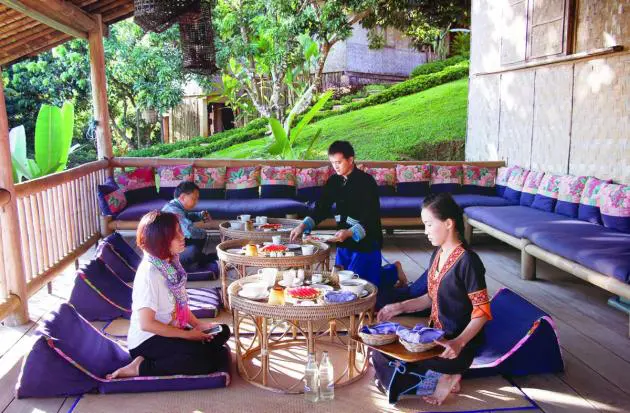
Before sunset we descended toward the Hmong-Lahu village of Kiew Karn in Chiang Khong district, where overnight accommodations waited at the eco-friendly Lanjia Lodge. Blending typical local architecture into the natural environment, the lodge has four thatched-bamboo cottages, each with four bedrooms, en-suite bathrooms and electric fans.
Asian Oasis and the Population and Community Development Association run the lodge as part of a programme aimed at improving the hilltribes’ quality of life. Twenty members of the staff are locals who came with no prior experience in the field. The owners share revenues with the community and maintain a Village Development Bank, to which Bt30 is donated for every guest. Such efforts earned the lodge this year’s Wild Asia Responsible Tourism Award for Best Community Engagement and Development.
Each cottage has a male and female host assigned as butlers. Dressed in classic Hmong garb, Krisda “Por” Nipasakul, 30, and Narisara “Nuch” Rudeelertpokin, 22, took care of us during our stay. After dinner on our veranda we had musicians and dancers from the villager entertaining us.
Por has a degree in public administration from Rajabhat University of Chiang Rai and Nuch is a nutrition graduate of Chiang Rai Vocational School.
“We both don’t want to live in the hectic cities,” said Por, who’d worked at the lodge for five years. “We love living and working peacefully right here in the place of our birth. We’re proud of our traditions and culture.”
The mist we missed at Pha Tang caught up with us the next morning, engulfing our cottage. As it dissipated we could see the surrounding hills and the brown swirling waters of the Mekong. Breakfast was also served on the veranda in this spectacular setting under gentle sunshine.
Afterward a young lady named Morakot accompanied us down the hill to the village to meet Laogee, one of nine Hmong shamans living there.
The 1,000 residents of Kiew Karn are a mix of Christians, Buddhists and animists. Laogee, 53, has “qualified” as a shaman since he was 20. The role isn’t inherited, as with the Lahu (who have one shaman in the village), but stems from having suffered a coma, whether through illness or accident. Recovery is recognised as a sign of a hardy, beneficent spirit, one that’s able to help others overcome serious illness.
With Morakot translating, Laogee told us about the complicated rituals needed to serve as an intermediary between this world and that of the spirits. Treatments include herbal remedies and perhaps the sacrifice of spirits or animals. In dealing with a serious ailment, the shaman enters a trance and travels through the spirit world to discern the cause and find a remedy.
Trekking back up the hill, we noted the differences between the Lahu houses on stilts to keep out wild animals and evil spirits, and with windows cooling the interior, and the windowless Hmong houses resting on the ground, safe because the spirit they worship resides within.
Further up we met Granny Pang, 74, who taught us how to make Hmong batik. She prepared all necessary materials, including melted beeswax and tools like fountain pens to draw the patterns, and showed us examples of her intricate work. The pieces we made became wonderful souvenirs of our visit.
There’s much more to do at the lodge. You can plant trees, learn the local way of farming, enjoy half- or full-day mountain treks and discover the healing properties of certain plants. You can even go birdwatching on Chiang Saen Lake.
Find out what’s on offer at www.Asian-Oasis.com/product/lanjia-lodge-hilltribe-discovery.
The writer’s trip was made possible by the Tourism Authority of Thailand’s Chiang Rai office and by Air Asia.
