
A floral farewell to His Holiness
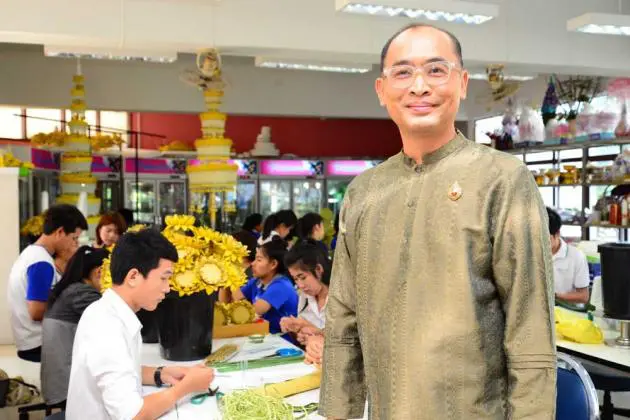


Creating the multitude of flowers for tomorrow's cremation of the Supreme Patriarch was a matter of devotion for the youngsters in charge
ONE HUNDRED young offenders at a correctional institute in Patum Thani are among those who have contributed to arrangements for tomorrow’s cremation of His Holiness Somdet Phra Nyanasamvara, the late Supreme Patriarch.
Associate Professor Vinai Tarvake, head of home economics technology at Rajamangala University of Technology Thanyaburi, was in charge of 200 students and the incarcerated youths – all male – who crafted the floral decor for the ceremony at Wat Debsirin. They have conscientiously kept the arrangements simple, in keeping with the late monk’s lifelong philosophy.
The guardian-adviser to the King while His Majesty spent time as a monk at Wat Bovoranives in the late 1950s, His Holiness was 100 years old when he died on October 24, 2013, the country’s longest-living supreme patriarch.
In the floral decorations for his cremation, globe amaranth predominates, its petals clipped and glued and formed into replicas of other species like the lotus and orchid, as well as elephants and roosters and tiered umbrellas. There will be six floral elephants standing as a guard of honour in front of the mortuary urn. His Holiness was born Charoen Gajavatra – the surname means “elephant”.
The Supreme Patriarch kept bantams, and two have been fashioned in flowers for the occasion, along with eight phoom (cone-shape tributary offerings) that are meant to evoke the notions of respect and faith.
The crematorium will be adorned with tens of thousands of amaranth petals mimicking 100 lotus blossoms, 100 cathereeya (cattleya) orchids, 80 bird-of-paradise blooms, three clematis at the doorways, 60 offering cups, 44 garlands, six tiered umbrella and 30 belts for the umbrellas. Vinai calls the concept “Gajavatra Rajamangala”.
“It’s about elegance and simplicity, in accordance with His Holiness’ conduct,” he says. “The white refers to His Holiness and the yellow is associated with Buddhist monks.”
He has followed tradition established at the cremation of the Supreme Patriarch during the reign of King Rama V and the last one 26 years ago. In those cases, though, two types of floral decorations were used. “The first involved fresh or artificial flowers and the second – dok mai beab thai [Thai-style flower] – is an ‘invented’ flower like these we’ve made to create different shapes out of amaranth petals.”
The initial challenge was to find a flower that would stay fresh and retain its natural beautiful as long as possible under hot, dry conditions. Globe amaranth, always popular among gardeners, seemed an obvious choice, but its alluring “pom-pom” blossoms are made of myriad tiny petals, so a great deal of time went into recreating other flowers and objects from them.
One of the most difficult tasks was replicating a royal urn with a three-tiered umbrella of state that is to be presented in tribute to His Holiness. “Getting the proportions right is very important – it’s three metres tall and has to be exactly balanced,” says Vinai. “The tiers are strung with crown flowers and Siam boxwood petals into a four-stem, four-bloom pattern. The yellow floral tassels are decorated with a sparkling material to represent the light of intelligent. The umbrella belt features amaranth dyed yellow and formed into three patterns – krajang and bai tes [traditional leaf-like motifs] and pikul [resembling the flowers of Mimusops elegans or Spanish cherry].”
The puangkeaw-style garlands that will decorate the doorways have been made of amaranth lotuses, signifying the Patriarch’s esteemed conduct and mercy. They are structurally stunning, precise down to the lowest level of tassels. The phoom offerings are just as exquisite in their meticulous design, with amaranth petals forming the lotus shape. The base is created with banana leaves folded into a large lotus petal and decorated with amaranth orchids.
The garlands adorning banisters and the lanterns are strung with boxwood-flower tassels and covered with folded banana leaves.
Vinai has told his young charges that they stand to make great merit through this work. “There are so many fine details that the creators have to be very patient. If they appreciate and memorialise His Holiness, it will lead to mindfulness and greater faith.
“It was the boys in the correctional institute who made all 102 of the amaranth cathareeya orchids. By working with their hands, their hearts are refined and softened. They actually asked to let them do more!”
REVERED ABOVE ALL
- His Holiness the Supreme Patriarch excelled in foreign languages, mastering English, French, German, Chinese and Sanskrit.
- In 1989, His Majesty the King invested him as the country’s 19th supreme patriarch, heading the Buddhist Order and the Sangha Council, and thus responsible for all ecclesiastical affairs.
- The King commanded that a royal urn, with a five-tiered white umbrella of state, be presented as decoration at the cremation.
