
A sense of time and culture


Play
An Edoera farmhouse adds to the enjoyment of washi papermaking
It's been a year since Japanese traditional techniques for making washi paper were designated as an intangible cultural heritage by Unesco.
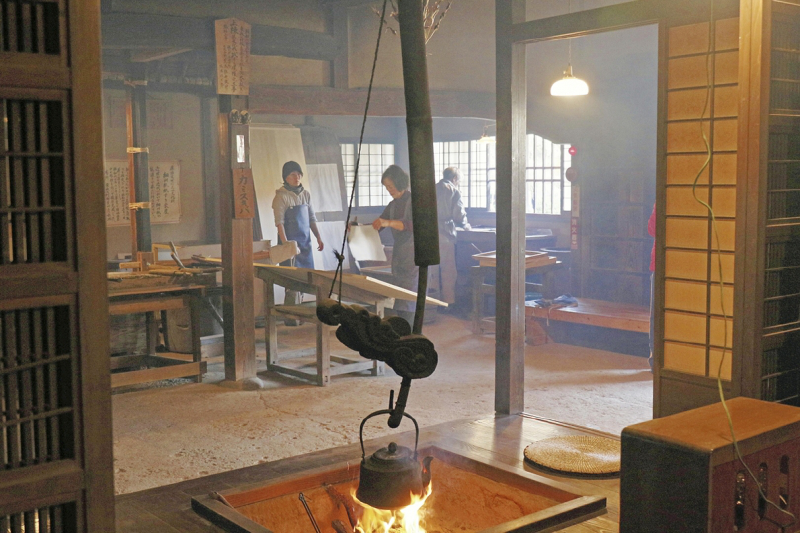
To celebrate the designation, Higashi-Chichibu Washi no Sato, a paper-making workshop in Saitama Prefecture, launched handmade washi-making demonstrations for visitors last month at a farmhouse that’s been reconstructed in the style of the late Edo period (1603-1867). The village of Higashi-Chichibu produces traditional washi paper called Hosokawashi.
Handmade washi is made by scooping up raw materials such as plant fibres soaked in water with a tool called a suketa, and shaking it so as to evenly entwine the fibres.
Only three types of washi are registered as Unesco's intangible cultural heritage — Hosokawashi from Higashi-Chichibu and Ogawa, Saitama Prefecture; Sekishu-banshi from Hamada, Shimane Prefecture; and Honminoshi from Mino, Gifu Prefecture.
All the registered products are highly regarded because they use only kozo mulberry trees as the raw material. Their makers also conduct conservation activities, including technical training, and give hands-on lessons at schools.
Higashi-Chichibu Washi no Sato was launched as a joint public-private venture in 1984 with the aim of passing on washi craftsmanship and revitalising the craft. About 80,000 people have visited the site in the year since washi was registered as an intangible cultural heritage, 50 per cent more than in the year before registration.
In the past, the reconstructed farmhouse was just for visitors to look at, and paper-making demonstrations were conducted at a different facility. But the company wanted a wider range of people to experience the craftsmanship of traditional paper-making and so decided to offer give paper-making demonstrations in the farmhouse in cooperation with a Hosokawashi craftsmen’s association.
The history of Hosokawashi dates back to the eighth century. In the mid-Edo period, techniques from an area at the base of Mt Koya, Wakayama Prefecture, for producing high-quality washi paper were introduced to what is now Higashi-Chichibu and Ogawa. This led to a significant increase in the output of washi in this area, which was close to the huge consumer market of Edo, and the region flourished as a production area. Stout and tear-resistant, Hosokawashi washi was well-regarded and used in merchants’ account books in those days.
Even now, Hosokawashi is used in books bound in Japanese style, tatoshi kimono wrapping paper and letter paper. However, Japanese handmade paper has been on the decline due to
lifestyle changes as well as the arrival of paper machinery manufacturers. There used to be 800 handmade paper farms in Higashi-Chichibu, but only a few remain today.
“It was such an aesthetic experience to see a demonstration of Japanese hand-made paper-making at the reconstructed farmhouse,” says Masayo Kato, who visited from Ranzan, Saitama Prefecture, with her child. “With the way the light falls and the smell of the irori fireplace, it’s a different atmosphere from a modern facility.
“If we could also experience hands-on paper-making in the reconstructed farmhouse, people might be more interested in the craft,” Kato adds.
