
Looking after mother nature


Play
A group of cyclists head to Khao Yai to dig a salt lick for the wildlife and prevent the weeds taking over their fodder
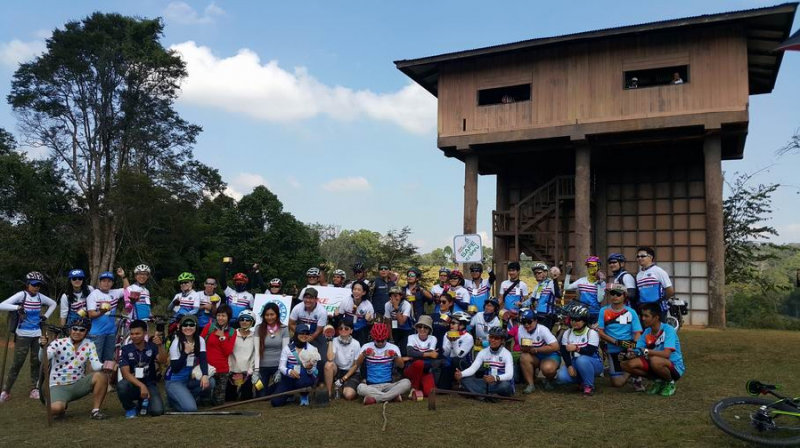
CYCLISTS FROM several groups include Strida, Brompton, Prachinburi Cycling Club and Lor Lek Rak Loke, recently headed to Khao Yai National Park in Nakhon Nayok to take part in Bike Finder’s fifth eco-friendly activity – creating a new salt lick near Nong Phak Chi Wildlife Watching Tower. The 50-odd participants were also charged with spreading the word about the “4+1 Don'ts” campaign that keeps the local wildlife safe.
Before putting their backs into the work, the cyclists listened to veterinarian Pattarapol Manee-on from the National Park, Wildlife and Plant Conservation Department, who explained not just how to make the salt lick but also what makes it so useful.
Pattarapol, who is better known as Dr Lotter, then led the group to the spot for the new salt lick, which has been named “Pong Palad Fon” in honour of the Permanent Secretary of the Ministry of Agriculture and Cooperatives Teerapat “Fon” Prayunsit.
Shoulders were first put into digging an area half a metre deep, five metres long and 50 centimetre wide before pounding pieces of dicalcium phosphate and mixing them with the removed soil.
The cyclists were also charged with pulling up saab suea (Siam weed), an alien species that negatively affects the animals.
“ Siam weed grows fast, especially from November to January and it is able to compete with other weeds. When it grows, the area becomes bush and helps the trees. But all too quickly the grassland becomes jungle. And that means that the grassland, which is a food resource for animals, decreases. The decrease of the grassland indicates that the number of animals will also decrease. Siam weed is useful when it’s in the right place. Thai people think that it’s a local plant and believe that if we hide behind it, a tiger can’t smell us because of its pungent odour. But we have to eradicate Siam weed and the best way of doing that is through burning. Obviously we can’t do that because of the pollution it would cause. So the next best thing is pulling it out by its roots,” Dr Lotter explains.
The “4 Mor+1” (4+1 Don’ts) campaign aims to keep animals safe following the discovery of a number of sick, injured and dead wild animals, victims of man’s negligence. The message is clear: Don’t Litter, Don’t Feed, Don’t Drive Fast, Don’t Make Noise and Don’t Leave Your Pets Behind.
“Feeding animals is a cause of abnormal behaviour. Littering has a negative effect on environmental aesthetics and reduces wildlife. Driving fast is harmful to animals and humans, because animals also utilise the road. The limit is 60 kilometres per hour. And animals are incredibly sensitive to noise as the frequency of sound waves that they can hear is from 17 Hertz to 100 kilo Hertz. While animals hear everything humans do, they can acclimatise to those sounds. But, sudden changes in volume from vehicles, musical instruments and high frequencies alarms them and causes stress,” the vet continues.
“The campaign is effective as we can see from the decrease in the number of injured and dead animals and the increase of volunteers. We also notice that tourists are much conscious of how their behaviour hurts animals. Today tourists tell us about animals that are injured or killed in a collision. Recently a driver brought a baby bear to me after hitting it. That’s a good sign,” says Dr Lotter. “Our campaign is a model for other nature preservation areas and we want it become government policy.”
But it is the fifth part of the campaign – “Don’t Leave Your Pets Behind” – that is causing the biggest problem at Khao Yai. People believe that releasing animals in the forest is making merit, but it is killing them.
“We aren’t happy with the increased number of animals and even less happy with the damage it causes, especially as it plays havoc with genetics. Inbreeding causes abnormal bodies and in addition to the physical distortions, the animals suffer from weakened immune systems, and infertility,” the vet explains.
“Khao Yai was faced with tragedy after a wild boar was released in the national park. It died but not before it had infected more than 100 hundred boars with Classic Swine Fever. And it also caused the loss of tigers, a species that eats wild boar.
“So, our activity of making a salt lick and removing Siam weed are also part of the campaign, as it allows volunteers to learn, feel and touch through a hands-on experience before they spread the word,” he adds.
