
China tallies its ancient books


Play
Rare Buddhist sutras go on display in Beijing as preservation, cataloguing proceeds in earnest
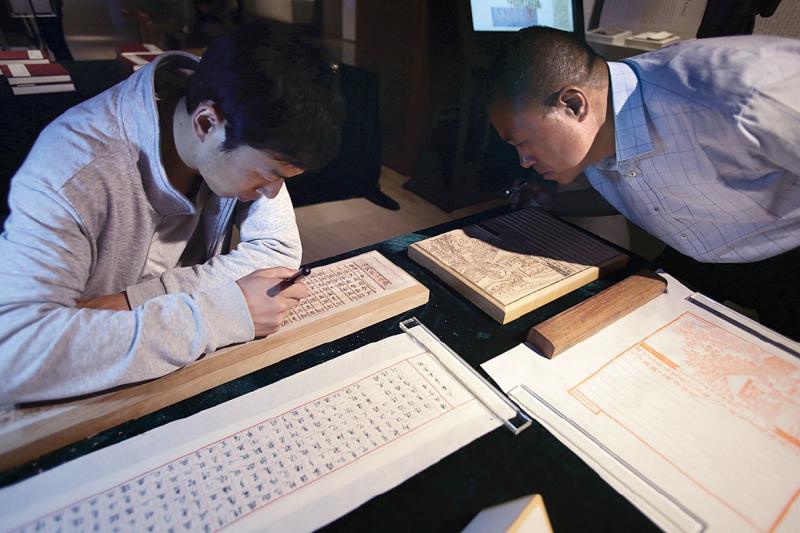
Three sacred Buddhist texts are now on display in Beijing as rare early examples of block printing in China, dating to the seventh century.
Called “national treasures” by scholars, the texts are the highlights of an exhibition of some 100 ancient and classic books from across the country that’s being held at the National Library.
One of the exhibits is a printed version of Mile Shangsheng Jing, one of the three sutras of Maitreya, the future Buddha. Dating to AD 927 during the Five Dynasties and Ten Kingdoms (907-960), it is the second-earliest surviving printed document found in China.
The Diamond Sutra, the world’s earliest printed book from China, is, however, not on display in the show. The Tang Dynasty (618-907) copy of the Diamond Sutra, found in one of the Dunhuang caves in 1907 by Hungarian-British explorer Aurel Stein, is now part of the British Library.
The Beijing show has a Diamond Sutra copy that is not dated but has been traced to the early 10th century by researchers at the national library. Among other rare books on view is a mid-10th-century copy of Mile Xiasheng Jing, one of the three Maitreya sutras.
The books were purchased from private collectors and added to the library’s collection last year after they emerged on the art market. They are the latest examples of China’s efforts over nearly a decade to catalogue and restore key ancient books.
The Ministry of Culture launched a project in 2007 to preserve “ancient books” – defined as written materials that originated before the end of the Qing Dynasty (1644-1911).
An essential part of the project has been the national-level cataloguing of precious written records in various media, including oracle bones and bamboo sheets, and in Mandarin and other languages, including foreign. The catalogue has expanded a few times and the latest update in May took the list to 12,274 items in total.
The current exhibition at the national library also has a selection of the new entries. These exhibits not only showcase ancient Chinese wisdom but also show the technical progress in restoring classic writings.
Meanwhile the number of restoration professionals has grown from less than 100 in 2007 to more than 1,000 today, says Zhang Zhiqing, the library’s deputy director.
Zhang is also deputy director of the National Centre for the Preservation and Protection of Ancient Books.
He says these professionals have masters’ degrees in preserving ancient books, from a programme jointly offered by the centre, three universities and the Chinese Academy of Social Sciences, a think-tank.
He adds that 22 national-level restoration studios have been set up where traditional skills used in preserving books are passed on from older masters to younger apprentices.
“To be a professional, one needs patience and persistence,” says Zhang. “It takes about five years for a learner to be able to work independently. He or she will then need at least two decades to become a real master. It’s a challenging job.” He estimates that about one-third of the ancient books being catalogued are damaged, but that doesn’t mean they all need repairs right away.
Li Jining, a researcher at the library, says the main principle is “first to save the life”, applying as little restoration as possible unless the book is in very poor condition. “For example, the original paper carries a lot of important information and should be kept as is if it’s not badly torn.”
He says the materials used for mending should be replaceable in the future as tools and methods improve, and any repairs need to be recorded for reference by later researchers.
The market price of rare ancient books has risen in the past two years. A copy of Mile Shangsheng Jing printed during the Five Dynasties period was sold for five million yuan (Bt26.4 million) at a Beijing auction on June 5.
Zhang says the exhibition should encourage private collectors to make donations or conduct transactions on lower prices so that more people benefit.
He declines to reveal how much the three Buddhist texts on show cost the national library.
