
Homage to a fossil


Play
"Tales of 500,000 Years", a short film by Thai artist and filmmaker Chaisiri Jiwarangsan, premieres in Venice
SOUTHEAST Asian cinema earned itself a major boost in Europe earlier this month when Filipino director Lav Diaz’s 228-minute, black-and-white drama “The Woman Who Left” was awarded the Venice Film Festival’s top prize, the Golden Lion, the first film from this part of the world to win this important award.
Thailand, while not winning any prizes, was also well represented at the festival. Showing in the sidebar section, Venice Days, “The Road to Mandalay”, a joint Taiwan, Myanmar, France, Germany and Thailand production, received good feedback from both audiences and critics. Directed by Midi Z, the Burmese film director who resides in Taiwan, this tragic love story is centred on two illegal immigrants from Myanmar who come to Thailand in search of a better life.
In the Orizzonti short film competition, meanwhile, Thai entry “500,000 Years” also impressed audiences. Directed by Chai Siris, a visual artist who works closely with Cannes Palme d’Or winner Apichatpong Weerasethakul, it focuses on a famed Homo erectus fossil in Thailand’s North and a dying culture.
It was the second time a work by Chai Siris had been selected for Venice. His short “Four Seasons” was screened in same Orizzonti short film competition back in 2010.
“I didn’t come here in 2010. Only my film was shown. I applied for the Thai Khem Khaeng funding but didn’t get any money, so I was unable to travel to Venice,” he says.
“‘500,000 Years’ was inspired by curiosity. Even as a child I loved reading scientific news and clearly remember seeing the news about the discovery of a Homo erectus fossil in Thailand, the third country where such a fossil has been found. When I grew up, I moved to Chiang Mai and every time I drove through Lampang, I would see a signpost for the ancient man. I checked and discovered that this was indeed the place where the Homo erectus fossil was unearthed.”
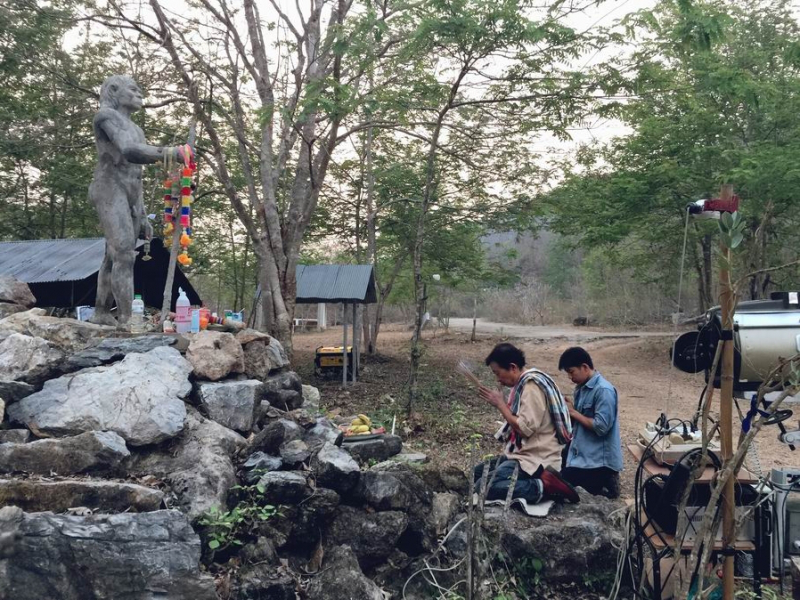
The film, which is set at the statue of Homo erectus, sees a mobile cinema truck coming to project a horror film as an offering to the statue. “I live on the outskirts of Chiang Mai and there’s an outdoor projectionist who has a cinema truck. Nowadays people don’t go to outdoor screenings but hire this kind of service to project films to the gods. I wanted to show both the cinema truck culture, which is disappearing, and the Homo erectus fossil, which is neglected by almost everybody except the local villagers who believe that the fossil is their ancestor, so they go there to pay homage and have built a small shrine.”
Chai Siris spent time in Lampang’s Ko Kha District in Lampang, where the Homo erectus statue was erected and explains that while it was originally intended for educational purposes, the statue is now worshipped by local people who offer food and clothes to the statue.
He hired a local projectionist to screen a strange Thai horror film from the ’90s, and filmed the atmosphere. “I intended to make ‘500,000 Years’ as an installation for an art festival, but most art festivals don’t have good enough facilities to screen my work, so I decided to cancel the presentation,” he explains.
Hebrought the work back to his editing room and sent the new version to several people including the delegate of the Venice Film Festival.
“The delegate was very interested in the film. He said that the film really inspired him and it is about cinema, which is his work. I never expected it to be picked for the competition,” he says with a grin.
“It’s really about the death of science, the death of cinema, the death of the cinema truck culture, and the changes that will inevitably occur. We may feel sad that cinema will disappear, but we have to accept the birth of something new. “It is said that if something that should die tries not to die, evil will occur.”
The film chosen for screening in front of the statue was Toranong Srichua’s horror film “Asurakaya” (“Demon”).
The 1991 production is one of the filmmaker’s lesser-known works. The director made his name with the 1985 war drama “Kampuchea: the Untold Story” and the erotic film “Twilight in Tokyo” in 1989.
“I wanted the mysterious atmosphere of the night in my film, and screening a horror film to ghosts creates a mysterious feeling,” the director says.
“I love Toranong’s works. I first saw ‘Twilight in Tokyo’ when I was seven and loved it. I always think of him as a master Thai filmmaker.
“When I went to look at the local projectionist’s archive, I saw he had the film and it felt like I had hit the jackpot.
“After the screening I talked with some audience members and they told me they liked my work as it was the only non-narrative film in the whole short film competition.”
Chai Siris, though, made it to Venice by the skin of his teeth.
“I’m a young artist with no money and so I applied to the Culture Ministry for travel support and two nights before the premiere, I learned the support had been approved. I was on the first plane out!”
“500,000 Years” is scheduled to other film festivals around the world but he has no plans to show it in Thailand.
“However, I’m open to any space that will screen this work. It can be a cinema or art gallery,” he says.
