
Redemption regained in Thai noir


Play
A promise of rebirth overcomes the scent of death in John Gartland's superb novella
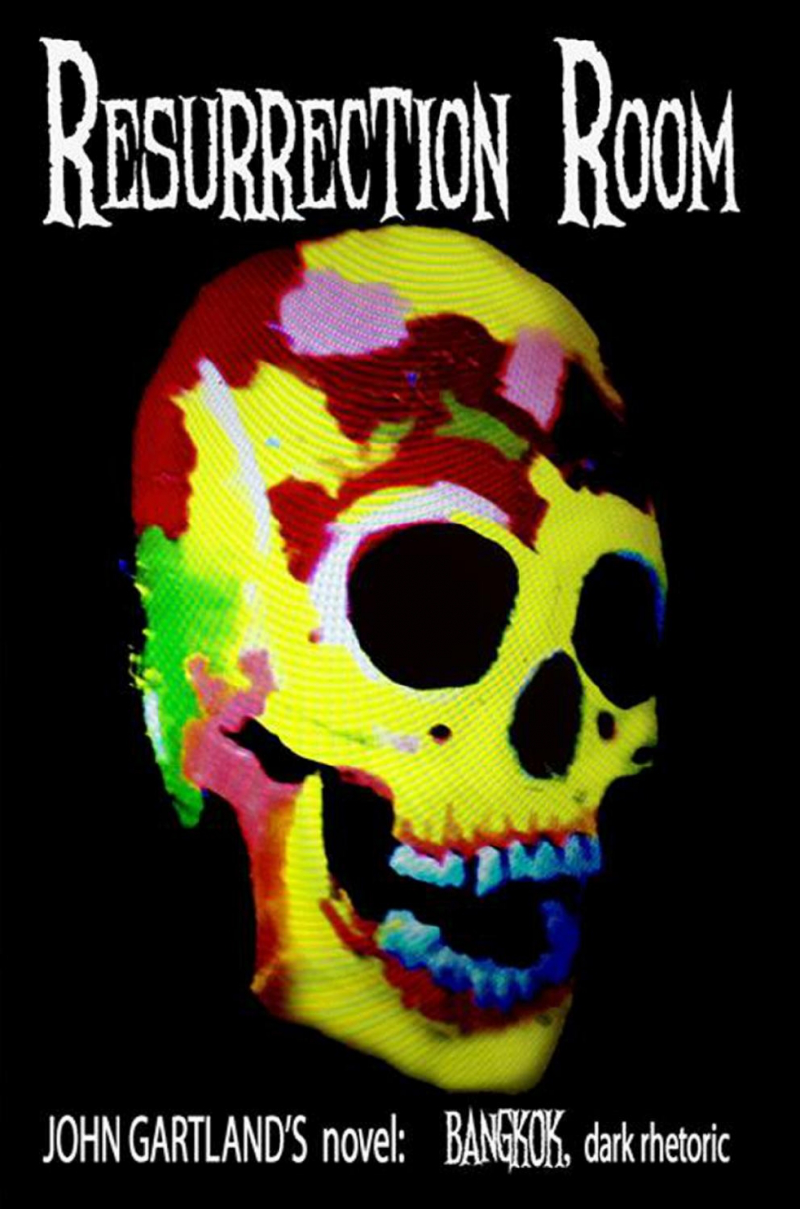
EXPATRIATE Englishman John Gartland, the “poet noir” whose “Heart of Noir” was praised on this page last December, takes another extraordinary linguistic flight in “Resurrection Room”, a novella of 128 pages available via Amazon.
It is deeply philosophical, addressing war, politics, religion and the struggle for freedom over oppression, and touches on subjects as diverse as the shortcomings of Thai education, the ineptitude of the bureaucracy and “the march of techno-tyranny”.
There is the lure of the demimondaine and chemical escapism. Coleridge and Burroughs seem to be among the muses at work. The tone is as dark as the storm clouds bursting over the capital and swelling dams far to the north. And yet there’s an iconoclast’s glee in the steady popping of overinflated ideological balloons.
Bangkok becomes Lizardville, gecko droppings amassing, and Redemption International University, with its Tower of Knowledge (go ahead and make the assumption), has adopted a business-English syllabus.
Unhappy with the English Department’s mercenary rebirth as BizEng are lecturers Watson Barclay, “a foreign literary nonentity just trying to put Mother England far behind him and keep a low profile”, and his Australian fellow academic Rick Holmes. They are the tortured but mischievous Watson and Holmes of this tale, and Conan Doyle is frequently cited.
A narrator appears, ominous as the weather, scudding the plot along as the principles grumble in pubs with names like Glorious Mysteries and Generalissimo’s. This is L Semper Lazarus, a name pregnant with possibilities. John Wilkes Booth’s vengeful cry after assassinating Abraham Lincoln immediately comes to mind – “Sic semper tyrannis!”, a panting abbreviation of the quotation meaning “Thus always I bring death to tyrants.”
Yet “semper Lazarus” would mean “always Lazarus”, evoking the farmer who Jesus resurrected from death. And indeed it turns out that our narrator Lazarus has been around ever since, unable to die again, doomed forever to eviscerate tyrants wherever he finds them.
A third possible reference is to Emma Lazarus, the 19th-century American author of the prose poem “New Colossus”, inscribed on the Statue of Liberty in New York. Gartland has been outspoken in opposing Western immigration policy, and here in his own prose poem might be mocking Emma’s sentimental “Give me your tired, your poor, your huddled masses.”
The freeing of Lazarus of Bethany from death’s grip is tenderly described, but “the Nazarene” warns him, “This is a hard gift.” The risen farmer ascends from his tomb Heaven-blessed, only to find himself in the hell of a World War I battlefield. He is now “Captain Lattimer Semper, the only man alive and unwounded in this choking, yellow masterwork of death”.
And later he will recall for us, in one of the book’s most moving passages, being at the Battle of Hastings too, as a member of King Harold’s bodyguard. “I was present at the gory birth of a new England, a land that would give us, after slow centuries, and the infusion of French language and culture, with the conquest, the incalculable gift of its language ... It would be the language men spoke when they made the Magna Carta, the Industrial Revolution, when they wrote the Constitution, made America. It was the language they spoke when they stepped on the moon.”
William the Conqueror had the wounded Harold hacked to pieces. “The lie of Harold perishing from an arrow wound was woven into history by the Bayeux tapestry, to hide this act of savagery from the gaze of the future. Propaganda was born.”
Lazarus as risen farmer is a ripe metaphor. Gartland, never shying from overt commentary on politics in Thailand, “where republicanism is a thought crime”, writes about “those on the ricelands ... clad in the smiling rags of Buddhist resignation”:
“Only the rich fertility of the Thai climate and soil kept many of them from starving. Still, they maintained a proto-feudal respect for their rulers, who were demigods in their eyes. Social wealth was an inverted pyramid, with colossal wealth among the elite, at the top of society, and low incomes for the masses at the base. That is as much as can safely be said.”
In the Battle of BizEng, the protagonists gain ground, only to be presented with the spectre of Brother Jerome, the university’s missionary president, preparing to put on display a Christian relic, the Holy Hand of Saint Hubert of Tours, “hoping its arrival will infuse more spirituality into university life at Redemption”.
By the time the embalmed gnarled limb arrives, though, Lazarus has assured us that Hubert was no saint. “The scoundrel’s hand is certainly legendary, having been marinated up the skirts of more whores and courtesans than the pope has hats.” It might be funny had not the pope who beatified Hubert made a devil’s pact with Hitler.
The book reaches a dreadful apocalyptic conclusion as Bangkok is simultaneously subjected to biblical floods and terrorist bombings. Despite its comic turns, “Resurrection Room” is a modern horror story, frightening primarily because not a word of it feels far-fetched.
No other expat author in Thailand writes with such lyrical artistry, from the passing quip (“An SMS rustled in my pocket”) to the provocatively conceptual (a restaurant where diners consume other people’s sins and guilt). The effect is frequently hallucinogenic, as when a passed-out bargirl, slipping from the lap of a patron, dissolves into a fatally wounded US Marine sliding from a comrade’s grip to the deck of a landing craft.
And all this is delivered to “the music of the rain; a cliche of an author waiting for an opus”.
