
Politics, parties and protests


There was plenty going on in recent days at London Fashion Week and it certainly wasn't just the amazing clothes
POLITICAL engagement, a fondness for parties past and the love of a good frill were just some of the highlights of this season’s London Fashion Week.
From Brexit to Donald Trump, the febrile political mood extended to the catwalks of London, just as it did in New York.
Gareth Pugh painted a vision of a dystopia in a dark, concrete basement, with black-clad, dead-eyed models walking to a disturbing soundtrack of samples including US President Trump promising to “build that wall”.
Bora Aksu took as his inspiration the Suffragette who fought for women’s right to vote in the early 20th century, and embroidered words such as “Freedom”, “Hope” and “Love” onto tights and collars.
Versace’s youthful Versus line had a “trackdress” with the back cut out and men’s tracksuit trousers made of wool, as well as chunky trainers with an exaggerated tread, padded jackets with zips down the back and t-shirt dresses.
At luxury knitwear brand Pringle of Scotland, there were rich woollen tops and updated argyle-print jumpers worn over hooded, sports-style tops with their strings hanging down.
Two of London’s leading lights sought to push the boundaries of femininity with eclectic collections that drew on metallics and utility wear.
JW Anderson had belts for straps on dresses, bodices lined with zips and also pockets, whether incorporated into a silvery gown or silk workman’s pockets attached to the front.
Christopher Kane hailed what he described as a “tougher femininity” with iridescent knits, spaceship prints, tunic dresses and flowers stuck onto dresses with velcro.

With references to full moon parties in Thailand, Brit pop and rave culture, high-street giant Topshop took London back to the 1990s for its top end Unique collection.
There were cropped army trousers, ribbed dresses in soft knits with rainbow edges, and bias cut dresses that slipped off the models’ shoulders.
And then there were the frills.
From a girly pink number with puffed sleeves to an extraordinary turquoise dress made of tiers of tulle, Molly Goddard was the queen of the latest trend for frills.
More understated were the white lace ruffs and cuffs at Temperley London, inspired by Anthony van Dyk paintings, in a collection also marked by fan-like glittering pleated skirts.
Older models protested outside the shows against age discrimination in the fashion industry, while a number of modelling legends took to the catwalk for the show by Irish designer Simone Rocha. Among those walking for Rocha, who is known for her intricate floral detailing, were 70-somethings Jan de Villeneuve, who posed for David Bailey, and Benedetta Barzini, the Italian actress and model.
British design duo Teatum Jones also made London history by using two disabled models in their show, after last season championing gay rights.
Meanwhile, the marriage of contrasts in Henry Moore sculptures – namely tool mark scratches on a seemingly smooth surface – inspired the new Burberry collection
The score marks took on new life in the laces and delicate finishes on shirts and sweatshirts, which were showcased alongside some of Moore’s large bronzes at London Fashion Week.
There were sculptural cuffs and sleeves, while traditional English knits were deconstructed to play with the shape, as designer Christopher Bailey explored the silhouettes and processes of the 20th-century Yorkshire artist.
Mostly black and white, the collection had flashes of colour in indigo blue coats or trousers, or a sweatshirt print derived from the sculptor’s sketches.
In an extraordinary finale, the models emerged in dozens of cropped couture capes made of everything from white feathers to black jewels, glass crystals, clear plastic, tassels, pearls and beads.
“They were a study in the shoulder – the trenchcoat is all about the shoulder, with the gun flaps, and the shoulder was also a big thing for Moore,” Bailey told reporters backstage.
He described how he spent many hours as a child in Moore’s sculpture park, and relished the chance to collaborate with the foundation that protects his works.
“I put my heart into this collection,” said Bailey, Burberry’s creative director and chief executive.
The clothes went on sale immediately, after Burberry adopted the “see now buy now” model last year, but the capes will be displayed as part of a new Moore exhibition in central London.
At another iconic British label, Mulberry, creative director Johnny Coca took inspiration from the equestrian-tinged styles of English country dress. Skirts were cut as if to ride sidesaddle, and dresses were made from the kind of quilts used to keep horses warm in their stables at night.
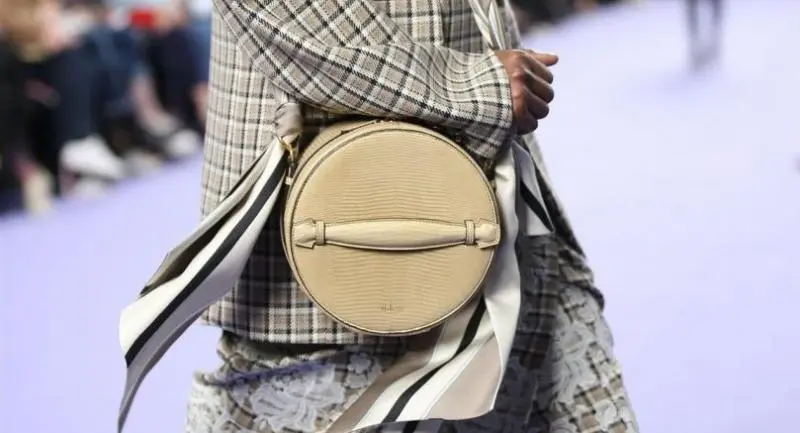
There were oversized tweed jackets, pinstripe blouses and hat box-style handbags, and heavy floral embroidery reminiscent of the wallpaper and sofas of country hotels.
“It’s about making something traditional feel new. Taking these archetypal British styles, and making them feel right for today,” said Coca.
