
Building Beyond the Museum: Why Culture Is Coming Closer to Home
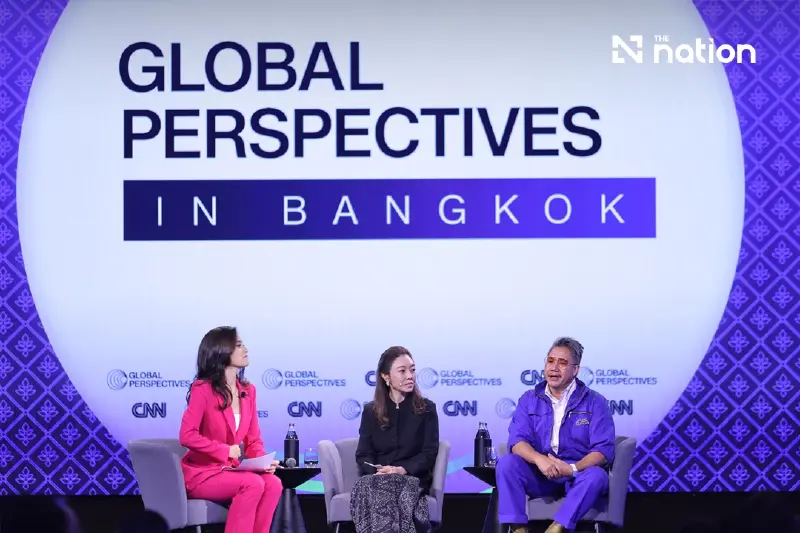


Marisa Chearavanont and Kulapat Yantrasast tell CNN Global Perspectives that museums matter most when they heal, gather and welcome everyone
Marisa Chearavanont and Kulapat Yantrasast tell CNN Global Perspectives that museums matter most when they heal, gather and welcome everyone.
The museum is moving closer. It is no longer a hushed monument on a hill, visited once and admired from a distance. It is becoming a neighbour: a free front door on a Bangkok street, a studio where visitors watch an artist at work, a forest in which getting lost is the point.
At CNN Global Perspectives in Bangkok on Wednesday (October 14), two of Thailand's most influential cultural builders argued that this shift matters more than ever in a world increasingly shaped by machines and screens.
The session, titled "Building Beyond the Museum", was moderated by CNN's Hanako Montgomery. It brought together Marisa Chearavanont, founder of Khao Yai Art Forest and Bangkok Kunsthalle, and Kulapat Yantrasast, founder, managing principal and creative director of WHY Architecture.
Montgomery, who said she had visited Dib Bangkok, the museum Kulapat converted from a 1980s steel warehouse, asked a deceptively simple question: what is a museum for, beyond housing art?
Culture as "brain food"
For Kulapat, the answer begins with a warning about technology.
"We're concerned that the machine will be as intelligent as us," he said. "But machine learning only learns what we have learned before. And unless we create new lessons, new memories, new histories, there's no way we can advance beyond."
Culture, he argued, is how people make those memories.
"Culture is not a luxury," he said. "Culture is brain food." Artificial intelligence systems learn from one another through a vast network, he said, while humans are "still finding each other".

Without empathy across cultures, he warned, people cannot connect. Museums, in his view, are places for gathering "collectively to think about our future", not merely for looking at objects made by people in the past.
He placed the museum within a wider "infrastructure of culture" that, he said, is flourishing in Bangkok. That infrastructure includes Marisa's projects, which he credited with having "brought the soul back to culture".
Revisiting the "three-legged stool" image used earlier in the day by CNN's Richard Quest to describe the global economy, he offered an addition.
"My question is, what is the seat?" he asked. "The seat is actually the home, which is culture, where we sit."
Museums, he added, should not be seen separately from street art, music, design and fashion.

The case for getting lost
Marisa described her institutions as places of healing, dialogue and experimentation, rooted in gratitude and a wish to give back. At Khao Yai Art Forest, she said, visitors are deliberately left without maps or generous signage.
Some guests complain, she acknowledged, but the omission is intentional.
"In a hyperconnected digital society, we have all the senses, and we used to use them for survival," she said.
The forest offers "a pause" in which visitors can "get lost", reawakening their senses and listening to birdsong and cicadas.
Montgomery, who admitted she never leaves home without her phone, observed that reconnecting with society may first require stepping away from the digital world.

Art for the neighbours
The Bangkok Kunsthalle, Marisa said, is free to enter. It occupies a former textbook-printing house that was abandoned and badly damaged by fire in 2002.
Its burned walls and metal frames have been kept as they were, as a reminder that life runs through "birth, growth, flourishing and decline", and of the need to be humble.
That humility, she suggested, is what makes the space welcoming.
Elderly Chinese neighbours came to see a film shot about ten metres from the building and brought friends. A show of 46 "vernacular objects" was assembled from the makeshift placeholders local residents use to block parking spaces, made from broken chairs and flat tyres.
"Nobody was intimidated to come in," she said, "because we are very humble."
Another exhibition invited visitors to take part. Inspired by Yoko Ono's 1966 work Mend Piece, the Kunsthalle laid out 19 long white tables of broken ceramics, string, glue and tape for neighbours and visitors to repair and transform.
The show was so popular it had to be extended. Marisa described a meditative scene, with the only sound the clinking of porcelain, and said she believed it had helped produce "several artists for the future".

Telling your own story
Montgomery noted that many of the great museums of New York and London hold material taken from places such as India and asked what happens when countries tell their own stories.
Kulapat drew a distinction between "storytelling" and "story selling" and said museums in formerly colonised nations are increasingly doing the former. He said he is working with the Indian government on a national museum that he described as set to be the largest in the world.
He framed it as an exercise in "constructive visioning" and perhaps even national healing, bringing India's diversity together in one place. He called the approach "post-colonisation museum thinking".
He also recalled being dragged to the Louvre aged seven and hating "every minute" of it. Yet the visit left a lasting lesson: other people around the world also made art, and behind every sculpture are people "trying to find beauty, trying to find meaning that lasts beyond our lives".

From sushi to pad thai
Asked what they hope for the next generation of Thai artists, both panellists spoke with pride. Kulapat said Thais are "one of the most creative people on earth" and welcomed the CNN event as a spotlight that can give Thai talent the confidence to compete globally.
Culture, he suggested, is moving "from sushi to pad thai": from something handed down from the top by one designer to a mix of ingredients cooked together.
Thailand, he noted, was never colonised but has always absorbed outside influences into something unique.
"Thai creatives hold the key to how diversity can live within a united world," he said.
Marisa, who is bringing emerging Thai artists to an exhibition in the south of France later this week, urged them to "be uniquely Thai", drawing on openness, flexibility, hospitality and spirituality. Montgomery, who is half Japanese, joked that she, too, was team pad thai.
The conversation ended there, but the message was clear. Museums matter, the panellists suggested, not as treasure houses but as shared homes for curiosity, empathy and memory, and the closer they sit to the people around them, the better they work.
