
Chut Thai on Cusp of UNESCO Recognition as Princess Sirivannavari Champions Living Heritage on World Stage
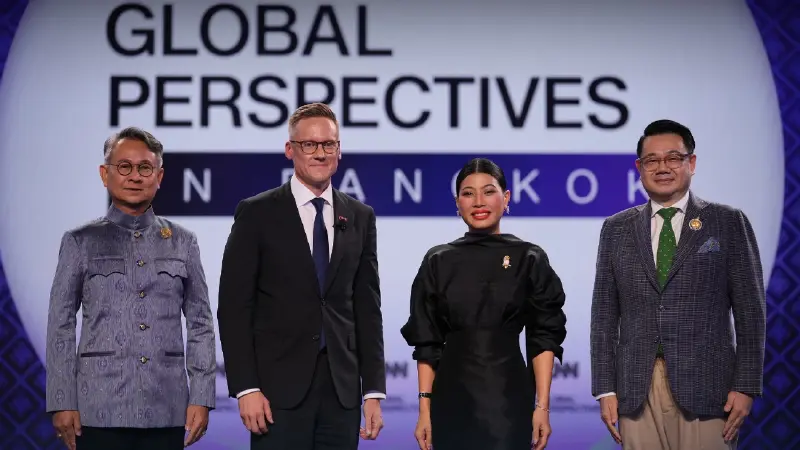


Thailand awaits a UNESCO decision as a CNN Global Perspectives panel hails Queen Sirikit's legacy and Princess Sirivannavari's work for Thai craft
- Chut Thai, the traditional Thai dress, is on the cusp of global recognition as it is set to be considered by UNESCO for its intangible cultural heritage list.
- Princess Sirivannavari is actively championing the dress on the world stage, continuing the legacy of her grandmother, Queen Sirikit, who originally developed the modern styles.
- The princess's work aims to ensure Chut Thai remains a "living heritage" by modernizing its use in contemporary fashion and supporting new generations of weavers and artisans.
Thailand awaits a UNESCO decision as a CNN Global Perspectives panel hails Queen Sirikit's legacy and Princess Sirivannavari's work for Thai craft.
Some garments are worn. A few become a nation's signature. At CNN Global Perspectives in Bangkok on Wednesday (October 14), Chut Thai, the traditional Thai dress, was celebrated as the second kind: a living emblem of identity, shaped by one remarkable queen, now carried forward by her granddaughter, and on the brink of global recognition.
The session, titled "Fabric of a Nation", was honoured by the presence of HRH Princess Sirivannavari Nariratana Rajakanya, who attended as a guest of honour.
The CNN presenter, Will Ripley, noted that she had come directly from a flight from Paris on a punishing schedule that will take her back to Europe after the event.
The princess has long championed Chut Thai and, following the example of her grandmother, the late Queen Sirikit, has worked to carry Thai textiles and craftsmanship onto the world stage.
The timing is significant. At the end of next month, Chut Thai will be considered by UNESCO for inscription on its list of intangible cultural heritage at a meeting in Xi'an, China.
Ripley described Thailand as "very close on the cusp" of joining a short list of nations whose traditional dress has been recognised. Examples of the eight styles were displayed at the side of the stage.

A queen's tour, and a national wardrobe
The story begins in 1960, when Queen Sirikit embarked on a world tour lasting more than six months and taking in the United States and 15 countries in Europe. Archive photographs shown to the audience captured the poise that drew attention abroad.
Wherever she went, Ripley said, people noticed "how exquisitely dressed she was", and what an "amazing representative" she was for Thailand.
Dr Anucha Thirakanont, chief executive of the Sustainable Arts and Crafts Institute of Thailand, explained that the project grew from a practical need.
The Queen, he said, had to "travel with style and with the Thai identity".
"She gathered the information from the past and reconstructed it from the historical background and historical dresses of Thai women, and also the court dresses," he said.

Her team of scholars and historians drew on old photographs, mural paintings and artefacts from the Grand Palace, including antique textiles.
Their aim was to make the dress "practical" and "easy to wear", and it was based on the ancient evidence. The result was a set of eight standard styles for women.
They range from the very informal to the very formal and suit different occasions. One of the grandest, which stood at the centre of the display, comprises the sabai, or shoulder sash, and a front-pleated tube skirt.
Dr Anucha said it was once worn by court ladies and the elite at important ceremonies. It "looks luxurious" but is, he said, "a very formal style".

Kullawit Laosuksri, editor-in-chief of Vogue Thailand, added a detail he called "extraordinary": the Queen Mother worked with the French couturier Pierre Balmain and the house of Balmain to engineer the eight styles into what is seen today.
From heritage to the runway
For Kullawit, the legacy is also a creative one. "You'll be surprised how Chut Thai has become the starting point of many, many designers," he said, noting that they use the same silhouette and modernise it into what women wear today.
"It became a reference for many young designers, and I think it's a very positive thing."
He spoke warmly of Princess Sirivannavari, who is herself a fashion designer.
"The Queen Mother has set a very, very strong foundation, and it's really extraordinary to see Her Royal Highness carrying that arduous task," he said.
He said she approaches traditional Thai textiles "in a fashionable and contemporary way", which he called "very, very important". The effects, he said, can be seen on the looms.
Younger generations are showing growing interest in Thai silk, and "weavers are getting younger" and "more daring when it comes to colour combinations".
Through the princess's initiatives, he added, new opportunities have opened for weavers and artisans across the country. He has seen her "very hands-on" with production.
Asked about the effort and time involved, Dr Anucha said the princess "has devoted herself to carry on her grandmother's task" and to ensure the continuity of craftsmanship.
That craftsmanship, he said, includes hand-loom weaving, embroidery and costume making. It is "not just to preserve the tradition but also to keep the tradition alive", he said.
"We are doing our best to make sure that this is a living heritage, not just a museum piece."
On the global stage, Kullawit pointed to the princess's recent appearance at Milan Fashion Week, which the presenter called historic.
He said it matters that Thai fabric is no longer seen as "just another fabric". Her autumn/winter 2027 collection incorporates Thai silk, he noted, proving it "is not just for ceremonial or special occasions".
"It can also be modernised," he said, "when it is designed correctly."

Craft as the future
Asked what defines Thai fashion, Kullawit answered without hesitation: "Craft is the answer to the future of fashion." Designers across Thailand, he said, are increasingly using handcrafted materials, including basketry, in their collections.
Dr Anucha stressed that the effort looks backwards as well as forwards. The aim, he said, is to "bring back all the knowledge that we have in the past", including natural dyes and natural fibres.
He noted that the princess has produced a number of publications on sustainable crafts, available online and through QR codes, covering not only textiles but also basketry and other handicrafts.
The UNESCO bid, Dr Anucha said, has been in the works "for many years". Inscription would "mean so much" to those involved, he said, because it would help them "tell the younger generation that this is your heritage and you are part of the safeguarding process". It would also, he added, honour the Queen Mother who developed the dress.
"This is actually our identity," he said, "and we are quite proud of that."

Worn with pride
The conversation ended on a personal note, with the panellists sharing what they were wearing. Dr Anucha wore a Raja pattern, a style created in the 19th century in the reign of King Chulalongkorn and altered a little in the reign of King Bhumibol.
His was made from silk ikat from Surin province. The presenter noted that three men's styles are also part of the tradition.
Kullawit wore a suit made of indigo-dyed cotton, with natural dye produced through the princess's initiatives. The place where it was made, he said, is close to her heart.
It was the very first province she visited at the height of the Covid pandemic, and it has since become "a household name in Thailand and all over the world".
He closed by reflecting on why such work matters in a globalised age.
"It would be so boring if you travelled all over the world and experienced the same design, the same culture, the same food, everything the same on the street," he said. "Cultural differentiation is something people are looking for."
Ripley called the panel "a love letter and a tribute" to Queen Sirikit, for whom "everybody in Thailand still aches". He said he hoped the late Queen Mother's legacy would be "made even grander" by the efforts of her granddaughter.
As he noted, the images of 1960 showed a queen who wowed the world on behalf of Thailand, and in Bangkok that morning the work of her granddaughter was doing the same.
