
Iron Age burial site with rare Phimai Black pottery found at Mun Bon Dam
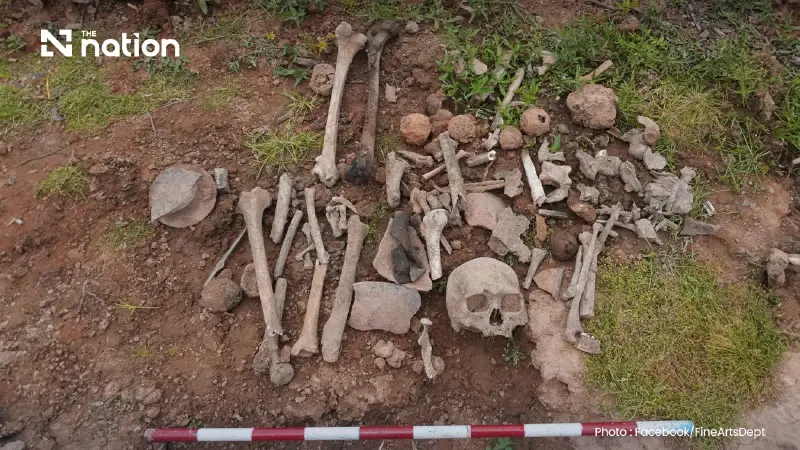


Archaeologists have discovered human skeletons, ancient tools, ornaments and a remarkably complete Phimai Black pottery vessel at Mun Bon Dam in Nakhon Ratchasima.
Archaeologists have uncovered a major Iron Age burial site at Mun Bon Dam in Nakhon Ratchasima, after falling water levels revealed traces of an ancient community believed to date back more than 2,400 years.

The discovery was made at a site in the middle of Mun Bon Dam, in Ban Taling Chan, Moo 9, Chorakhe Hin subdistrict, Khon Buri district. The area has been jointly named Mun Bon Dam Archaeological Site 1, or Non Ko Chot, after the receding water exposed archaeological remains that had been submerged for decades.
Experts from the 10th Regional Office of Fine Arts in Nakhon Ratchasima, together with specialists from the Maha Viravong National Museum and the archaeology group, inspected the site on July 9, 2026, after being alerted to the discovery.

Initial surveys found archaeological evidence scattered across the eroded ground surface, indicating that the area was once a prehistoric burial mound from the Iron Age.
Among the finds were ancient human skeletons, pottery vessels placed as burial offerings, iron tools, polished stone axes, glass beads and clay spindle whorls. Archaeologists said the objects reflected ancient beliefs about the afterlife, as well as the technology, way of life and trade links of communities living in the area at the time.

The highlight of the discovery is a Phimai Black pottery vessel, found in an exceptionally complete condition. The vessel measures 24.5 centimetres in diameter, 11 centimetres in height and 0.7 centimetres in thickness. It is regarded as the most complete example of its kind found so far in southern Nakhon Ratchasima.
Phimai Black pottery is known for its polished black surface and distinctive wide-flared rim. The pottery style was first identified in 1964 by American archaeologist Professor Wilhelm G. Solheim II at Prasat Phimai and Ban Suai, in the northern part of Nakhon Ratchasima province.

The Mun Bon Dam discovery is considered significant because it is the first recorded find of this pottery type in the southern part of the province, and the closest ever found to the source area of the Mun River.
Archaeologists said the discovery could expand understanding of early communities in the Mun River basin. It suggests that ancient people did not live only in the middle or lower Mun River areas, but also established communities near the river’s upper reaches, which later became a vital cultural and economic artery of the lower Northeast.
The 10th Regional Office of Fine Arts in Nakhon Ratchasima is expected to prepare conservation and advanced study plans for the site. Further discoveries may be possible if water levels in the dam continue to decline.


Source: Krungthep Turakij
