
Wat Chaiwatthanaram: The Temple That Rose Again
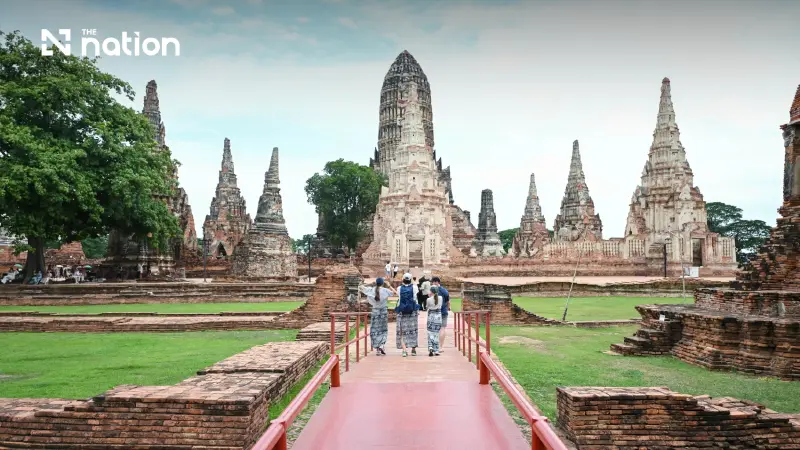


A field visit to Wat Chaiwatthanaram traces the 12-year, $1.8-million restoration that turned flood damage into a model for conservation-led tourism
- Wat Chaiwatthanaram was severely damaged by major flooding in 2011, which submerged the historic site and threatened its structural integrity.
- A 12-year, $1.8-million restoration project, a joint effort between the U.S. government, Thailand's Fine Arts Department, and the World Monuments Fund, was undertaken to repair the flood damage.
- The project not only restored the temple's structures but also established it as a model for conservation-led tourism, integrating preservation with public engagement.
- As a result of its successful restoration, the temple is now viewed as a "temple reborn" and has gained international acclaim, including being named one of National Geographic's top travel destinations for 2025.
A field visit to Wat Chaiwatthanaram traces the 12-year, $1.8-million restoration that turned flood damage into a model for conservation-led tourism.
On the west bank of the Chao Phraya River, where the light turns the brick towers to gold each evening, Wat Chaiwatthanaram no longer looks like a monument merely surviving history. It looks restored — deliberately, patiently, and with a purpose that extends well beyond its own walls.
That was the impression left after a recent field visit with the Public Relations Department, where an expert from the Fine Arts Department walked visitors through the temple's 400-year story: from its construction under King Prasat Thong to its near-collapse in 2011 to its recognition today as one of Thailand's clearest examples of what conservation can do for a place – and for the people who visit it.

A temple built on grief and grandeur
Wat Chaiwatthanaram was raised roughly 400 years ago on land that once belonged to King Prasat Thong's mother, built to house the ashes of his parents.
Its architecture, the Fine Arts Department guide explained on the visit, is a deliberate replica of Buddhist and Hindu cosmology – the central prang representing Mount Meru, ringed by smaller towers standing in for the moon, the sun, and the surrounding continents.
The ancient Khmer-influenced design, echoing Angkor Wat, was as political as it was spiritual: a declaration of royal legitimacy modelled on the grandeur of an older empire.

For a century, the temple served as a royal ceremonial site. Then, in 1767, the Burmese army razed Ayutthaya, ending 417 years of the city's history as Siam's capital.
The blackened brick still visible on parts of the structure is a direct legacy of those fires — left deliberately unrestored, the guide noted, because the scorch marks are themselves historical evidence, not damage to be erased.
The flood that forced a reckoning
The temple's more recent crisis came not from war but from water. Severe flooding in 2011 submerged Wat Chaiwatthanaram under roughly two metres of water, undermining brickwork, stucco, woodwork and centuries-old murals.
Of the temple's original collection of Buddha images — some 300 in the surrounding corridor, several depicted uniquely as an emperor wearing a "cloud crown" — many had already lost their heads over the centuries, cut off for sale abroad or lost to natural decay. The 2011 floods threatened to accelerate that erosion further.

The response became one of the largest cultural heritage partnerships the United States has funded anywhere in the world. Beginning in 2012, the U.S. Ambassadors Fund for Cultural Preservation, Thailand's Fine Arts Department and the World Monuments Fund launched a joint restoration project, ultimately running for twelve years and receiving a total of $1.8 million in American government funding across five phases.
The work went well beyond patching cracks. Engineers designed and installed new drainage and flood-control systems, restored four Meru pavilions and their connecting cloisters, repaired mural paintings and Buddha statues, and used laser scanning and digital mapping to document the site with a precision that will guide future conservation work for decades.

The project closed formally on 15 November 2024, in a ceremony held — fittingly — on Loy Krathong Day, Thailand's festival of light and water.
Conservation as a tourism strategy
What distinguishes the Wat Chaiwatthanaram project from a straightforward repair job is its second objective: using the restoration itself to strengthen tourism and community engagement, rather than treating them as separate concerns.
The World Monuments Fund has said the partnership helped position the Fine Arts Department for long-term stewardship of the site and created a template for how other Thai heritage sites might be preserved.
Alongside the physical works, the U.S. Embassy in Bangkok organised public education events for Thai students and produced short documentaries chronicling the restoration for wider audiences.
The results are already visible in how the temple is perceived internationally. Wat Chaiwatthanaram was named among National Geographic's 25 Best Places to Visit in 2025, described in the list as a "temple reborn" – language that reflects not just aesthetic restoration but a broader recovery of the site's identity as a living cultural landmark rather than a static ruin.

Today, the temple draws tourists steadily by day and, increasingly, at dusk, when its illuminated prangs form one of the most photographed silhouettes in Ayutthaya.
Visitors are asked not to climb the smaller, unfinished towers — a deliberate choice by the Fine Arts Department to protect fragile brick rather than complete structures that were, by design, never finished.
Around 40 per cent of the temple's original valuable artefacts survive today; much of the recovered gold and statuary now sits in the nearby Chao Sam Phraya National Museum, forming a companion exhibition to the ruins themselves.

A living case study
For Ayutthaya, a UNESCO World Heritage Site since 1991 and once one of the wealthiest trading capitals in Asia, Wat Chaiwatthanaram now functions as something more than a single restored building.
It stands as evidence that conservation and tourism need not compete — that careful, long-term investment in a fragile heritage site can, if managed well, deepen public interest rather than merely accommodate it.
As Fine Arts Department staff continue monitoring the temple's flood defences and structural stability, the site has become something of a proving ground for how Thailand might approach heritage preservation elsewhere: not by freezing history in place, but by giving it the infrastructure to keep telling its story.

Practical information
Location: West bank of the Chao Phraya River, Ayutthaya Historical Park, Phra Nakhon Si Ayutthaya Province.
Opening hours: Daily, 08:00–18:30.
Admission: 50 baht (also included in the 220-baht historical park combination pass).
Best time to visit: Late afternoon, when the setting sun turns the prangs gold — sunrise occurs behind the temple, making dusk the more photogenic option.

