
Fair hands on the rudder
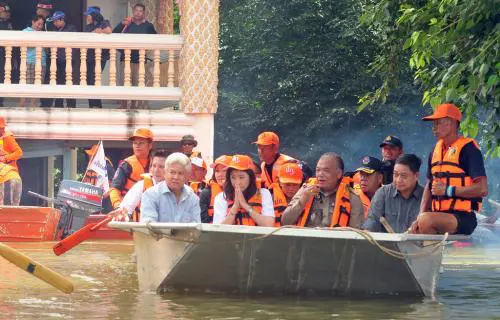


Southeast Asia's women leaders are assessed at a Thammasat seminar. Yingluck's ears must have been burning
Subhatra Bhumiprabhas wonders if it’s premature for Thailand to have a woman prime minister. It was a surprising notion from the veteran journalist and outspoken feminist who’s been recognised by the Asian Public Intellectual Fund.
But, as Subhatra pointed out, the push for gender equality has never looked further than a 50:50 ratio of female to male election candidates. Thailand has suddenly leapt far beyond that.
The discussion arose at a seminar on “Female Leadership in Southeast Asia: Aquino-Megawati-Suu Kyi-Yingluck” late last month at Thammasat University Tha Prachan.
Historians, social critics and some decidedly non-feminist participants joined the session organised by Thammasat’s Southeast Asian Studies Programme, the Foundation for the Promotion of Social Sciences and Humanities Textbooks Project, the My Dear Southeast Asia Club and the Siam Archive Association.
Subhatra pointed out that, for much of the 17th century, four women ruled Pattani – the nation state that fell to Siamese control.
Raja Hijau was merely installed a puppet ruler, enthroned after all the men in her family were killed in a power struggle, but she enabled trade to flourish, fostering Pattani’s most glorious era.
Hijau died after 32 years on the throne, to be succeeded by her sister Biru, who maintained relations with Siam while convincing the sultan of Kalatan to embrace the Pattani Confederation.
One of the three cannon that Raja Biru had made for the region’s defence now sits in front of the Defence Ministry in Bangkok.
“These ladies successfully ruled Pattani despite initially being chosen as puppet queens,” Subhatra said.
She also cited Queen Supayalat, who ruled Burma in the late 19th century. MR Krukrit Pramoj called her wicked, but most Burmese today are proud of the way she resisted Western power.
Thailand-based British historian Chris Baker noted that every woman who has become the leader of any country in Asia has achieved that status because her ruling father was assassinated. Outside Asia, he said, only Argentina’s Isabel “Eva” Peron came to power that way.
The reasons why it’s common in Asia, Baker said, include the slain father’s political capital, the appeal of female qualities in the wake of violence, and the esteem given to family hierarchy in this part of the world.
The list of women achieving power this way in Asia includes Sirimavo Bandaranaike of Sri Lanka, Benazir Bhutto of Pakistan, Indira Gandhi of India and Corazon Aquino of the Philippines.
“Yingluck Shinawatra is a slightly different case,” Baker said. “Former prime minister Taksin Shinawatra is her brother, but he possesses father-like characteristics.”
In most cases, Pichet Saipan of Thammasat’s Faculty of Sociology and Anthropology noted, these women have come to power “through democratic elections after political crises that affected their families”.
“Interestingly, they are or were all members of the elite – none came from poor families, including Yingluck Shinawatra. My view is that it’s not premature for Thai society to have a female prime minister – this is the right time for her.”
The question arose about Yingluck’s ability to hold onto power. Pichet and Baker agreed that it’s “highly likely” she’ll serve at least one full term, “due to many factors”.
Corazon “Cory” Aquino became president of the Philippines after her husband was assassinated in 1983, on his return from three years’ exile in the US. She decided to help lead the campaign against the incumbent Marcos administration in what became known as the People’s Power revolution.
“The Filipinos were celebrating the 2,000th birthday of the Virgin Mary, and Cory was seen as representing Mary with her good virtue, the saint of the people, backed by the Catholic Church,” said Akarapong Khamkoon of the Thai Studies Programme at thammasat’s Pridi Banomyong International College.
Aquino, insisting she was nothing more than a plain housewife, admitted to reporters that she had no political experience – but that she hence had no experience in corruption.
“Few Filipinos today admire her as much as foreign correspondents do,” Akarapong said, “but if you read academic reports from a grass-roots perspective, she was a saint, saving the people from suffering.”
“Cory Aquino was essentially a transition figure in Philippine political history,” Thammasat history professor Charnvit Kasetsiri commented. “She held the position mainly by compromising on power. I think Prime Minister Yingluck will eventually have to do the same.”
Like Aquino, Megawati Sukarnoputri – daughter of Indonesia’s President Sukarno – projected the image of common housewife, wearing the modest national costume and her hair in the traditional Javanese manner.
“The people called her Ibu Mega – ibu means ‘mother’,” On-anong Thippimol of Thammasat’s Liberal Arts Faculty observed. “But she was both extremely admired and extremely hated. One headline said her mouth reeked of diesel oil, meaning she was corrupt.
“In 2001 the military shifted its support away from President Abdulaman Wahid because he wanted to limit its power, and supported Megawati instead. It was the right time, with Indonesians celebrating the centenary of Sukarno’s birth, the father of the nation. He’d been not only the country’s first president, but also the one who gained its independence.”
Megawati held office from 2001 to 2004 and is now being touted for the presidency again, with an election due in 2014.
