
The gods come down
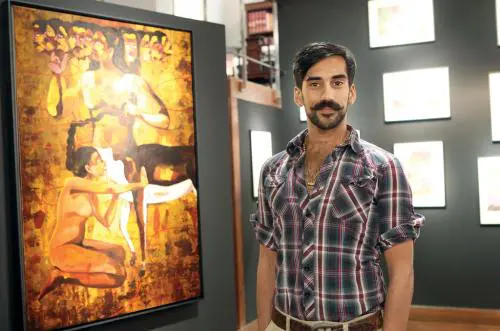


Ramayana heroes turn human in paintings that would stir angry howls in India
Spare a little sympathy for Ravana. Maybe the “demon-king” of Lanka and the main antagonist of the Ramayana wasn’t all that bad after all. According to Siddhartha V Shah, in fact, old 10-headed Ravana was simply a broken-hearted scientist whose biggest weakness was in loving a beautiful woman too much.
That’s the version presented in the exhibition “Tales of Love and Betrayal: A Modern Retelling of the Ramayana”, on show at the Serindia Gallery for the next two weeks. Shah, a Hindu, is the curator.
Meanwhile, Sita – another much-maligned character from the epic saga that Thais calls the Ramakien – is recast as an ideal daughter, wife and mother.
She’s treated shabbily by her husband, Lord Rama – forced to walk through fire to prove her chastity after being carted off by Ravana. She passes the test but Rama remains unconvinced and banishes the pregnant Sita to a forest to give birth to twin sons alone.
“That’s an awful thing to do,” says Shah.
So Shah found three Indian painters who offer a different view of the story, beyond the traditional patriarchal constraints and Hindu bias.
“There are many things in the Ramayana that people don’t understand,” Shah says. “Through this exhibition you’ll experience Ravana and Sita in a new light.”
Hindu Anand Gadapa, Christian Nirmala Biluka and the late Maqbool Fida Husain, the Muslim “Picasso of India”, take liberties with the Ramayana that not long ago would have earned them with death threats in their homeland.
The most controversial paintings are by Husain, who died in self-imposed exile in London last June. He was often threatened by Hindu fundamentalists unhappy with his depictions of deities frolicking about in naked abandon.
Hindu deities are usually seen not just clothed but flamboyantly costumed. The paintings of Gadapa and Biluka aren’t nearly so sensitive in terms of faith.
One painting in Husain’s Hanuman series has the nude monkey god departing Lanka with Sita riding on his tail, and she’s in the buff too. Hanuman is, however, clothed in another work – in Superman’s skin-tight outfit.
“If I staged this show in India we’d be in trouble with the fundamentalists – they want these artists’ hands cut off!” Shah says. “They like to use modern art to create divisions in society. There are still conflicts between religion and modern art.
“I’m not interested only in the controversy, though, but in this question of modern art and religion. It’s a field that contemporary artists rarely look at.
“Rama, who is a god, doesn’t appear in the exhibition because I want to show the Ramayana not as a religious text but as a story that’s universal. This is my modern retelling. Many people think they know the story, but there are a lot of backstories that we don’t know, especially about the emotional experiences of its characters.”
Shah brings Ravana and Sita down to a more human level, the demon-king no longer overtly evil, just a man who has lost at love and is thus prone to making mistakes.
Gadapa makes Ravana an unsung hero, depicting him full of talent – in alchemy, acupuncture, music, architecture, herbal healing and writing medical textbooks.
“He’s extremely developed spiritually, but becomes corrupted by power,” Shah suggests. “He’s a confused man with a broken heart – but he has a heart like everybody else. He only has 10 faces because he’s revered as the master of four Vedas and six Upanishads, in other words the master of 10 sciences. He’s quite an intellectual!”
Feminism permeates Biluka’s paintings of Sita. In her unfulfilled desires and her husband’s abuse, Sita shares the same fate as many women in modern Indian society, says Shah. “There are countless boundaries around Indian women,” he says, pointing to the painting “Sitayana”.
It shows Sita holding a small deer that represents her earthly desires, ringed by circles signifying various episodes of her life. Her only option, it seems, is to suffer and endure. For Indian women, there is no other choice.
Not wishing to directly provoke a backlash back home, Shah is instead determined to revive the country’s far more liberal Baroda school of modern art.
“The Baroda school is very narrative, storytelling-oriented, less about the finished product and more about the mental concept,” he says. “Baroda artists are open-minded.”
The exhibition in Bangkok is designed to show how easy it is to relate to the likes of Ravana and Sita. “We don’t exaggerate the story. We just make the people in the story a little more equal.”
It’s common enough for Indians to regard characters from the Ramayana as heroes. Rama epitomised nationalism early in the last century. These days Hanuman is most admired.
“Hindus believe he’s alive and hiding in the Himalayas. If you’re in trouble you call Hanuman, they believe, and he’ll come,” says Shah.
Shah, considerably less orthodox, prefers to see the practical lessons in the Ramayana. “These characters are no different from us. I don’t believe that gods are ‘up there’ and we’re ‘down here’.”
LOVE AND FAITH
“Tales of Love and Betrayal: A Modern Retelling of the Ramayana” continues until November 6 at the Serindia Gallery in the OP Garden on Soi Charoenkrung 36.
Call (02) 238 6410, e-mail [email protected] or see www.SerindiaGallery.com.
