
Faces in the flood
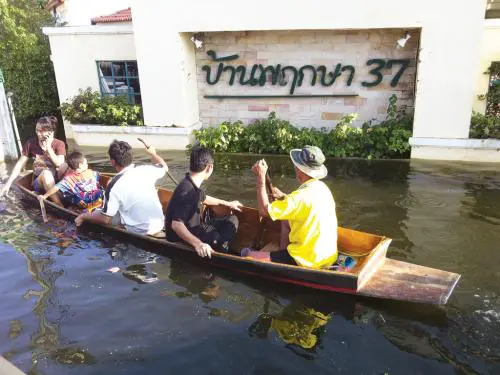


What it's like to share your home with the deluge of the century
Nattasupa Trongma’s two-storey townhouse was swamped when the floodwaters hit Soi Nimit Mai 3/2 in Min Buri on October 23, but she hasn’t budged. The murk outside her door is receding – now down all of 10 centimetres from its 80cm peak. She and her husband refuse to move.
“We decided not to,” Nattasupa says, “because we wanted to see the building’s shortcomings in the flood so that we can fix them and prevent any severe damage if it’s ever underwater for even longer.”
They’ve both put in the sandbag time, even devising a dyke in the kitchen, while a pump throws the incoming water back out.
Her husband took time off work but Nattasupa has to get to her job or see her salary cut. Her employer has no contingency plans for “disaster leave”, and she’s already sacrificed her cherished holiday time to this crisis.
Instead of a 90-minute trip to the office in Pak Kret over in Nonthaburi, Nattasupa now spends three hours or more getting there. Wearing shorts, she wades through the wet to get a boat to take her to a public van.
There weren’t even any vans for more than a week when Chaeng Wattana Road was inundated. “I had to hitch rides with passing trucks. One day I was in three different trucks! I finally got to work at 11am.”
Once at work, of course, she can change into proper clothes.
Part of their survival plan means eating less. Nattasupa cooks what she can with what’s available at the market. “We haven’t stored a lot of food because that would just mean other people would have less to eat.
“But we’ve learned how to live with floods and how to avoid harm. If we have to go through this again next year, we won’t suffer as much.”
Nattasupa advises people affected by the flooding or expecting to be hit to reach a family understanding first about whether they’ll evacuate or stay. And if everyone agrees to stay, they have to be extra patient with one another.
Don’t stay glued to the TV news, she warns – it’ll just bring panic. Instead, keep an eye on the water level in nearby canals to see what’s really happening.
“Think of it as if you’re going camping – with the limited food and facilities – and it’s more like an adventure challenge.”
WANNAPA KHAOPA
THE NATION
He’s minding the store
Chana Yamnil, 39, has been living in his printing shop in Bang Yai, Nonthaburi, since October 19. His house – which he and his wife only bought in February – is sitting in a metre of floodwater.
“I don’t want to talk about it,” he says. “It’s just too hard to believe.”
The couple shifted necessities from home to the shop in a three-storey building, thinking it would be entirely safe, but soon enough there was floodwater sloshing around the ground floor.
Others who’d taken up residence there cleared out, but Chana and his niece stayed to make sure the water didn’t rise beyond 80cm, because then it could damage their machinery.
“The printing gear is the heart of the business,” he says. “It has to be protected around the clock.” They’ll cling on as long as there’s electricity and tap water.
Daily life now involves riding a paddleboat to Bang Yai market (45 minutes to an hour) instead of a motorcycle (five or 10 minutes). “It’s not easy, but I have to go,” Chan says. “Otherwise I have no food or drinking water.
“The local and government officials and private donors don’t bring relief supplies inside Bang Yai City, just to the perimeter, so we have to paddle out to get them.”
The market is now, unexpectedly, a river market. Chana and his niece live on instant noodles unless friends with shops nearby call them over for cooked meals. “Nearby” can mean a 20-minute workout in a rowboat.
His wife stays with their daughter and son, ages nine and eight, in Phetchaburi, returning to check on her husband and niece on weekends. Chana hasn’t seen his kids in many weeks, though.
“I really miss them. I promised them before the flooding crisis, before school started, that we’d have a trip to Pranburi. Now I’ve told them that, once a car can get inside Bang Yai, we’ll still go.”
SUCHEERA PINIJPARAKARN
THE NATION
Keep it in perspective
Sixty-year-old Paschurat Praisri has been stuck on the upper floor of her house for almost three weeks, but she’s still smiling.
The house is in the compound of the Armed Forces’ Joint Communications Department on Song Prapha Road, where her son, Sergeant Chittiwat Praisri, is stationed.
The deluge arrived on October 29, reached a metre and a half and stayed that high for a week. It’s dropped since a barrier of Big Bags went up and is now 50cm.
“My son wasn’t here the day the water came in the house – he was helping people upcountry.” Paschurat laughs. “I didn’t expect so much water! My husband and I moved what we could but we had to leave things that were too heavy, like the fridge.”
The water downstairs is too dirty to walk in. “It was clear at first but got muddy after a few days. My husband and son open the front and back doors every day so the water gets moved around and doesn’t get too stinky.”
Otherwise, Paschurat says, life isn’t so tough. There’s still tap water and electricity. Their two big dogs are safe and content. A military boat carries Chittiwat back and forth to work and he can buy what they need at the market in Pakkred.
“But because there’s no refrigerator we don’t have any fresh food, just dried food like noodles and canned stuff.”
“I don’t feel stressed – there’s no use getting stressed,” Paschurat says. “The water comes and it will go after a while.”
SOMROUTAI SAPSOMBOON
THE NATION
Stranded but safe
Panuson Auyporn, a 28-year-old salesman, will not be prised loose from his home in Nonthaburi’s Preuksa 37 community, where the water is more than a metre deep. “I don’t want to be a burden to others, and I think it’s better if I stay here to keep an eye on my home and my neighbours’,” he says.
His wife and nephew are staying in Nakhon Si Thammarat, the family’s home province. His company has been shut down because of the flooding, though he still gets paid.
“I never cook meals normally – I just buy ready-to-eat,” Panuson says, “but staying alone, I do easy cooking, like rice porridge, noodle soup or fried rice. There’ve been very few relief parties because the water in the soi is so deep, but luckily I have neighbours who always drop off food and supplies.”
Panuson has twice received relief packages, one from the tambon and the other from a private firm. The chairman of his housing estate brings him lunch every day. And he feels lucky that the electricity and telephone haven’t been cut off so he can watch TV and use the computer.
Contemplating the cleanup, Panusorn says, “I try not to look because it makes me depressed!”
But just the same, “I hope the water clears out fast, because living like this is torture.”
MAYUREE SUKYINGCHAROENWONG
THE NATION
