
Wit and wisdom from Europe


Play
Swiss and Spanish innovation feed hungry imaginations at the Thailand Creative and Design Centre
Two new exhibitions at the Thailand Creative and Design Centre demonstrate that, when it comes to food, Switzerland has more to offer than chocolate, and that the first thing you think about Spanish cuisine shouldn’t be the “molecular gastronomy” at El Bulli restaurant.
Although completely different in context, the dual exhibitions intertwine in terms of culture, creativity and cutting-edge innovation. Both shed light on the Western approach of taking design to the next level by showcasing more than 400 ingenious inventions.
“Foodjects: Design & the New Cuisine in Spain” covers the reinvention of Spanish cuisine through new culinary technology, where chefs and designers have collaborated to provide a fresh experience in dining.
“The new Spanish cuisine has revealed itself as one of the world’s most creative and surprising, a success linked to a culinary tradition as rich and as varied as the country’s landscapes,” says Martin Azua, an award-winning experimental designer.
On display are kitchen utensils, tableware, food products and table decorations where designers have pushed its boundaries in terms of technological advancement and artistic inspiration while honouring a rich Spanish cultural identity.
“Chefs and designers collaborate to provide new formats for food, to appreciate the textures, the flavours, the contrasts or the aromas,” says Azua.
His own masterpieces are on view. The “Copporon” is an eye-catching drinking glass somewhere between a copa and a Spanish porron, and in shape between a wine bottle and a watering can. You sip your wine slowly through the pointed beak of the glass.
Also exciting is Bodo Sperlein’s “Equus Collection, Re-cyclos Magical”, a set of white porcelain tableware full of clever humour. Horses’ legs, heads and hooves become handles and a trivet supporting a bowl.
As Azua points out, “Eating has been made a sensorial and intellectual experience in which a sense of humour and surprise play a major role.”
Deunor Bregana and Anne Ibanez Guaridi’s “Lunar Soup Plate” takes its inspiration from water ripples and droplets. The plate catches light to create texture and emphasise the liquidity of what’s sitting on it.
There’s a documentary video on famed Spanish chef Ferran Adria of El Bulli, talking about modern Spanish food.
“Spanish chefs,” Azua says, “understand cuisine as a language, a means of expression using new culinary technologies to arouse sensations and emotions, and daring activities which leave no one indifferent, which provoke discussion and debate.”
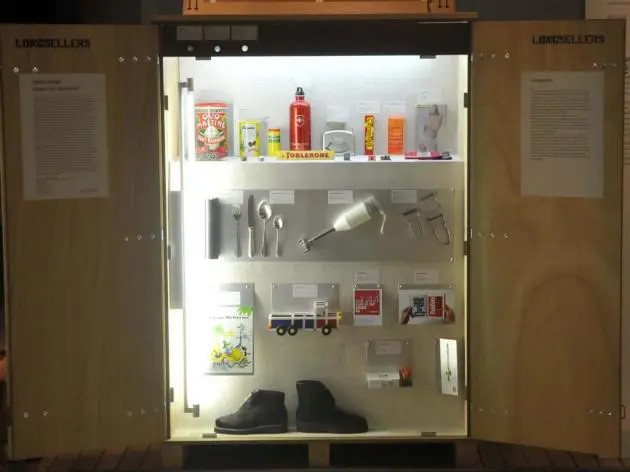
The exhibition “Criss+Cross: Design from Switzerland”, straight from the Shanghai World Expo, features sophisticated and contemporary invention in furnishings, fashion, graphics and even mundane goods.
In eight sections, the exhibition presents different design objects. “Up to the Mountains” includes schemes for the tourism industry, from cable cars to sports equipment. “Longsellers” displays world-renowned items like Toblerone chocolate, the Swiss Army knife and furniture by Willy Guhl – on sale for more than 30 years and still in demand.
Switzerland has had less success in fashion design, but you see some rare, innovative pieces by Creation Baumann, a textile company that utilises modern technology. “Schoeller-Spirit” is made with metal fibres. “Pailleten Pollock” changes colour when touched.
CLEVER IDEAS
“Foodjects: Design & New Cuisine in Spain” and “Criss+Cross: Design from Switzerland” continue until January 22. Admission is free.
The Thailand Creative and Design Centre is on the sixth floor of the Emporium and open daily except Monday from 10.30 to 9.
Call (02) 664 8448 or visit www.TCDC.or.th.
