
Mahler just gets bigger
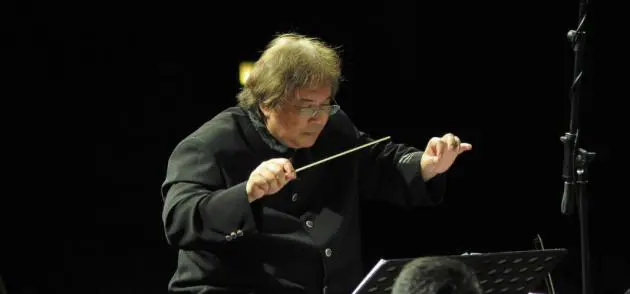


Halfway through its concert series devoted to him, the Siam Philharmonic is breathing the same air as the Austrian genius
Somtow Suchartitkul and the Siam Philharmonic’s entire performance of Mahler’s Sixth Symphony can now be viewed on You Tube but, in fact, the February 16 concert was one of life’s “you had to be there” events.
With the Sixth, Somtow has passed the halfway mark in the Mahler Cycle, and he did so with the kind of panache and verve that’s only possible once Mahler’s music has sunk into your bones.
Led by Hungarian concertmaster Vilmos Olah, the orchestra reached new heights as it worked through material as dense and varied as Mahler gets.
Performing the Sixth entails two running debates. The first involves the order of the two inner movements, marked scherzo and andante, and the second is about the correct number of hammer strokes in the fourth and final movement.
These hammer blows represented strikes of “fate” to Gustav Mahler. But in a revision, he omitted the third blow (although some scores in circulation retain it), for reasons haunted by speculation. Among the theories: The superstitious Mahler worried that a third blow would kill off his symphony’s hero.
With rare exceptions, the Sixth is presented these days without that third blow – but the Siam Philharmonic chose to include it.
As to the order of the inner movements, Bruno Walter advised Mahler to reverse what he’d written and place the andante before the scherzo. I believe Mahler had it right to begin with, and the Siam Philharmonic concurs.
The debate on the matter ranges from key modulations to emotional impact. Playing the slower andante later ensures the emotional impact I believe Mahler intended. Reversing the order produces a symphony that seems off-balance to these ears.
After only a minimum of rehearsals, the Siam Philharmonic displayed an unusual amount of dedication and commitment. Rarely does a Mahler symphony proceed without some glitches, even with the most accomplished orchestra, and yet the Siam gave this intense material a flair and virtuosity rarely heard in orchestras of less-than-major calibre.
The opening martial music was arresting from the first note. We could sense that a performance of high magnitude was underway. While the tempi overall was slower than normal, it allowed the music to breathe, so as to expose details that a quicker pace might obscure.
Coming in at one hour and 28 minutes, this presentation must be one of the most protracted this side of Leonard Bernstein (whose baton was in use, having led Mahler’s Ninth in San Francisco in the late 1980s, not long before by Bernstein’s death).
Slower tempi or not, time seemed to stop altogether – or pass so fast that we reached the end in no time. It was an 88-minute moment “in the now”.
The few glitches were not glaring or obvious. The second violin section at times seemed fatigued, especially during the Finale and the slow andante. As in most of the Mahler symphonies that Somtow directs, the first and second violin sections were split, allowing for the “call and response” phrases so prevalent in Mahler’s music to be heard more distinctly.
Even though this separation causes the second section to sound less imminent since the musicians face away from the audience, Mahler grants it much importance in his writing.
The brass playing was exemplary – the strongest section of this orchestra, along with the lower strings. The percussion suffered only from the heavy curtain behind, which absorbed much of the sound, especially the cowbells.
The first violin section, led by Olah, reached heights of virtuosity not heard in any previous Mahler performance by this orchestra. It appears that with each outing, the overall calibre of the playing gets better. They will soon have Mahler firmly in their bones.
At the conclusion of the final smashing chord, the audience sat in silent rapture for a full 20 seconds before the applause erupted.
I was impressed, as well, at the players’ grasp of music that is not part of their own culture. Few of them will have heard much of Mahler until recently, and they are generally young and relatively inexperienced.
A big “Bravo!” of course to music director Somtow (who has long had Mahler in his bones) for bringing this music to Thai audiences for the first time.
Stan Gayuski is a member of the New York chapter of the Mahler Society.
