
One awful day in March


It was a year ago today, in fact - the quake, the waves and then the nuclear terror
The 50 photographs from the pages of the Japanese newspaper Asahi Shimbun are worth more than a million words. The East Japan Earthquake Press Photo Exhibition
at CentralWorld until Wednesday offers a then-and-now perspective of the massive earthquake and tsunami that devastated the country’s northeast a year ago.
The powerful images track the disaster from ruin to recovery, people’s faces lined with grief and smiling with hope. The message is clear: Trust the power of the human spirit to find its way from tragedy to triumph.
“It’s a part of history we will never forget,” Asahi Shimbun’s Takashi Kasuya says of the destruction and death caused by one of the biggest earthquakes ever recorded, which also triggered a nuclear crisis when the cores of three nuclear reactors at Fukushima melted.
The exhibition’s opening section “What happened then?” has a series of four photos titled simply “Tsunami”, all taken within one minute, showing the town of Minamisanriku being swept aside by furious currents.
Newspapers around the world carried another of the pictures on view, called “She Cries”, which caught a woman weeping at the edge of ruined Natori city.
“I volunteered to go to Iwaki in Fukushima,” says Asahi Shimbun reporter Atsushi Matsukawa, 39. “All I knew at the time was that a strong earthquake had occurred, and I imagined I’d see collapsed buildings and split roads. But I couldn’t believe my eyes when I arrived. I kept asking myself, ‘What happened?’”
The paper’s cameramen recorded what Matsukawa saw – a sea of debris, whole towns no longer recognisable, let alone inhabitable, ships on dry land, houses underwater, citizens clinging to high perches.
Later there were the crowds in front of bulletin boards that listed the missing people, tears shed at evacuation centres, monks chanting prayers in the rubble, a cooling snowfall.
“I tried to maintain my sense of duty,” Matsukawa says. “I didn’t want the reports to be exaggerated or the pictures overly sentimental, but this was the worst story I’ve ever covered. I met a man who lost five members of his family, and every morning he made five cups of tea in their memory.
“In Onakawa, even a hospital 20 metres up a mountain was swept away, killing some of the patients and carrying others off. The designated evacuation sites were also inundated. It was just heartbreaking.”
There are so many photos of anguish and sorrow that it’s doubly cheering to see others depicting happiness amid the endless detritus of the calamity.
The picture “Found it!” shows a young schoolgirl in Ishinomaki beaming as she discovers her favourite textbook in her collapsed home. “So glad to see you” was taken at a school in Kamaishi during its first post-quake student assembly – it shows a girl cradling the face of her tearful, long-lost friend.
The exhibition’s next focus is on the Fukushima nuclear crisis, which necessitated mass evacuations that created ghost towns across the prefecture. Photos depict an evacuee being tested for radiation exposure and a baby being decontaminated a second time after his parents tested positive.
Matsukawa ventured into the no-go zone around the Fukushima No 1 power plant – briefly, since visits were limited to two hours. He took a picture of an evacuee who’d been allowed to fetch things from his home. There the man found his pet, already long dead. Matsukawa decided not to include the image in this exhibition.
He left the restricted zone and kept his Geiger counter running.
“In the still-inhabited village of Iitate, 40 kilometres from the nuclear plant, we found that the radiation level was high enough to harm human health. It was clearly not safe to stay. Finally the government ordered the residents to evacuate.”
The exhibition’s section called “Grief” covers the aftermath. “The 49th day memorial service” shows a weeping man placing his mother’s ashes in the family tomb. “Hold him tight” sees a boy hugging a portrait of his late father.
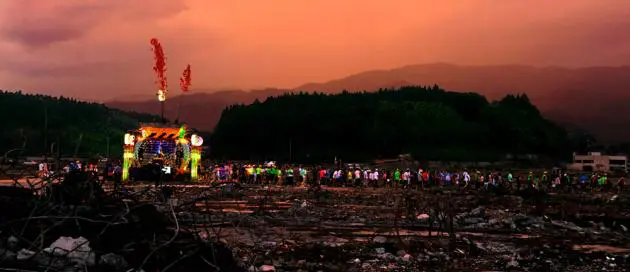
Matsukawa points out his favourite image, “Reuniting with ten thousand souls”. It was taken in Rikuzentakata during the Moving Tanabata Festival held each August.
Because the catastrophe destroyed almost all the decorated floats used in the festival – and killed many of the regular participants – it didn’t seem likely there would be a celebration in 2011.
The residents kept it going, though, for the sake of those souls lost to the disaster, using the only float that was left. Everyone had been separated into different evacuation zones and temporary housing, “but they reunited with tears of mourning”, Matsukawa says, “while the sound of flutes and drums fill the ruined area that was once the bustling city core.
“The float, moving across the ravaged town with the falling dusk, glowed with a light that would surely guide the spirits of those lost to the tragedy.”
The exhibition closes with a section called “Hope”, devoted to what’s happened in the year since – the gradual recovery, temporary shops rising from the mud, good cheer slowly restored.
There’s another “I found it!” This time it’s a pair of pictures depicting a young lad’s joy as he pulls his school satchel from the wreckage, and then, six months later, toting the bag to classes at a makeshift school.
Another sweet pairing depicts a girl tearfully playing her trumpet at the place her house used to stand. The horn was a gift from her grandmother, who was killed along with her mother. A month later – as also captured in an accompanying video – she’s playing the trumpet at a charity concert, where she stopped crying long enough to declare, “I won’t let sadness defeat me. I won’t give up.”
“Disaster makes us stronger and teaches us to help each other,” Matsukawa says. “One year has passed and I don’t want people to forget what happened. Some progress has been made in rebuilding lives, but much remains unfinished, and the nuclear situation remains fragile. I continue to follow the aftermath.”
LESSONS LEARNED
The East Japan Earthquake Press Photo Exhibition, organised by Asahi Shimbun and Mitsubishi, continues until Wednesday from 11am to 9pm on the ground floor of CentralWorld. The show will travel next to Jakarta and Seoul.
