
Where hope teaches lessons
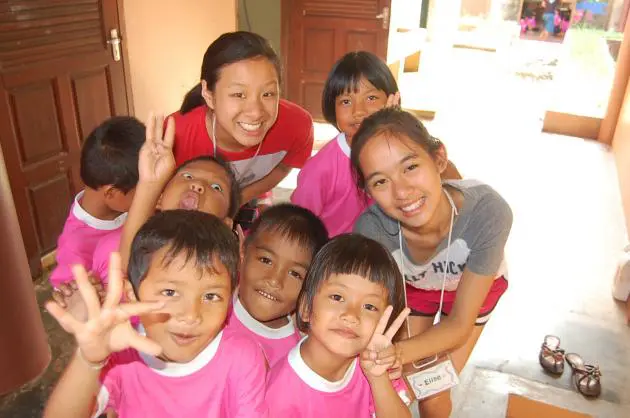


Originally built for tsunami orphans, Yaowawit School in Phang Nga could use a little help
Little Miw’s grin stretches across her face as she grabs my hand and chirps, “Wait, wait!” Suddenly, tiny fingers tackle me from behind and my face is smothered with neon-green paint. The children shriek with laughter as I turn and chase them, grabbing blue paint and preparing for a counter-attack.
It’s a typical morning at the Yaowawit School in Kapong, Phang Nga, a place that truly upholds Thailand’s reputation as the Land of Smiles.
As senior students from Hong Kong International School, we’ve had the chance to volunteer around the globe, teaching English in Cambodia, Indonesia, Hong Kong, India and Rwanda. Like many of the other children we’ve worked with, the Yaowawit students come from challenging circumstances.
However, what is most striking about the Yaowawit students can be summarised in one word: resilience. As Fiona Parsons, a volunteer who lives in the area, says, “Kids at Yaowawit are much more confident and happy than kids at other local schools. They have much brighter futures.”
Built in 2005 to educate orphans who’d lost their parents in the tsunami the year before, Yaowawit now boasts nine classrooms, a set of dorm rooms, a swimming pool, guesthouses, a temple, a theatre and two spacious patio dining rooms.
The school educates 108 students between the ages of four and 18 in the standard Thai curriculum, preparing them for national exams. But Yaowawit’s unique educational environment stems from its focus on valuable life skills such as learning English, sustainable agriculture and hospitality services.
As one of the school’s main initiatives, students are currently developing 10 agricultural learning stations. Last Sunday we were privileged to be a part of the grand opening of this programme, which involves using recycled materials, such as tyres and toilets, to grow herbs and crops as a source of food and income.
The students also learn how to work in the hospitality industry, serving meals to our 20 HKIS volunteers with the utmost enthusiasm.
Despite disadvantaged backgrounds, Yaowawit students demonstrate an eagerness to learn. Regular visitors to the school Americans Gary Soden and Amanda De Norminbille spoke to us about how Yaowawit has progressed over the years. They commented on the curiosity of the students, saying, “Yaowawit raises the standards for all other schools in the region.”
June, who is graduating this year at age 18, speaks flawless English after years of dedicated study. She’s now seeking an overseas scholarship to further her education. The teachers at Yaowawit hope that students like June will return one day to help other children succeed as well.
Despite the strong reputation the school has garnered, it refuses to rest on its laurels. The funding received from donations, the government and hotel guests only covers about 80 per cent of the monthly costs. While its farm produces rice, herbs, fruits and vegetables, it is not yet self-sustaining.
When we arrived at Yaowawit last week we couldn’t imagine how much we would come to care for the children in this school. Not only do we admire its progressive principles of sustainability, education and hospitality, but we also treasure the inspirational dedication and positive attitudes shown daily by the students, teachers and staff.
To sustain such a home for children with outstanding potential is of highest priority, and so we turn to you.
Whether you visit as a tourist and stay as a hotel guest, work as a volunteer, or just donate resources, supporting Yaowawit is investing in a positive future for Thailand.
Lars Henriksen, one of our guest speakers and an “uncle” to the kids, shared first-hand experiences of the tsunami relief effort. When asked about his thoughts on Yaowawit, he had only one comment: “After the tsunami hit, people asked what my best hope for the region was. Yaowawit School is beyond my dreams.”
Heesun Sonia Min, 18, from South Korea, and Margaret Cutlip, 17, from the United States, are students at Hong Kong International School.
FACE ONLINE
Have a look at the “Yaowawit School Kapong” page on Facebook.
