
The robot in its sadness
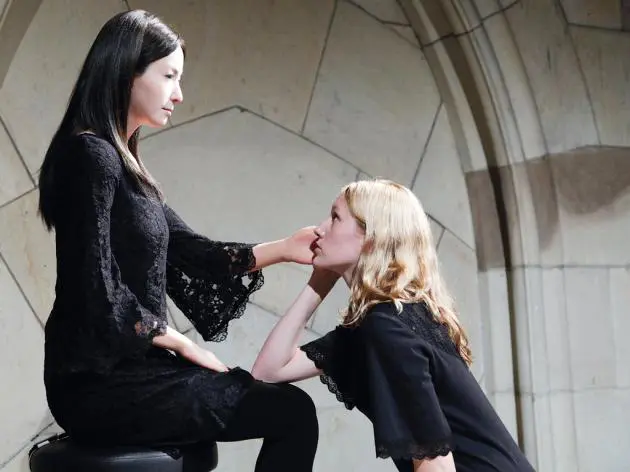


Poignant moments abound when a machine says 'Sayonara'
The Japan Foundation, which last month brought the drumming twin brothers of AUN to Thailand, has another fascinating duo coming to Bangkok this week – two inventive university professors, accompanied by their robot.
Hiroshi Ishiguro built the humanoid named Geminoid F and Oriza Hirata has made him a star of the stage with the play “Sayonara”.
Hirata, head of the Seinendan Theatre Company, is world renowned for his “colloquial theatre”, including plays like “Tokyo Notes” and “Citizens of Seoul”.
Ishiguro has been placed among the planet’s “top 100 living geniuses” for his creations, including one machine that looks like him and gives lectures by remote control, the professor’s voice beamed in from overseas.
Introduced by a colleague (a philosopher, interestingly enough), the two experts developed what are simply referred to as “robot plays”.
“I, Worker” had two robots doing the housework until one of them got fed up with the drudgery. “In the Heart of the Forest” saw robots and humans together assessing the differences between apes and humans.
“Sayonara” is their third collaboration and the first one using a humanoid – a robot that’s looks like a human. Geminoid F recites poetry in Japanese, French and German to her dying owner, leading to the question of how life and death are perceived differently by people and intelligent machines.
“Sayonara” arrives in Bangkok after performances in Japan, Germany, Italy and France and ahead of shows next year in the US. This week’s show is the Asian premiere outside Japan, and I ask Hirata why not Seoul or Hong Kong instead?
“The week-long workshop I did at Chulalongkorn University in 2003 was one of the most impressive among all of my experiences of holding theatre classes in other countries,” he replies by e-mail.
“We also performed ‘Tokyo Notes’ there in 2006 and since then I’ve longed to work on a cooperative project with Chula. We finally realised it with this new kind of theatre – android-human theatre.”
Hirata adds a timely point.
“Many Japanese companies have factories in Thailand, whereas in Japan they cut costs by using robots. Regardless of whether this is a good thing for humans, I don’t think we’ll be able to stop the trend of robots taking over our workload. We artists should think about how humans will behave when that happens.”
Hirata wanted to adjust the script to better suit Thai ears, so the Japan Foundation hosted a translation contest last summer. The winner – Rangsiman Kitchaicharoen, a member of the Naked Masks theatre group who’s studying communication arts – even managed to translate the poetry with only slight changes to the words and phrasing.
“I think a drama becomes mankind’s common heritage once the writing is completed,” Hirata says, “so I usually don’t mind how it’s adapted or directed. ‘Tokyo Notes’ becomes ‘Seoul Notes’ in South Korea, for example.”
I warn him that Thai youngsters might think “android-human theatre” involves smart phones that run on the Android operating system. “These things happen,” he laughs.
Next up for Hirata is a variant on the Chekhov classic “Three Sisters” – with a humanoid playing one of them.
Acting with |an android
If someone tells a professional actor he’s acting like a robot, it’s not a compliment. What if an actual robot is sharing the stage and is told the same thing? I ask Geminoid F but she declines to answer.
Instead, Bryerly Long of the Seinendan Theatre – who plays opposite the robot star of “Sayonara” in Japan – is fielding the questions.
She says she prepared for the role just the same as any other. It’s not like it’s a one-actor play, she points out, since another actress is backstage providing Geminoid’s voice and controlling the motion.
“But you don’t get the same kind of support onstage as you would from human actors,” Long says. “There are times, for example, when the robot has a technical glitch and just stops. That can be quite surprising in the beginning because a human actor doesn’t stop if he forgets a line.”
Long’s trick is to regard Geminoid as a doll that requires her imagination to come alive. And it helps that the play is about loneliness, “so I can develop that from the lack of reaction as well”.
Busy week
“Sayonara” – part of World Performances @ Drama Chula – runs from Thursday to Sunday at the Sodsai Pantoomkomol Centre for Dramatic Arts. The dialogue is in Thai and Japanese with English surtitles.
There is no admission charge. Tickets to reserve seats are available at the CU Book Centre on Siam Square or via (081) 559 7252.
Hirata will also conduct free morning playwriting workshops. Apply at [email protected].
Hirata and Ishiguro will give a lecture on “Man & Machine: A Future of Arts & Sciences” on Friday at 1pm in Chula’s engineering building.
Get more details on the “Drama Arts Chula” and “JF Bangkok” Facebook pages.
