
Investing in the future by recycling the past


Play
Two new 'green' library projects in the Bangkok area showcase the possibilities for eco-friendly spaces
With natural resources continuing to dry up and energy costs rising, cities the world over are looking to “greener” forms of construction for homes and public facilities. Thailand is no exception and many of Bangkok’s architects and designers are studying ways to come up with buildings that minimise the environmental impact.
In June last year, HSBC Thailand finalised its collaboration with the Bangkok Metropolitan Administra- tion and other leading businesses that saw the transformation of an old vacant building in Lat Krabang area into a “Green Library”.
Located in HM the Queen’s 60th Birthday Park in Romklao, a community that’s home to 9,000 families and 16 schools, the makeover was done according to Leadership in Energy and Environmental Design (LEED) guidelines issued by the US Green Building Council and aims to promote energy-efficient building.
“We wanted to build a green library in Thailand and we were aiming to be Asia’s first public library accredited with a LEED Platinum Certificate, which is the highest level of the green building standard,” says Tummarut Piemsirimongkol, vice president, Administration, Procurement & Corporate Real Estate, HSBC Thailand. “That meant saving as much energy as possible both in the construction and interior design. The end result is that our library is using only 62 per cent of the electricity consumed before and we have been able to reduce water consumption by 45 per cent.”
The 400-square-metre library, which is surrounded by an attractively planted courtyard, is divided into three zones. The reading room is well stocked with about 1,000 books of different genres as well as magazines for students and adults and also features a computer corner.
Next door is a kid’s room, where families can enjoy cartoons, picture books and educational toys and the occasional documentary. Many visitors, though, are drawn to the green exhibition made from recycled particleboard, which explains how the building conserves energy.
Thermal insulation has been installed in the roof and the walls are coated with heat-resistant paint. The double-glazed windows are adapted from old louvers, which reduce the heat. To save more money, the library generates some electricity through recycled solar panels and automatic light sensor switch lights and appliances on and off both inside and outside the building.
Much of the furniture is made of recycled materials and sanitary ware for men is water-efficient, while guttering on roof stores then sends rainwater to an underground water tank for use in the courtyard.
“We tried to reduce waste during construction. We turned scraps of woods and louvers into windows and our bookshelves are made from rice straw. The air conditions are controlled by body heat,” says Tummarut.
Since opening a year ago, the library has drawn a little over 25,000 people.
Over in the Lad Yao area of Chatuchak district, Kasetsart University’s Eco Library is also proving popular with students and neighbourhood bookworms. Opened in January, it’s designed by Assistant Professor Dr Singh Intrachooto, who operates the Creative Centre for Eco Design and Scrap Lab.
The university has turned an unused 300sqm storeroom of the main library into a free-access reading space. The decor is strictly minimal and all the furniture is made from cast-offs or scraps donated by factories.
“We want to promote reading both among students and local residents around this area while at the same giving visitors ideas of what can be done to conserve the environment and save energy. Everything here is made from of recycled materials,” says Aree Thunkijjanukij, director of the office of university library.
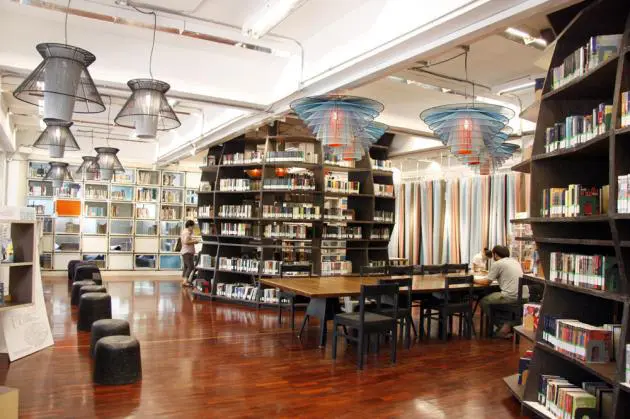
And indeed there’s no resemblance to an old-fashioned school library. The space looks more like a lively playground with sleek wooden walls adapted from old library catalogue drawers decorated with signboards made from leftover iron.
The library is divided into three zones. The common reading space, dubbed the “tree of knowledge”, is stacked with bookshelves fashioned from odd bits of wood donated by Modernform. These old about 3,000 novels, literature for adolescents, short stories, religious books, general knowledge titles and books about energy and the environment.
Colourful patchwork curtains made from remnants from Natural Niche and named “the waterfall of intelligence” come with plenty of pockets to hold educational pamphlets.
The comfy purple sofas were once the staff uniform of the Siam Commercial Bank, the black stools were fashioned from old rubber while the coffee tables have been adapted from advertising light boxes.
To jazz up the ceilings, Singh has used energy-saving light bulbs and beautiful lamps woven from leftover threads. The Kid’s Playspace is adorned with a selection of comfy star-shaped beanbags and the little ones will be happy lounging around reading fairy tales, cartoons, textbooks and eBooks on natural disasters and ecology.
The last stop is the Alumni Space, furnished with wooden tables and old chairs with tops made from leftover buttons, where new graduates can come to search for information about education and applications.
“We want to promote a library as a hangout for public. We have no textbooks on the shelves. Instead we provide creative titles to stimulate the mind,” says Aree.
ECO-CHILLING FOR THE MIND
>> The Green Library is in HM the Queen’s 60th Birthday Park in Lat Krabang district. Admission is free. It’s open daily except Monday from 10 to 6. Find out more at (02) 543 9187 and the GreenLibraryBKK page onFacebook.
>> The Eco Library is at Kasetsart University on Phaholyothin Road. Admission is free. It’s open from 8 to 8 on weekdays and 11 to 7 on weekends. Call (02) 942 8616, extension 126-7, or visit the KUEcoLibrary Facebook page.
