
THE ACCIDENTALLY ELUSIVE KHAN


He's not hard to find, but Pichet Klunchun and the entire USA missed him
Akram Khan recently made dance-world headlines for an unenviable reason. America’s official Olympic broadcaster chose to show an interview with swimmer Michael Phelps during Khan’s performance in the opening ceremony.
Fortunately the rest of the world got to see the British choreographer of Bangladeshi descent in Danny Boyle’s extravaganza, paying tribute to the victims of London’s 7/7 bombing. The piece was viscerally soulful.
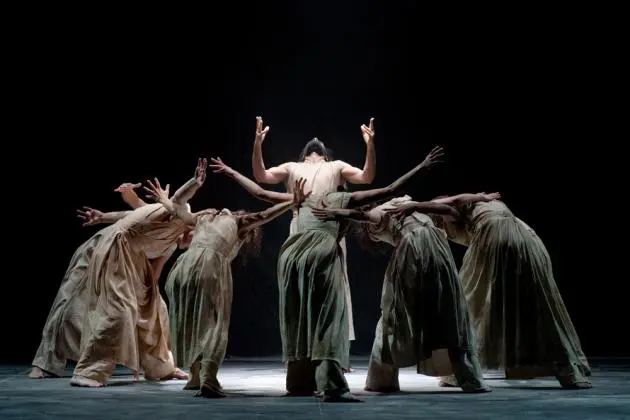
And we also got to see Khan present his new work “Vertical Road” at the recent Singapore Arts Festival.
“Vertical Road” was inspired by a poem by the Persian philosopher Rumi. “Next time I shall die, bringing forth wings and feathers like angels,” one passage goes. “After that, soaring higher than angels – what you cannot imagine, I shall be that.”
And the 70-minute piece did indeed take viewers on a journey to the inner world of the spiritual, inexplicable and rarely explored. Khan’s energetic and graceful choreography, fronted by Persian dancer Salah El Brogy, blended smoothly with the music of his long-time collaborator Nitin Sawhney on a set designed by Kimie Nakano and Jesper Kongshaug.
The UK Critics Circle gave it an award for the “best modern choreography” of 2011.
Khan also took part in the Esplanade’s ConversAsians programme, conducting two master classes for local dancers and choreographers. He described the creative process behind two very different recent works, “Gnosis” and “Desh”.
During a separate public talk, Khan revealed that, as a youngster, he was a fan of Michael Jackson’s “Thriller” and was so hyperactive that his mother signed him up for lessons in kathak, the traditional Indian dance. He eventually abandoned kathak, he said, because he wanted to be himself, not his guru.
And the credit for his own success, Khan stressed, belongs to his long-time producer, Farooq Chaudhry.
Khan recounted the curious incident that inspired “Vertical Road”. After a performance in Sydney he was waiting for a taxi to his hotel, but a pair of locals cut in front of him and hopped in the cab. One of them rolled down the window and asked, “Are you Akram Khan?” There was no apology, though.
Finally in a taxi, Khan phoned his father in England, and the driver realised who his passenger was. He turned out to be a long-lost childhood friend of Khan’s dad from a remote village in Bangladesh! Returning to Sydney a year later, Khan brought along his father to reunite the two old friends.
Over lunch in Singapore, Khan told me his interest in theatre began when he was a teenager and joined the cast of Peter Brook’s “The Mahabharata”. Khan’s company, I recalled, was set to perform at the Thailand Cultural Centre four years ago but the show was cancelled due to the death of Her Royal Highness Princess Galyani Vadhana.
We also talked about a match-up that many producers have been trying to make – Khan and Pichet Klunchun.
Both have strong backgrounds in rigid classical dance and both discovered artistic freedom in modern dance while at university. Both create modern works. Both love asking questions.
Khan has collaborated to critical acclaim with artists of various backgrounds, like Sylvie Guillem, Sidi Larbi Cherkaoui and Juliette Binoche. Pichet’s dance dialogue with Jerome Bel has been a global phenomenon.
They’ve seen each other’s work too, performed at the same festivals in Europe, and even been in the same room. They just can’t seem to get talking. “Someone says, ‘Pichet’s here!’” Khan laughs. “But every time I look around he’s disappeared!”
Sounds like a mission for the British Council in Bangkok.
Keep track of Khan at www.AkramKhanCom-pany.net.
Singapore’s National Arts Council supported the writer’s trip.
