
The sensual and the spiritual


Play
Orissa Dance Company takes Bangkok audiences on a wondrous journey
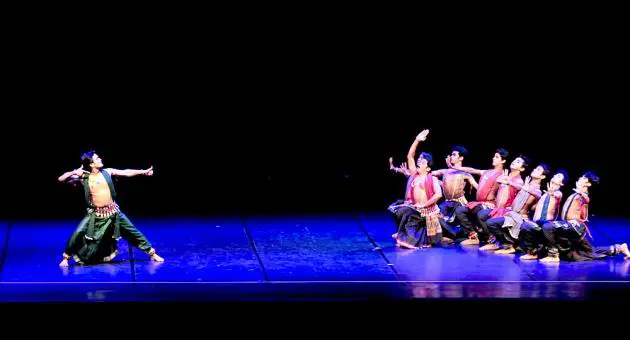
Wedged between an electrifying street dance show and three consecutive contemporary dance productions on this year’s Bangkok International Festival of Dance and Music programme, India’s Orissa Dance Company’s performance on Monday night was a delightful retreat from the chaotic modern world.
Founded in 1975 by Guru Gangadhar Pradhan, the Orissa Dance Company has long been involved in the promotion and teaching of the classical Indian Odissi dance, music and related art forms, aiming to popularise and propagate these traditions both at home and abroad.
Odissi is the oldest surviving dance form of India and dates back more than 2,000 years. Second-century temple carvings depicting its poses have been discovered and the dance is also distinguished from seven other classical Indian dance forms by its independent movements of head, chest and pelvis that most closely resemble the postures of temple sculptures.
Unlike other classical Indian forms like kathak or bharatanatyam, odissi presents fewer sharp angles and celebrates the beauty of the curve and fluid movements that ripples through the dancers’ bodies. These sweeps of the upper torso, arms, hands and fingers were executed exquisitely by the performers of the Orissa Dance Company in their rendition of the epic Ramayana.
The original version of Thailand’s Ramakien, this interpretation of the Indian epic traces the journey of Rama, the avatar of Vishnu, from his marriage with Sita and her abduction in the woods to the fight with the demon king Ravana to bring her back and restore peace to the world.
Unlike khon performances of the Ramakien, this show didn’t select just an episode, but went through a series of events with the focus on different rasas, the essential mental state fundamental to classical Indian performing arts.
For example, the scene where Rama and Sita first met was the embodiment of sringana rasa (joys of love), while veera rasa (chivalry) through Rama managing to lift and break the heavy bow to prove his worthiness for Sita. In the fighting scenes, bibhatsa and rudhra rasas, disgust and wrath respectively, were dominant.
Facial expressions are vital for conveying these mental dispositions, so while dominant emotional themes might already be clear from the actions of each scene, the rasas would still not be achievable in a dance form like khon in which masks are worn.
The performers were thrilling both as dancers and actors. Their bodies moved in a mesmerising flow with strong leaps and staccato footwork that often brought flamenco dance to mind and was intensified by the bells attached to the dancers’ ankles. There was also a lovely variety in the choreography, ranging from voluptuous duets to powerful group dances and long lines of hypnotic body waves.
The live odissi music, too, was breathtaking and soothing, with woodwind instruments, percussion and skilful singing making rich, lyrical sounds.
The company has successfully revitalised the most ancient of Indian dances and joyously performed it for the contemporary audience with a slightly modern touch against a dark backdrop that was simply yet effectively lit.
The show was also short and sweet, lasting just an hour. It takes talent to end a performance just when the audience’s pleasure is at its peak, without allowing any chance for a beautiful yet limited traditional dance vocabulary to become repetitive.
On their toes
Up next at the festival is “Four Seasons”, a contemporary dance performance featuring Vivaldi’s musical masterpiece, by Italy’s Spellbound Dance Company. It’s being staged this Sunday at 7.30 at the Thailand Cultural Centre.
Tickets cost from Bt600 to Bt2,000 at www.ThaiTicketMajor.com.
Find out more at www.BangkokFestivals.com
