
A mind for movement


Play
Asian dance is one of the dominant traits of the world's most famous dance festival
The words “Only Lyon” immediately caught my eye as I arrived at Lyon airport two weeks ago on my second trip to France’s second city. The first was 12 years ago when I watched Taiwan’s Cloud Gate Dance Theatre perform “Songs of the Wonderers”, Patravadi Theatre’s “Ramayana: Sahasadecha Episode” and much more during the 10th Biennale de la Danse à Lyon.
Eighteen performances later at the 15th Biennale, “diversity” is the word that comes to mind as I realise that dance today has many more possibilities than I had ever imagined. I talk to Dominique Hervieu, artistic director of both the Biennale and the Maison de la Danse. If her name sounds familiar, that’s because she thrilled Bangkok audiences with “La Bossa Fataka de Rameau” a few years back at the Thailand Cultural Centre as part of La Fête.
Speaking of her two administrative positions, Hervieu says, “In France, I’m the only one assigned to do this right now. It was the same for the former artistic director of the Maison de la Danse and founder of the Biennale de la Danse à Lyon, Guy Darmet, who did this for almost 30 years.
“With choreographic culture, daily interaction with the audience – both adults and children – and NumeriDanse [the online video database of dance performance excerpts], I can really build works for the audience at the Maison de la Danse.”
Hervieu reveals that while the Maison de la Danse, the most active theatre in the region presenting about 50 productions to 150,000 audience members annually, can financially support itself through ticket sales and subscriptions, the Biennale de la Danse à Lyon is subsidised by the city as well as the regional and central governments.
“In Lyon, dance is an exception, like theatre in Avignon and cinema in Cannes,” she explains.
“The Biennale is a major event. I decided to make it shorter so that it has festive rhythm – audiences have to keep in mind that it’s only 18 days and so they have to rush. Also, the performances in the Biennale are more of a surprise for them, I think. At the Maison de la Danse, I can present work by [cutting-edge French dancer and choreographer] Olivier Dubois, for example, but not so often as in the Biennale.”
Describing how she puts the programme together, she says, “I discuss with the artists two years before and so even as we speak, I’m planning the next Biennale. And in our discussions, either an idea or a direction emerges. For example, among this year’s programming traits are ‘storytelling’ and ‘Asia’.
“When I started to put the Biennale’s programme together, many French artists told me that they were interested in storytelling: Anjelin Preljocaj had adapted a novella by Laurent Mauvignier and Rachid Ouramdane was working with a woman writer. This is not completely new – it happened before in the 1980s – but in France nowadays we have very austere and strict dance, with no stories or emotions. I think it’s important to offer the audience this re-entry into storytelling.”
Hervieu draws a link between the two traits. “Storytelling is an important part of Asian dance, especially Balinese dance. And their presence here at the Biennale also gives a nice contrast to French dance.
“Antonin Artaud watched Balinese dance in 1931 and wrote a seminal book ‘Le Théâtre et son Double’ [‘Theatre and Its Double’], which has influenced dance and theatre artists worldwide. He noted that while in Paris, our dance was very traditional and bourgeois, Balinese dance was very new and spiritual.
“The programming [for Asian dance] began with Bali then I added works by [Japanese dancer and choreographer] Kaori Ito and [artistic director of globe-trotting butoh company Sankai Juku] Ushio Amagatsu, and so on, which I also love.
“What I like and what French choreographers sadly don’t do anymore, is that Asian choreographers invent dance language.
“For French choreographers, there are no more roots – everything is possible. Some come from visual arts, others circus and theatre. Many choreographers have not practised classical ballet, only contemporary dance and improvisation. It’s good that it can be so open, giving the audience various kinds of experiences. But it’s not always good – sometimes they don’t go deep enough in their research with the result that their performances are like works-in-progress. We worked like this from the 1990s to the mid-2000s and it’s been useful but I hope it’s the end of that now because audiences are exhausted with this kind of situation.
“I’m also presenting something very different in ‘Japanese Delight’ with three Japanese hip-hip companies. Amagatsu told me some of his dancers are hip-hop dancers too. This is what’s happening now – a hip-hop dancer we see onstage today can be in Amagatsu’s [butoh performance] the evening before. This is not the case for French dancers. I think if we can be a little more flexible, it would be better.”
Surprisingly, the biannual dance festival also features works that can be clearly categorised as theatre – like Groupe Rictus’ “Romeo and Juliet” and Antoine Defoort and Halory Goerger’s “Germinal”.
Hervieu explains, “There is no line between dance and theatre. For me, this question of disciplines is over. I think dance is mature enough to invite others. For many years, the Avignon and Edinburgh Festivals have been inviting dance. I am a programmer of dance and so I’m now inviting theatre. You simply can’t limit yourself to one aesthetic: it’s boring and your artistic world would be very narrow. It’s more interesting to have this kind of dynamics.”
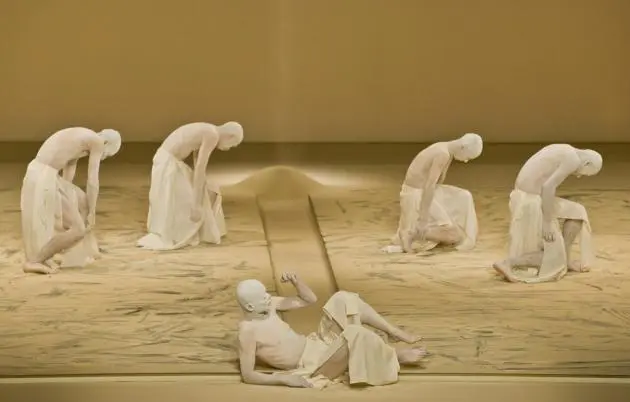
Another new addition to the festival is the Fabrique des Oeuvres in which eight artistic teams are invited to finish their last phases of their productions, among them Sankai Juku’s “Umusuna” in residency with theatres in the Lyon area, and thus create “made-in- Lyon” works.
“This involves a great deal of money, time and effort. I was afraid at first but in the end it went very well. [For the next Biennale] I’d like to do more than eight – maybe 14.”
Hervieu is working on the programme of the next Biennale now but refuses to reveal any hint of who might be performing. “I’ll call you,” she promises.
Not so secret is that she’d like to programme more dance on the streets. “I did two this year,” she says, “One was the opening show with 40 dancers on an outdoor stage at the Place Bellecour [the city’s largest square]. It was like a rock concert ambience, with a crowd of more than 10,000. The other featured extracts of Balinese dance and was free to all comers. Seeing people come from the market to watch it was like a dream.”
The writer’s trip was supported by the French Embassy in Thailand, Institut Française and Biennale de la Danse a Lyon.
Join the dance
_ The 15th Biennale de la Danse à Lyon” ends tomorrow and the next will take place in September 2014.
_ For more information, visit www.BiennaledelaDanse.com.
_ Lyon is two hours by TGV from Paris. It is also possible to fly there from Bangkok via Frankfurt, Munich, Zurich and other major European cities.
