
Butterfly's singing angel
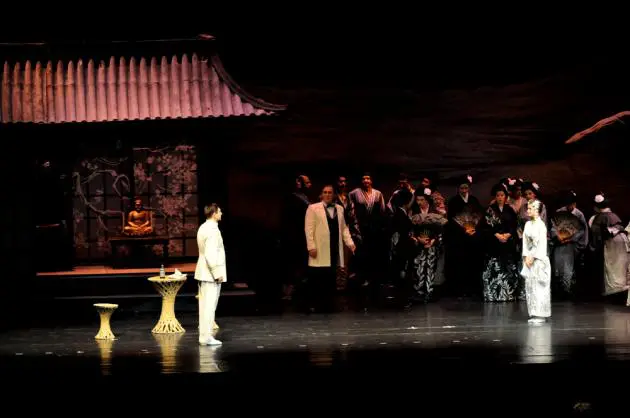


Chelyabinsk State Symphony Orchestra's production fails to lift off
Russia’s Chelyabinsk State Symphony Orchestra capped off a classical weekend at Bangkok’s 14th International Festival of Dance and Music with Puccini’s “Madame Butterfly”, offering the audience some innovation in its staging.
Cio-Cio-San, performed by the young, slim and charming Christina Sushkova, didn’t sing, but only mimed her movements and showed facial expressions. The powerful and more senior soprano Yelena Rotkina, portraying the Angel and always standing nearby with her white-painted face and angelic wings, sang marvellously for her.
It’s debatable whether this trick worked. It’s true that the fragile-looking Cio-Cio-San made her victim-of-true-love character more credible for the audience. However, the fact that she was surrounded by other performers, playing American and Japanese characters, who did sing, emphasised the dated stereotypes of the masculine West and the feminine East, and resulted in Cio-Cio-San looking like a puppet who was always being manipulated. At first, I thought Sushkova was a dancer in Chelyabinsk Ballet Company and only later discovered that she’s a bona fide opera singer. Knowing the libretto by heart, she may have been wondering when she would be allowed to sing, without the Angel.
Other than that, it was a straightforward traditional staging of the classic. The set design with painted backdrop and Cio-Cio-San’s house in the 19th-century Nagasaki showed commendable attempts at recreating Japanese scenery, though looking carefully at some specific details, the word “pan-Asian” tended to come to mind. Prince Yamadori’s palanquin was either too small or had been damaged by Suvarnabhumi Airport’s ground services staff. Some costume design choices were odd – like that of the Bonze which made him look like a character in the film “Three Kingdoms”, across the East China Sea.
The cast had a good balance of singing and acting. The singing prowess of baritone Sergey Gordeyev and mezzo-soprano Marina Novokreschevona, as Sharpless and Suzuki respectively, occasionally stole the limelight from tenor Dmitry Polpokin’s Pinkerton. Another tenor Sergey Sidorov, as Goro, seemed to have worked a little too hard on his hand gestures – and I’ve never met any Japanese who use that many gestures.
It should also be noted that this was not the first time we’ve seen “Madame Butterfly” in recent years – it’s not the first time the Bangkok’s International Festival of Dance and Music has presented it either.
Last Saturday, the Thailand Cultural Centre was more packed than on the festival’s opening night, and far busier than at any of the contemporary dance the previous week, so chances are that next year we’ll get to see more of the same opera classics and fewer contemporary dance performances.
There’s nothing wrong with enjoying what we’re familiar with again and again – that’s why Thais gets to watch eight versions of “Khu Kam”, “Mae Nak” and “Ban Sai Thong” in one lifetime. However, we should never forget that there are more contemporary, and more controversial, staging of classical operas being performed every evening in cultural capitals all over the world that could provoke our thoughts even more.
There are also many modern and contemporary operas that opera lovers are watching everywhere but here and this festival has not yet presented in the past 14 years. Surely we don’t want to always be lagging a few decades behind.
MORE TO SEE
- Tomorrow night, the Chelyabinsk State Symphony Orchestra accompanies the screening of the BBC documentary “Planet Earth Live”.
- On October 12, it’s an absolute must-see – the Lim
