
The incredible lightness of simplicity


Play
Japanese minimalist brand Muji draws on the lessons learned from the twin disasters of 2011 to design a range of items that use less material
The anguished aftermath of last year’s Japanese earthquake and tsunami has prompted Japanese minimalist lifestyle brand Muji to think more deeply about design impacts, particularly in the way we use energy.
Whole towns were wiped out by the disaster and the sea of debris left behind highlighted the modern world’s obsession with consuming to excess, something that actually goes against traditional Japanese culture. An old Japanese saying “Hara hachi bunme” instructs people to eat until they are eight out of 10 parts full. It’s sensible advice: eating moderately or stopping before we feel totally stuffed is good for the health. Determined to show that excessive consumption can be avoided without excessive self-control, Muji set up the project “Product Fitness 80” to point out that by reducing other measures from 100 per cent to 80, we can enjoy a balanced and healthy life.
The practical presentation is a travelling exhibition also named “Product Fitness 80”, which showcases a selection of more than 30 everyday products that use only 80 per cent of materials and energy for production without diminishing their functionality, yet reduce waste by 20 per cent. On display until October 22 at Central Chidlom’s Event Hall, most of the products can either be made smaller, thinner, narrower or lighter with sustainable and renewable materials.
“After the quake, the time came to reconsider the right fitness – the sizes of what we use. Thais may share the same experiences after last year’s flooding. What’s the right and sustainable way? Returning to what’s right is not about resisting but about gaining a healthier state of mind. We shouldn’t consider that 100 per cent is full satisfaction but excess. An average of 80 per cent is just right balance,” says product designer Naoto Fukasawa, who achieved widespread recognition with his groundbreaking wall-mounted CD player, designed for Muji in 1999.
While the minimalist approach is the brand’s philosophy, Muji has strongly felt the need to renew its determination to pursue craftsmanship in harmony with society and the earth since the disaster.
“We constantly question if we have used excess materials; whether products are over packaged, if their size is too large or they weigh too much. We ask ourselves if can we reduce waste in the ordering, manufacturing or transportation of products,” he adds.
At the exhibition, Muji asks questions about even the most trivial of matters. Less is more is at the core of the design concept. Cotton buds don’t have to be of the conventional length, but come with a reduced stem. And by narrowing the width of a toilet paper roll, resources are saved without loss of efficiency and packaging costs are also reduced.
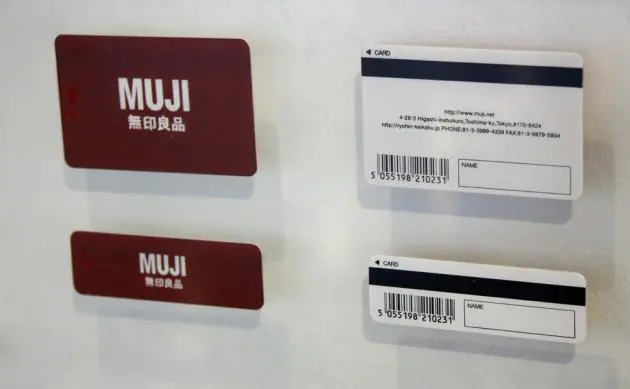
New plastic cards – of the credit card sort - come with the same length as the conventional size cards but are half the width, allowing for the magnetic strip and signature bar on the back, a logo on the front and little else. A tape dispenser is narrower but still perfect for fixing something into place. Spiral notebooks made from recycled paper have wider gaps in order to reduce the wire used.
In the kitchen, a single pan lid has multiple uses and fits five different sized pans, preventing clutter when kitchen space is at a premium. Large refrigerators consume electricity regardless of whether they are empty or full. Smaller fridges are not only designed to conserve energy, but may also encourage you to buy less and reduce food waste.
Muji also looks at repurposing with a bath towel designed in a square-panelled pattern. By simply cutting along the lines, you can reuse this worn out bath towel as a bath mat or duster. Because it has been designed to have segments, it will not fray when cut into sections.
Babies grow so fast that clothes become useless very quickly. By sewing Muji’s cotton t-shirt according to the print patterns on the cloth, it can be turned into a baseball ball.
Plenty of attention is paid to sustainable and renewable materials. Solid wood has been shunned in favour of fast-growing bamboo, which is used as the main material for a dining table thanks to its strong, durable and renewable features. Even left over thread can be reborn as comfortable socks with an exquisite balance of multicoloured stripes thanks to the skills and intuition of the producer in knitting and blending various threads.
Rescued cotton is still cotton. Muji has made a dish cloth using the ochiwata (rescued cotton) that comes loose during the process of combing cotton to make thread. Roughly woven without bleaching, the user can enjoy the texture of the material in its original state.
Firm in the belief that raw materials are beautiful in their original state, Muji displays a stationery set made from aluminium with no artificial colours added or polished, a non-coated bent wood chair and a non-coated bicycle that looks trendily old.
Being lightweight and space saving are also important features in Muji’s design. The passionate cook will love a set that’s made up of a one-ring burner, kettle and frying pan that are stored tidily in a stainless steel case while travellers will appreciate the lightweight jacket that uses just 150 grams of nylon material and has a pocket to store essential items.
A semicircular hanger can be used to hang things tidily on walls or poles without slanting to one side or causing clothes to wrinkle and also fits in every room and in every corner. Produced after customers requested a compact washboard to launder undies while travelling, the palm-sized washboard is a must-have for any woman’s bag.
While conventional sofas tend to be delivered in fully assembled form, Muji produces a self-assembly sofa whose back can be stored in the seat. It’s easily transported in a car.
Apart from redesigning products to fit our daily lives, the designer team has travelled around the globe scouting for new materials and new production sites and is always on the lookout for things that can be adapted to the demands of the modern lifestyle while retaining their original essence.
The new concept store Found Muji recently opened in Tokyo’s Aoyama area and houses a collection of remodelled products based on durable everyday objects found across the globe.
“The idea is not to redesign these products, but rather to update them slightly and incorporate them into our contemporary lifestyle. In Cambodia, we found an amazing place that has maintained its traditional cloth dyeing practice. In China, we found a simple bucket and porcelain bowls that have been produced using the same technique for centuries. Just by looking at things around us, many things with value came to our attention,” says Fukasawa.
“To me, a good product should have three vital things - functionality, aesthetics and charisma. Functionality serves as a fundamental component while aesthetics is subjectivity – there is no universal aesthetic. Charisma is a factor that is hard to explain but has compelling attractiveness so we can’t let it go.”
A QUESTION OF AESTHETICS
>> “Muji: Product Fitness 80 Exhibition” continues until October 22 at Central Chidlom’s Event Hall. It’s open daily from 10 to 10. Call (02) 793 7416.
>> Discover more with The Nation’s video at www.NationMultimedia.com and on the “Sunday Leisure The Nation” Facebook page.
