
Don't mention the war
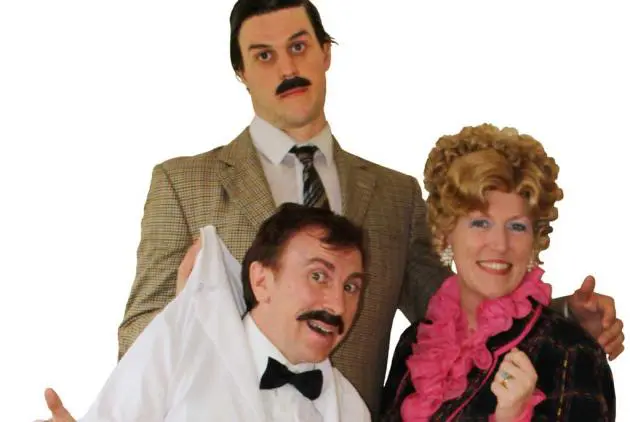


Nothing to worry about, Major. Have dinner at Fawlty Towers - in Bangkok
The best of British comedy, “Faulty Towers the Dining Experience”, is coming to the Anantara Bangkok Riverside Experience for six uproariously funny nights next Wednesday through October 29.
Internationally acclaimed by critics and audiences alike, this madcap dinner show is a loosely scripted, pitch-perfect tribute to the original British sitcom “Fawlty Towers”.
First broadcast in 1975, “Fawlty Towers” took its name from that of a fictional hotel in the seaside town of Torquay on “the English Riviera”. The plots centred around tense, rude and put-upon manager Basil Fawlty – portrayed by John Cleese of “Monty Python” fame, his bossy wife Sybil (Prunella Scales) and the hapless Spanish waiter Manuel (Andrew Sachs).
Each episode revealed their attempts to run the hotel amid farcical situations and an array of demanding and eccentric guests.
In a list drawn up by the British Film Institute in 2000, “Fawlty Towers” was named best British television series of all time.
“Faulty Towers the Dining Experience” – it’s spelled with a “u” instead of a “w” – is performed in restaurants and has been touring the world since 1997. Receiving huge critical and public praise, it has been a constant sell-out ever since it debuted at the Edinburgh Festival in 2008.
We talked to artistic director Alison Pollard-Mansergh and the acting troupe – Karen Hamilton (Sybil), Andy Foreman (Manuel) and Rob Langston (Basil).
How was the show conceived?
Pollard-Mansergh: From 1992-1996 I was part of a corporate-theatre company in New Zealand, and we started doing some “Fawlty Towers”-type nights for corporate functions. When I moved to Australia in 1996 and couldn’t find a theatrical agent quickly, I decided to start doing these nights again in Brisbane.
It was then I met Andy Foreman and we started doing a show. We thought we would do it for about six months, and that was 15 and a half years ago!
What do you guys like most about your characters?
Foreman: Manuel is the character the audience cares for most. He has the most reason to interact closely with them, and because of the confusion from the language barrier can develop and extend many impromptu moments.
Hamilton: Sybil’s style, her voice, and especially her laugh!
Langston: I like Basil’s extremes: One moment he’s fawning over distinguished guests, then he’s dismissive of less distinguished guests’ needs, then he’s berating people.
What’s the most challenging part of performing in this show?
Foreman: Varying the delivery of the lines to still get the laughs. We have to work with the rhythm of the audience more than stage shows.
Hamilton: Always the improvisation. Two-thirds of the show is improvised. We need to live as the characters and react as the characters to a whole gamut of statements from the guests.
Langston: New and different venues can be a challenge. We need to make sure the audience can see us and see what we’re doing. It can be challenging!
Is there a script at all?
Pollard-Mansergh: Yes, there is a script. It started with what I brought over to Australia from New Zealand and has grown from there. It is constantly growing and developing. However, the script is only one-third of the entire show. The rest is improvised, bouncing off the energy provided by the audience.
The show seems to be very engaging. Do you rely much on the audience’s input?
Foreman: The show relies on audience involvement and interaction. Although the audience doesn’t change the scripted storyline they are still part of it, and when we’re roving and visit individual tables, they are the focus of our attention.
Hamilton: We really don’t need the interaction though. If an audience member wants simply to watch, that’s cool. We read that from the audience.
Is the show decent for children?
Foreman: Yes. There are so many comic moments in the show that we don’t need to do anything offensive, either verbally or physically to get laughs.
Hamilton: Oh, yes – children can sometimes be our best players. Just recently, a boy of seven in Ireland quoted me just about every line from the series. Amazing.
Do you adjust the show to different cultural climates?
Pollard-Mansergh: Yes, we do. We love finding the things that work in the different countries we perform in. The core always stays the same, but some cultures react in very different ways to some of the things we do. We even have some specific routines that we only do in certain countries. It’s fun to work out what works best.
ALL YOUR FAWLT
“Faulty Towers the Dining Experience” will be at Brio of Anantara Bangkok Riverside Resort and Spa from October 24 to 29 at 7pm. The performance is in English.
Tickets are Bt3,700 per person. Call (02) 476 0022 extension 1416 or e-mail [email protected].
Learn more about the show at www.FaultyTowers.net.
