
The stage redefined
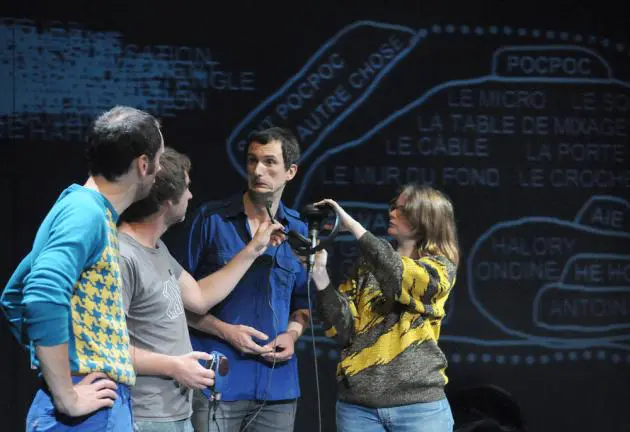


A wacky work by a Belgian troupe questions the very structure of performance
At Les Subsistances, a performing arts centre on the northern bank of the Sane River, home to Antoine Defoort and Halory Goerger’s “Germinal”, audience members are politely asked if they understand French and if, like me, they reply in the negative, they are handed a set of headphones.
The Belgian pair’s contemporary work was created at the centre during their residency there and subsequently presented to the public as part of the 15th Biennale de la danse Lyon last month.
My immediate impression was that lighting designer hadn’t meet his deadline, as the stage lights were flashing on and off without purpose. Like the rest the audience, I quickly realised that it was actually the four actors – Defoort and Goerger in addition to Arnaud Boulogne and Ondine Cloez – who were fumbling with the lighting control boards on the stage. Later, they started their silent dialogue, which we could only understand by reading French surtitles and those who couldn’t read French now started hearing in English through the headphones.
With two actors standing on stage left and the other two on stage right, they played with the two screens of surtitles, which later became four, causing confusion as to who was saying what. It was a peculiar experience but had me asking myself whether when I see a performance or film in a foreign language, I am watching the story unfold on the screen or reading the surtitles/subtitles. It was also a reminder that actors were simply serving the playwrights – that what they were saying on stage were not actually their words.
After the surtitles scene, one of them went backstage and returned with an in-house communication headphone, through which they talked to the stage manager, reminding us this time that she was the true boss calling the cues and running the performance. They then physically dug up the bare stage and when they found a guitar, turned the performance into a musical number, showing how any dialogue or situation can easily be turned into a musical to entertain the audience.
The fun continued as they started to formulate concepts in the hope that these would lead to a legitimate performance. On a backdrop visible to the audience, they gathered words for everything around them, their names included, and tried to categorise these, setting as a criterion the sound it created when knocked by a microphone. A question here is: does one needs to find a concept in order to create a contemporary work?
I thought of the many directors and choreographers who feel obliged to explain their research in the programme booklet to ensure the audience follows their thoughts. Others, meanwhile, refuse to speak when asked by the audience what they’d like to convey in their work instead simply smiling or asking what the audience gets out of it.
A few days after, a press relations officer in Lyon asked me to name my favourite performance. My reply was Defoort’s and when I described the characteristics of the work, she noted that only the Belgians would be able to create a work like that.
These days, as I drive home from work across the Thai-Belgian bridge in Bangkok, I think about “Germinal” and hope we’ll get to experience more Belgian contemporary performance here in Thailand.
It’s also noteworthy that despite the nationality of the artists and the non-dance nature of the performance, “Germinal” was included in the Institut Francaise’s “Dance Focus”. This event allowed presenters, producers, cultural officers and journalists from all over the world to experience new creations in contemporary dance by French artists, as well as professionally connect with them, in one weekend.
The writer’s trip was supported by the French Embassy in Thailand, Institut Francaise and Biennale de la Danse Lyon.
ON THE WEB
www.AmicaleDeProduction.com
