
Tribal Tattoos Works Fashion Magic
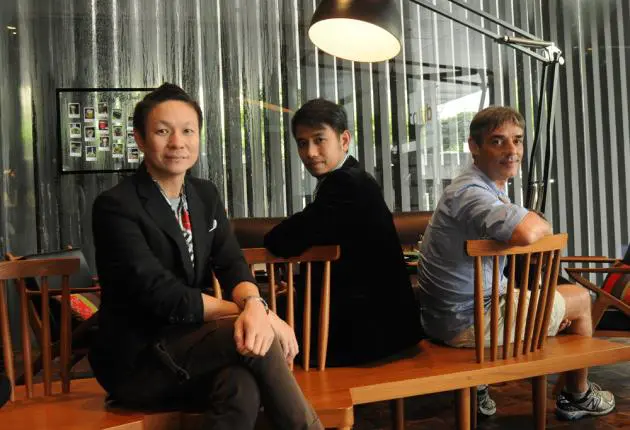


The Tube Gallery taps Chin ink and a Belgian painter’s vibrant colours
Northern Myanmar’s Chin tribe has caught the eye of art and fashion with the tattoos on their faces. Tube Gallery presented the “Chin-unmasked” spring and summer 2013 collection recently at Wrap 54, an art studio of renowned Belgian artist Christian Develter.
Inspired by the latest series of paintings by Develter’s “Chin Urban and Tribal”, Phisit Jongnarangsin and Saksit Pisalasupongs, designers of Tube Gallery, said that if they painted, they’d love to do what Develter does.
The 12-year-old fashion label this season translates the artist’s vision of modern Chin women into fashion. Develter’s art has so much in common with Tube Gallery fashion, especially the use of strong vibrant colours and the interest in Asian and tribal cultures.
“Vice versa, Tube Gallery style would be what I would have done in fashion world as well,” notes Develter. “We met him about last year at his art exhibition in Phuket, and immediately we were so inspired,” adds Phisit.
Develter reveals that he aims to be a mixture between the contemporary and the past featuring the perfect symmetric urban contemporary faces of Asian females painstakingly painted with tribal Chin tattoo designs from Myanmar.
“I spent about three weeks there,” he says. “When you look at the tattoo lines, it seems like they’ve been done by computer, but they’re not. The original is very old generation, and when we translate it to art and then fashion, it is very interesting.”
The Chin and their tattoos are relatively unknown to the outside world. These paintings are an open invitation to learn more about these remarkable women living in Chin and Rakhine states of Myanmar. “I don’t want the look to be too ethnic, so I paint on modern women’s faces,” Develter points out.
However, instead of simply applying the Chin paintings directly on their designs, the duo of designers add their own vision of beauty and art in stunning looks, in particular when unmasking the spider webs in the face tattoos. “You will see a strong graphic that creates an immediate impact due to its beautiful structure,” Phisit says.
“We played a lot with the paintings. We started from taking the tattoo off the lady’s face in the painting. The result was a very interesting, avant-garde mask, which not many people could have guessed that it came from a face of a woman in Myanmar. Then, we multiplied the mask on a computer program to create a modern graphic pattern. The outcome was a modern yet beautiful graphic that we were not expecting,” says Phisit.
“Then we were thinking what else has such an amazing structure – the butterfly, of course,” says Saksit. “The beauty of the black lines on butterflies is very much the same as the tattoo on Chin women’s faces. Also butterflies’ colours are very similar to Develter’s colours,” he continues. “We use lots of different types of butterflies, twisting and turning on the fabric.”
In term of colours and fabric, Pisith points out that the colour stripes are inspired by Chin woven fabrics, yet the original textile cannot be used in high fashion. The painting has been printed on silk and sequinned material, while the colours dominating this collection are Lime Green, Ocean Blue, Yellow, Purple, Red and Black. “For the silhouette we prefer a classic clean line and modern shapes, since the pattern already has quite an expressive ethnic design,” he adds.
Yet in order to keep the signature of Tube Gallery, Saksit says they used laser cutting on the fabric and acrylic and then hand-stitching to create new dimensions. The overall looks are very impressive, like wearing pieces of art.
OLD TRADITION
- Chin women for generations have been willing to submit themselves to pain and sacrifice in the name of beauty.
- The different tribes in northwestern Myanmar use tattoo marks in a centuries-old tradition to distinguish one hilltribe from another or indicate their martial status and social rank.
- Although forbidden and dis-couraged by the government, this practice lives on deep in the unforgiving hills and jungles of Chin State.
