
Wolfe gobbles up Miami with gusto!


Crazed punctuation abounds in a confluence of multicultural madness
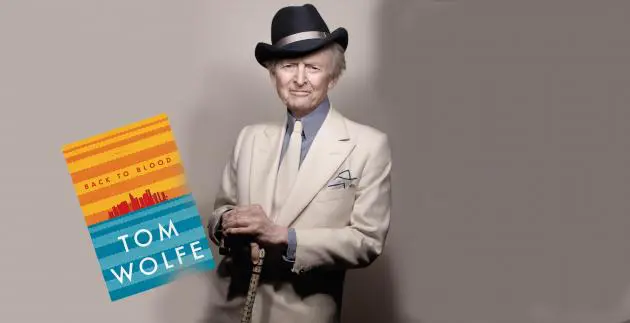
Back to Blood
By Tom Wolfe
Published JOnathan Cape
Available at Amazon.com
Tom Wolfe made his name with four collections of magazine stories published in rapid succession between 1965 and 1970 that chronicled the wild American 1960s in hyperventilated prose replete with ellipses ... italics and exclamation points!! These grandiose stylistic tics of “the New Journalism” have persisted throughout the decades. Wolfe is now 81.
But give him credit for honest, dogged research. His book about the first American astronauts, “The Right Stuff”, took him nearly a decade. He turned to fiction in 1987 with “Bonfire of the Vanities”, a novel about high finance, low crime and racial tensions in New York City. He knows his New York well, having worked for the Herald Tribune throughout the 1960s.
The novel was a commercial and critical success. His second novel, “A Man in Full”, was much less so, elegantly panned by no less than John Updike in the New Yorker. Norman Mailer and John Irving piled on. Unfazed, Wolfe dubbed them “The Three Stooges” and, in an essay entitled “Stalking the Billion Footed Beast”, insisted his kind of street-reporting novel was better than high-toned “literary” ones.
He’s back with a bang in “Back to Blood”. The city this time is Miami, where wealth and power are squabbled over by Cubans, Anglos, African-Americans, Haitians, Russians and more. Half the population is recent immigrants. “Did one segment of them, the Cubans control the city politically?” a WASP newspaper editor muses. “Cuban mayor, Cuban department heads, Cuban cops, Cuban cops, and more Cuban cops, 60 per cent of the force now Cubans, plus 10 per cent other Latins, 18 per cent American blacks, and only 12 per cent Anglo?”
The moral centre of the novel is a Cuban cop named Nestor Camacho. He’s short in stature but such a mass of gym-built muscle that he’s able to climb a 30-metre rope to rescue a Cuban refugee from the top of a schooner’s mast. For this he is pilloried by his family and the entire Cuban community, because the refugee had not yet set foot on American soil to claim legal sanctuary.
Next he subdues a much bigger black crack dealer who was strangling his sergeant, but a videotape of him shouting abuse at the fallen giant goes viral on YouTube, enraging Miami’s black community. Camacho is forced to surrender his badge and gun.
Who is he going to offend next? the Cuban mayor wonders. The Haitians?
Yes, the Haitians. Ghislaine Lantier is a fair-skinned Haitian, a university student, daughter of a French professor. The volunteer social worker was minding children in the crack house when Camacho brought down the dealer. She now asks him for help with her brother, who is getting involved with a Haitian gang in high school.
Meanwhile his girlfriend, Magdalena Otero, a nurse, has left him for her boss, Dr Norman Lewis, a blond Anglo psychiatrist who specialises in porn addiction. He proves to be a sex addict himself and a shameless social climber, who reaches the peak of Miami society when he meets Sergei Korolyov, the handsome Russian oligarch who has donated $70 million of modern Russian art to the Miami museum, causing a grateful city to rename it the Korolyov Museum. Magdalena falls for him and dumps the doctor.
Korolyov doesn’t know it, but Comacho is about to offend the Russian community.
Wolfe’s prose is nothing if not vivid. Here are Magdalena and her mother in an argument about whether she should leave home for an apartment:
“Magdalena was standing up belligerently – her fists on her hips and her elbows winged out – as Mother and Daughter traded hisses and growls and eyetooth glowers, Mother was sitting forward on the couch with her elbows winged out – this seemed to be an instinctive stance of both combatants in their mothers-and-daughters – and the heels of her hands pressed down on the front edge of the frame, a veritable feline, ready to spring, claw, rips guts out, eat livers whole, and bite heads off by sinking both sets of incisors into the soft centres of the temples. Her father, if Magdalena knew anything about it, was possessed by a fervent desire to evaporate.”
Pulsing with passion and ambition, Miami is also infested with all kinds of lowlife, but the good guys in this novel are Comacho, the big black police chief Cyrus Booker and the little Anglo newspaper reporter John Smith. They are all forced into stark moral choices between material advancement and their own sense of manhood.
Wolfe’s stylistic tics can become boring and repetitious. He has introduced a new form of punctuation as well – :::::: – a pair of which brackets his characters’ inner thoughts. But his sense of the city turns this novel into a sweeping epic. A Marine Police speedboat, a multiple-yacht orgy, a Cuban bakery, a family pig roast, a crack house, a Russian nightclub, a ritzy art show, a Jewish nursing home – all fit into Wolfe’s breathless orbit and the reader is grateful to be taken for the ride.
