
Sweet treats with a Japanese touch


Play
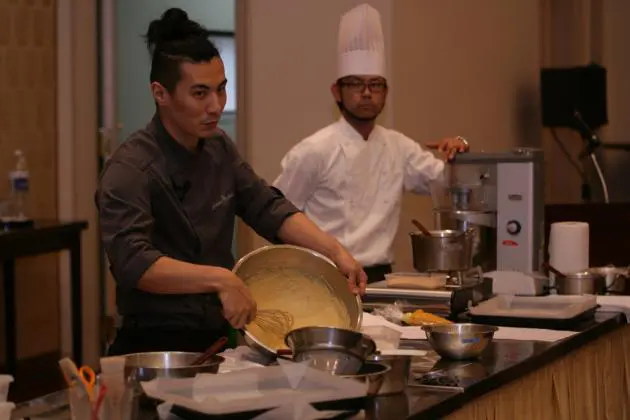
Morihide Yoshida, plays with western confectionery to create his own delicious desserts
The rich aroma of melting sugar fills the comfortable meeting room in the residence of the Japanese ambassador to Bangkok making tummies growl loudly as Morihide Yoshida, Japanese pastry chef extraordinaire and a winner of numerous awards, demonstrates his skills in front of a small group of expectant reporters.
We look at the list of ingredients for the three pastries printed on the four-page handout, realising simultaneously that no matter how clear his instructions, none of us here will ever be able to replicate any of these delicious desserts.
In Japan, a meal is prepared with such artistry that the mere sight of it is mouth-watering. Yoshida’s sweet treats are no different – masterpieces in design as much as in delicacy.
While the Japanese culture of cake making has been mostly learned from the west, the Japanese people have introduced their own twists, adding local ingredients that add a distinctive and special taste.
“The cakes look very western but they are geared toward a Japanese palate,” Yoshida says.
Taking the right amount time to mix the ingredients is important, he adds. “Even if we delay for a second or two, specially during pasteurisation, the taste of the cake is sure to be different,” Yoshida points out.
Japan’s food culture today is far more westernised than in the past, he notes. “It is interesting to see people bringing different food cultures back to our native land. Personally, I’ve found that learning about different food cultures helps me in creating my own specialities.”
Yoshida graduated from the Japan confectionery school Nippon Kashi Senmon Gakko before heading to France to further his studies at the Ecole Nationale Superieure de la Patisserie Yssingeaux.
He returned to Japan to work at the Park Hyatt Hotel, Tokyo and opened his own shop, Patisserie Naturelle Nature & Co in 2005. His cakes have been recognised with the Second Grand Prix in Andre Lecomte competition (2005) and he also won the Grand Prix on “TV Champion 2 Pastry Chef” in both 2006 and 2007.
He greatly admires the French food culture and laments the fact that it is difficult for a chef to create anything new there. “The French consider their food is the best and tend to conserve it,” he says.
Japanese cuisine is world-renowned for its preparation methods and unique and refined presentation. Unlike many other types of Asian cuisine, Japanese do not rely on herbs and spice blends to season their dishes. Each ingredient is carefully selected and kept in harmony with its own individual flavour.
Practically unknown to western culture until the 1970s, food, and even the physical act of eating, differ significantly. The Japanese believe in keeping balance and harmony in nature.
This is the reason many Japanese foods are eaten raw.
The long Japanese life expectancy is believed to be the result of eating habits but Yoshida isn’t convinced. “It’s true to some extent,” he says, “but medical facilities in Japan are also very good and that is another part of the reason.”
