
The wider world ahead


Thai architecture students show they're ready for the Asean challenge
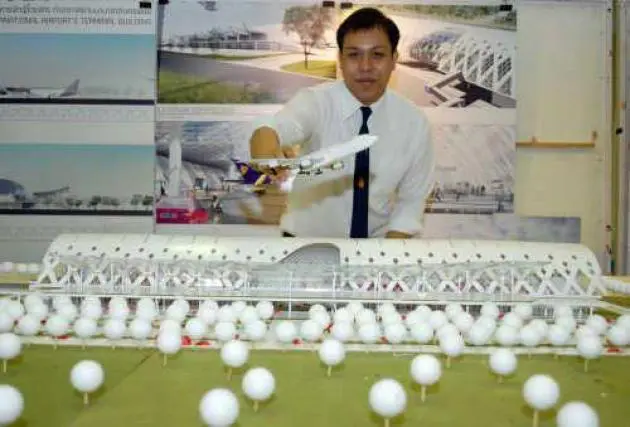
Imagine tourists arriving in Thailand at a “woven” airport terminal, ornate as an Isaan fabric. Picture a Southeast Asian institute of cuisine housed in a building that looks like it’s wrapped in banana leaves.
Senior architecture students at King Mongkut’s Institute of Technology (KMIT) Lat Krabang unveiled these and other thesis projects on Tuesday, and they really do believe the structures can be built.
Thai architects are gearing up for the Asean Economic Community’s inauguration in 2015, knowing their profession is one of nine designated for “free trade” among the members of the Association of Southeast Asian Nations. The more they know about other cultures in the region, the more successful they’ll be.
“We’re preparing our students,” says Pongsant Suwannachit of the KMIT Architecture Faculty. “We’ve adjusted the curriculum to accommodate more Asean ideas. The programme focuses on new technology in construction and the local wisdom and philosophy of architectural styles across the region, as well as competitiveness in a broader market.”
Rather than conceptual projects, the students are asked to conceive structures that can actually be built. For inspiration they spent four months in the field, visiting projects such as the new Thai-Lao Bridge at Nakhon Panom.
Suteema Srisook realised that the province’s 28-rai domestic airport could easily serve as a gateway to Myanmar, Laos and Vietnam. It would need a flashier passenger terminal, though, so he adapted Isaan textile-weaving techniques into his design. The lattice structure of the dormer roof, based on that of London’s Heathrow Airport, is thus transformed, high technology married to age-old local skills.
Suteema, who loves to travel, reckons that Nakhon Panom Airport could leap from a few domestic fights each day to 48 as an international hub.
Meanwhile Pa-Sathorn Songthawornthawee, who knows all about fishing as a native of coastal Narathiwat, wants to bring the same kind of transformation to Samut Sakhon’s Mahachai fish market, turning it into a regional giant that most tourists would want to see. He envisions a modern 21-rai market that doubles as a learning centre, all visually embellished with symbolic ship masts.
Inspired by the grand fishermen’s markets in Japan and London, Pa-Sathorn conceived a two-storey building next to the pier. While the catch of the day is auctioned off on the ground floor, visitors to the second floor could learn how it’s caught, how the local boats are made, and about the structure and the history of the region. They could even learn how to make a model boat. “From upstairs they could watch the fishermen trading and view the beautiful scenery along the Tha Chin River, where there are hundreds of masts bobbing,” he said.
Wathit Huabcharoen fancies the much-discussed notion of Thailand becoming “the world’s kitchen” – and at least wants to see Bangkok become Southeast Asia’s kitchen.
His Asean Cuisine Institute would occupy 10 rai on Sukhumvit Soi 28, a modern two-storey building whose design was inspired by the cheevajit philosophy of healthy dining, in which the soul is nurtured along with the body – and by the Thai talent for wrapping desserts in banana leaves.
Using only basic geometrical forms – circle, square and triangle – and wood, rough concrete and copper, his institute has an entrance with a double layer of triangular frames resembling the gable of a temple. Further offsetting the modern look are sliding wooden windows demonstrating the traditional raneang woodworking technique.
Wathit has even planned the curriculum, with a four-year course for Southeast Asian students, three months for expatriates and housewives and a quick two days for tourists.
Every long-term visitor from our neighbouring countries could live at Pongpop Nakpongphan’s 35-storey Bangkok Condominium on Phaholyothin Soi 7 (Soi Aree). He’s used a concept called “interlocking in space” to optimise the available area, with big windows and glass partitions everywhere. Sunlight and wind are tapped to save energy costs.
Keen on the nature sciences and especially ecology, Pitcha Ingkatanuvat visited Kasetsart University’s Plant Conservation Centre and decided it needs to be bigger and more up to date.
With more than 15,000 new species of plants found and 1,500 new papers written every year, she recognised the need for a massive library – and has cleverly designed it in the shape of a leaf. The vast, mostly digital library is in large part a botanical garden, with thousands of varieties of flora growing directly under the roof.
Outside the building, needless to say, would be a green paradise.
IDEAS ONLINE
See more projects at www.Arch.LMITL.ac.th.
