
Games children play


Play
A guide to age appropriate milestones for infants and toddlers as they travel along the road to where play and childhood development meet
Playing is essential to development of children, contributing to their cognitive, physical, social, and emotional wellbeing. How they play depends largely on their age and the family situation. Here are some general guidelines to help your kids benefit the most from playtime.
By six months of age
By this age children should be rolling from back to front and front to back, can sit without support, and support their legs while standing. They may be on the verge of crawling or rocking on their hands and knees and will begin passing objects from one hand to another. One of the best ways to accomplish these milestones is by playing on the floor every day, often referred to as “tummy time”. Surround children with toys that are in and out of reach encourage infants to grab, reach, kick, and push up their bodies with their arms. Not all children like tummy time at first but keep at it!
By nine months
Constantly engaging your child in talk begins to pay off as children show they understand words like “no”. The more parents engage their children in talk, the quicker language development will occur. Furthermore, children like to explore the concept of cause and effect. As such they love to watch objects fall and look for things they see their parents have hidden. Parents can support this type of play by rolling balls, stacking blocks and knocking them down, and pushing cars
Twelve months
This is a time where playing involves making noise and unfortunately a lot of mess. Banging pots and pans, hitting drums, throwing and kicking balls are all good activities to encourage gross motor skills. Holding crayons and encouraging your child as they draw lines across a page, and stringing large wooden beads are excellent ways to encourage fine motor skills. Kids love to copy their parent’s movements so give them lots of actions to copy! Read books to your child every day as a way to encourage cognitive development regardless of age.
Eighteen months to two years of age
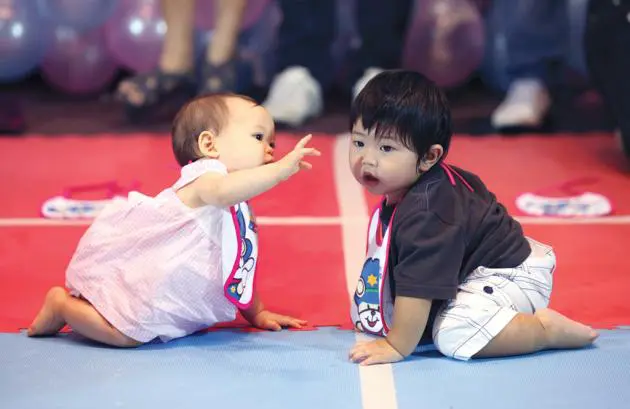
Children at this age still play “next to” other kids as opposed to “with” other kids and getting children to share at this age is difficult. Playing with other children is important to develop socialisation skills but keep expectations realistic. Introduce the concepts of taking turns and monitor toddlers closely for any disagreements. Children at this age are fast, unpredictable, and their coordination is questionable.
It’s important to allow them to be active and explore their surroundings while maintaining safety. Using crayons, introducing age appropriate puzzles, and having a child turn the pages of books are great ways in work on fine motor skills. Around two years of age try to make a game where a toddler participates in getting undressed and dressed so that by the age of three they have it mastered!
Three years of age
They should now be playing “with” other children, are able to follow two step directions, and are more coordinated. Therefore, playing outside is a bit less daunting and all outdoor activities encourage gross motor skill development. Colouring, drawing shapes, cutting with child friendly scissors, and pasting are all great ways to work on fine motor skills. Counting games, matching games, and make-believe play with toys are an ideal ways to work on cognitive development.
Children get bored quickly and aggressive behaviour is normal for toddlers so don’t be horrified when it happens. Instead, strategise ways to minimise child and parental frustration. Plan activities keeping them short, sweet, and varied.
Play things or toys should be engaged for one at a time to reduce distraction. Playtime should be fun but it’s also a time where children discover what appropriate and inappropriate behaviour is. Therefore, set limits, encourage verbal expression of feelings and problem solving, introduce levels of discipline, and praise for good behaviour routinely.
The American Academy of Paediatrics recommends children do not watch any television before the age of two and then only one to two hours of quality programming per day thereafter.
Dr Pikul Arsirawech is a specialist in Developmental and Behavioural Paediatrics at Samitivej Sukhumvit Hospital. For more information, call (02) 711-8236-7 or email [email protected].
