
King of the jungle
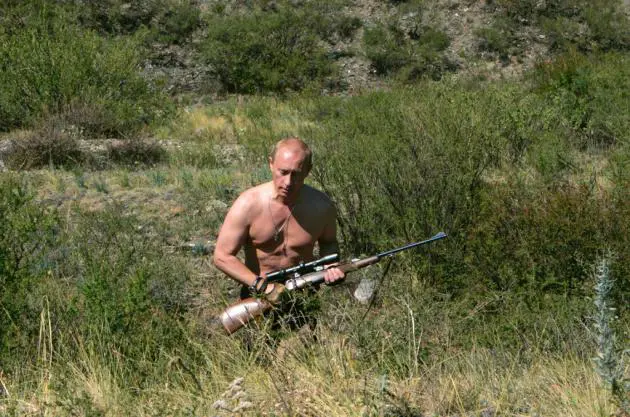


Vladimir Putin's enemies flee or die. National interest is swept aside by one man's mania for absolute control
The pace at which alarming events occur in Vladimir Putin’s Russia hits home when you realise that this chilling profile of the steely president predates the mysterious death of Boris Berezovsky.
One of the so-called billionaire “oligarchs” to emerge from the ideological bankruptcy of the Soviet Union, he had played a major role in bringing Putin to power in 2000. Then they fell out and he fled the country.
His death by hanging in England this past March 23 might have been a suicide. Readers of Russian journalist Masha Gessen’s remarkably brave book, in which Berezovsky appears again and again, might think otherwise.
And readers outside Russia will feel either chastised or vindicated by Gessen’s analysis, depending on how far their opinion of Putin was shaped by early Western press coverage.
Jubilant that Soviet communism had collapsed and the Iron Curtain had melted away, and preoccupied by dramas developing elsewhere, the US-dominated news media decided Putin was a charming if roguish reformer, a commendable ally.
It took more than half a decade, nearly two terms of his presidency, before the terrible truth became plain – that only the word “rogue” applied, and even that was being far too kind. “Thug” is a better fit.
He is, it would seem, the new Stalin – although Gessen doesn’t say as much, preferring to liken his dictatorship to that of Belarusian President Alexander Lukashenko.
Most appalling among Gessen’s many well-founded accusations is that the awful tragedies blamed on Chechen “terrorists” were in fact the work of the FSB, Russia’s secret police, and that Putin, the agency’s former director, at the very least condoned what they were up to.
Chechnya’s fight for independence merely provided a handy way to disguise the Kremlin’s reincarnated totalitarianism in the cloak of the globe-spanning “war on terror”.
These included a string of explosions that demolished inhabited apartment buildings in several cities in 1999, killing nearly 300 people. Russia launched the Second Chechen War in retaliation, but Gessen convincingly claims the bombings were an FSB “false flag” operation to justify that war and elevate then-premier Putin to the presidency.
She says that, although Chechen rebels initiated the 2002 Moscow theatre siege and the 2004 Beslan school hostage debacle, they had “inside” help indicating FSB involvement, only to be wiped out by Russian security forces acting without concern for the loss of hostages’ lives. Putin used to the Beslan massacre as an excuse to change the law so that regional governors would be appointed rather than elected – and come under his direct control.
Sorrow and a seething fury take turns in succeeding chapters as Gessen recounts the Kremlin’s disastrous handling of the 2000 Kursk submarine tragedy and the criminal persecution of oil magnate Mikhail Khodorovsky because he financially supported opposition parties.
Doubt still clouds the strange demise of Alexander Litvinenko in London in 2006, injected with an umbrella tipped with radioactive polonium, but in Gessen’s mind the truth is clear. The British bobbies couldn’t extradite the alleged killer, a former KGB man, because he’d won an MP’s seat and thus immunity.
To her detriment, Gessen wears her bias on her sleeve, thus abdicating her duty as an honest biographer.
She must be criticised for never acknowledging Putin’s popularity, which, even if the survey figures were inflated, soared in his first term, if only because the Russian standard of |living was itself soaring on the back of oil and gas wealth.
While earning admirers far and wide for disdaining America’s incessant overseas meddling, Putin has indeed been a boon to industry, education and even religious freedom in his country. Even Mikhail Gorbachev gave Putin due credit for “pulling Russia out of chaos”.
To her credit, Gessen is a laser beam focused on the chaos into which the country has again descended precisely because of Putin’s authoritarianism. It is, she writes, very much like America’s old Wild West, every member of Putin’s circle enabled to grab whatever he can.
Gessen is understandably heartfelt in particular about the murder of a fellow fearless journalist, Anna Politkovskaya, in 2006, a critical juncture in Putin’s clampdown on independent media. The following year, former chess champion Garry Kasparov led a series of “Dissenters’ Marches” that police blocked.
They were followed three years later by rallies against electoral fraud, and again in 2012 when Putin was poised to return to the presidency after another turn as prime minister. There were also the protests over the jailing of the rock band Pussy Riot. In the offing today is a law against “homosexual propaganda” that will ban gay literature and symbols like the rainbow flag.
The rallies continue, and Gessen ends her book on an unusually hopeful note, fresh from a large protest at which everyone wore white to invoke a “snow revolution”. “As I approach our dacha, it starts to snow. By morning, the countryside will be covered in white.”
