
Independence day


The Free Thai Cinema Movement gears up for documentary screening and panel talk tomorrow.
Enacted in 2009, the Thai Film and Video Act replaced an antiquated 80-year-old censorship regime for Thai films. It instituted a film-ratings system that was supposed to make things better but instead made things worse for filmmakers, especially independent directors.
Under the new system, the process of getting official clearance to release movies has been made even more bureaucratic. The censorship committees have banned two films, the sexually explicit “Insects in the Backyard” and the political satire “Shakespeare Must Die”.
A third film, the Thai-Cambodian border documentary “Boundary”, was initially banned but then, after a bit of confusion, was cleared for release with the condition that it be edited to mute out an incidental reference to His Majesty the King.
Following the “Boundary” episode, there has been a resurgence of the Free Thai Cinema Movement, which started in 2007 to protest the Film and Video Act that was being pushed through the post-coup National Legislative Assembly.
Filmmakers have been taking to Facebook to post Instagram-type photos of themselves along with quotes and the movement’s “No Cut, No Ban” logo, calling for an end to the banning and censorship.
“It’s an attempt to organise ourselves, do away with the censors and regulate ourselves as the TV people have the right to do,” says “Shakespeare Must Die” co-director Manit Sriwanichpoom.
He’s among the organisers of tomorrow’s Freedom on Film event, from 1 to 6.30 in the fifth-floor auditorium at the Bangkok Art and Culture Centre. It will begin with a screening of a new 2.5-hour documentary on censorship. That will be followed by panel discussions with filmmakers, legal experts and rights advocates.
Panellists will include Apichatpong Weerasethakul, who fought a lengthy battle with scissors-wielding censors over his 2006 feature “Syndromes and a Century”, which was eventually released in Bangkok with the censored scenes replaced with black, scratched film leader.
Others will include Prachya Pinkaew (“Ong-Bak”), Nonzee Nimibutr (“Nang Nak”), Pantham Thongsang (“Ai-Fak”), Tanwarin Sukkhapisit (“Insects in the Backyard”) and Nontawat Numbenchapol (“Boundary”).
The panel talk will be in Thai with no translator, but the film has English subtitles.
The event is organised by the Film Department of Kasem Bundit University with participants including iLaw, the Thai Film Director’s Association and the Free Thai Cinema Movement.
Seats are reportedly all spoken for, but if you’re interested, turn up anyway, and maybe they’ll find you a place to sit.
OUR NATIONAL HERITAGE
Since its inception two years ago, 50 films have been inducted into the Registry of Films as National Heritage by the Thai Film Archive and the Culture Ministry.
Begun in October 2011 to mark that month’s annual Film Conservation Day, 25 historic films were named, with 25 more added to the registry this past October.
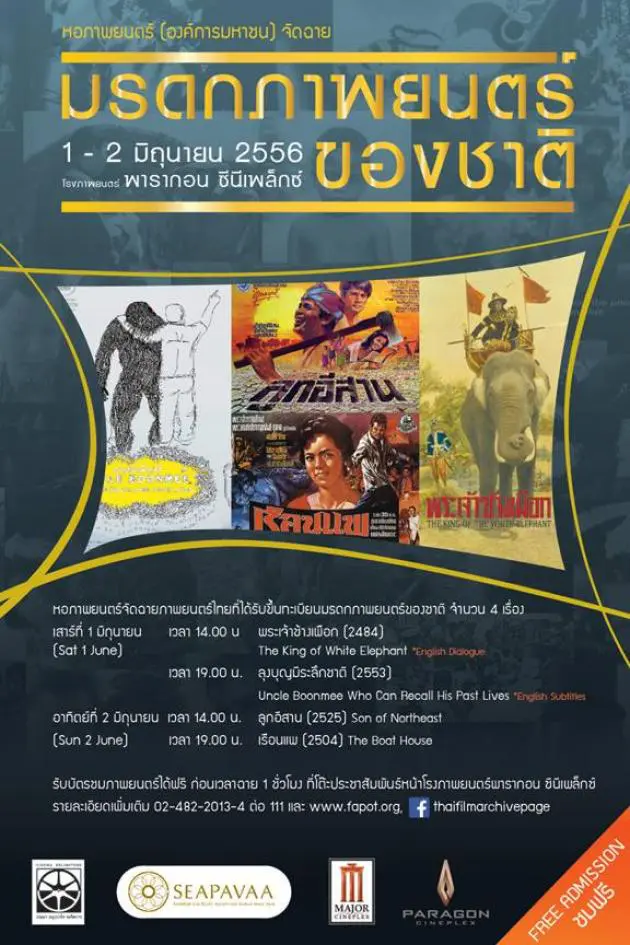
Tomorrow and Sunday, four of the National Heritage films will be screened for free at Paragon Cineplex in Bangkok. Showtimes are at 2pm and 7pm.
Up first is “The King of White Elephant” from 1941. The oldest surviving Thai feature, the epic of elephant battles and palace intrigue is also a rarity because it’s an English-language film, produced by statesman Pridi Banomyong as anti-war propaganda, to let the world know that not all Thais agreed with Japan’s imperialist moves.
Also tomorrow is Apichatpong’s “Uncle Boonmee Who Can Recall His Past Lives”. The newest entry in the Registry made history in 2010 by being the first Thai film to win the top-prize Palme d’Or at the Cannes Film Festival.
First up on Sunday is 1982’s “Son of Northeast” (“Look Isaan”), a landmark drama by Vichit Kounavudhi that follows the migrations of struggling farming families.
The programme closes with another classic, “Reun Pae” aka “The Boat House” or “The House Boat”, a sumptuous 1961 Thai-Hong Kong co-production that blends music, romance and adventure in a rollicking and tragic tale of three guys after the same girl.
Neither of the movies on Sunday have English subtitles. Tickets will be handed out one hour before the show.
