
On the right note


Play
Festspielhaus opera house offers a hands-on place for kids to make music
Cautiously, 10-year-old Arrius steps out onto a super-sized piano keyboard which is inlaid in the floor. The surface under his feet lights up and a musical sound fills the room.
After a few tentative steps, he then taps a key to the left, then one to the right, targeting the black keys. The first few notes of a simple G-major beginner’s piano piece, the “Flea Waltz”, ring out – and then he trips over the keys, laughing.
Waiting impatiently in the wings for her turn is none other than international opera singer Anna Netrebko.
She’s also keen about trying out a dance atop the keys of the huge piano in the new children’s music museum “Toccarion” near the Baden-Baden opera Festspielhaus. She quickly creates a musical chord with both her legs.
Netrebko and her partner Erwin Schrott, recently in town for a production of “Don Giovanni”, were booked by opera house director Andreas Moelich-Zebhauser to attend the Toccarion’s opening festivities.
“I had no idea what was coming,” Netrebko says. “This is fantastic.”
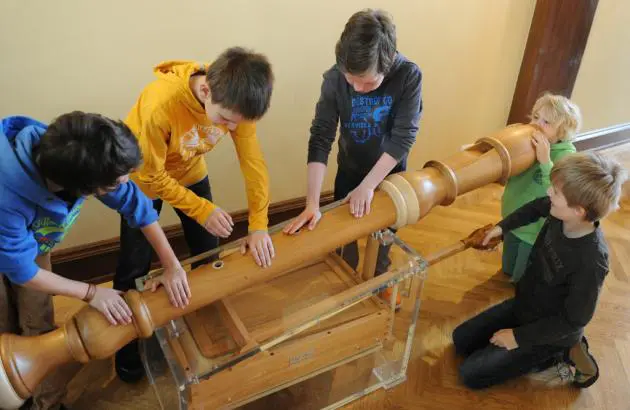
And Schrott also immediately gets into the spirit of things, playing a super-sized recorder with the children, needing an entire hand to cover the holes in order to create the musical notes.
“Hats off for these wonderful ideas,” he says admiringly.
The museum covering 600 square metres is part of the Festspielhaus youth programme. The name Toccarion is completely made up, but derives from the Italian word “toccare” meaning to touch or handle.
And it is precisely this hands-one approach with which Moelich-Zebehauser aims is to cultivate children’s joy of music, above all classical music.
Today’s museum visitors, in his view, should become, if not a member of the orchestra, then at least a member of the audience. And for such an aim he is getting top stars such as Netrebko on board.
“I expect that when they are here for their performances, they will all show up at least once in the Toccarion and get together with the kids,” Moelich-Zebehauser says.
Music educator Cornelia Stank is smiling serenely. She never ceases to be amazed at how quickly the children take to the music instruments, and how much playfulness they bring to their exploration.
Along with a team of seven so-called pilots, she leads groups limited to a maximum of 25 children – both as a precaution that things don’t get too loudly out of hand, but also to provide a chance to go more deeply into the music.
Children with or without any previous musical education are initiated into the world of music in three thematic sections – “Song and Voice”, “Rhythm and Dance” and “Musical Instruments and Orchestra”.
It was a former entrepreneur, Sigmund Kiener, and his foundation, concerned at the often inadequate attention given to early musical education for children, who got the idea for Toccarion going.
“Music has too much taken a back seat in many German kindergardens and schools,” Kiener says. “But children need space for creativity in order to be able to experience music. They are strengthened for the rest of their lives if they can experience music at an early age.”
For this reason his foundation provided 4 million euros (Bt160 million) to restore a part of the old Baden-Baden train station and equip it with the latest technology.
In the high-ceilinged rooms children can play at directing an orchestra projected onto a huge movie screen. In rooms down in the basement, they learn how the human voice works, can train their sense of rhythm and create their own music compositions.
Opera stars Schrott and Netrebko, with an expression of regret on their faces, have only enough time to quickly walk through the rooms before they have to go back to rehearsals for “Don Giovanni”.
“But we’ll be coming back, and we’ll be bringing our son,” Schrott promises. “Probably even tomorrow.” Their son Tiago is four and a half years old, and Schrott is certain of one thing: “He is going to have fun here.”
