
In Pakistan, Nusrat never died


Play
The king of qawwali left an indelible mark on the world
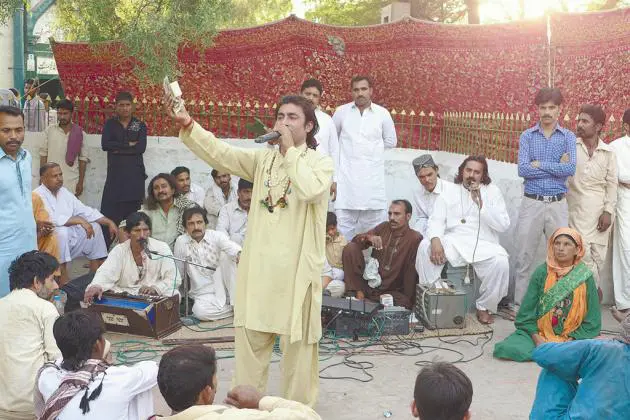
At the heart of the city of Faisalabad in eastern Pakistan are scattered shrines dedicated to the saints of Sufism. Every Thursday crowds gather at the shrines to offer prayers. On one such evening, powerful singing in Punjabi, the provincial language, could be heard from among the shrines.
Weaving through the throngs of pedestrians, I traced the source of the music to an outdoor plaza where an impromptu concert was taking place.
The singers sounded as if they were shouting from deep within their throats. The vocals were accompanied by a small organ and a pair of drums. As the vibrato-like singing reached its climax, others chimed in.
The music I was listening to was a devotional song known as qawwali, in which singers ad-lib classical poems praising Allah and saints.
Faisalabad was home to Nusrat Fateh Ali Khan, one of Pakistan’s most popular musicians, who has been dubbed the King of Qawwali. Locally, the performance tradition has continued uninterrupted.
The song contained such phrases as, “My beloved has come home to me. Praise be to Allah, we have been united. What a beautiful miracle this is.”
Qawwali dates back to around the 13th century, when followers of the Islamic sect of mysticism called Sufism sang to become closer to Allah.
This mode of singing often sends audiences into a trance. When Nusrat held a concert in Japan, the audience, which included many Pakistanis, was entranced. Qawwali has been a tradition for more than 600 years in Nusrat’s family, which can trace its lineage to Afghanistan.
Since he was a child, Nusrat was trained by his father in the traditional melodies and techniques of qawwali. His father died when Nusrat was very young. When Nusrat was 16, he picked up the torch by embarking on a career as a qawwali performer.
Initially, Nusrat performed mainly in Pakistan. When he was 36, however, he reached a turning point. At a British summer music festival in 1985, Nusrat attracted an enormous amount of attention, resulting in his career taking off overseas.
Afterward Nusrat held concerts in many countries, including the United States and France. Gradually, he started to perform abroad more often than back home. But no matter how busy he was, he never failed to schedule concerts in his home country each year during major religious festivals.
“He put Faisalabad on the world map. He is worthy of tremendous respect,” says Bashir Ijaz, 63, who interviewed Nusrat for a local newspaper.
Faisalabad is Pakistan’s third-largest city, where agriculture and textiles are the main industries. At the centre of the city a clock tower built during British rule stands as an icon of the city.
The city has no notable tourist destinations to boast of and therefore is not well known. But locals are proud to claim Nusrat as someone from their city.
Nusrat used Western musical instruments, gave old songs contemporary arrangements and performed qawwali in a number of languages.
Despite criticism from the conservative establishment, Nusrat sought new audiences through his attempts at experimentation. “Nusrat not only made qawwali part of the world’s cultural heritage but also drew a national following among Pakistani urbanites, who had been listening to only pop music,” says music critic Fasi Zaka, 36.
Nusrat died of a heart attack in London in 1997. His oeuvre includes more than 120 albums.
A stroll through Faisalabad with the faint sounds of qawwali in the background made me feel as if I had been temporarily drawn into a mysterious world. Or perhaps it was only a dream.
