
Horrors of '88 on public view


Myanmar tolerates an audacious exhibition recalling the bloody student uprising
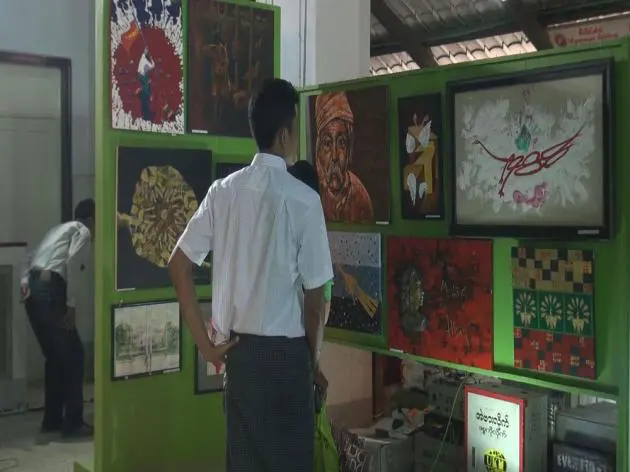
AN EXHIBITION at Yangon’s Judson Hall last month boldly commemorated the 25th anniversary of the 1988 student pro-democracy uprising in poems, photos, paintings and other memorabilia.
The 88 Generation Student Peace and Open Society organised the show to celebrate the pro-democracy struggle in Myanmar and remember the thousands killed in cold blood by the military.
“I feel both sorrow and contentment,” 22-year-old visitor Nay Thet Thet Nway remarked as he viewed the displays. “These were people who sacrificed themselves for the democratic revolution. Some died in the streets without any identification. We’ve never sacrificed like they did.”
Nay Thet’s generation is too young to remember the protests, and the details were suppressed for decades, all but erased from official history.
The activists since released from prison, many of them only recently – those who sowed the seeds of the pro-democracy movement – now strive to keep the memory alive. It’s become part of the local lore, signified as “8888” for August 8, 1988, the day the protests began.
Students at the Rangoon Institute of Technology sparked the uprising after police shot dead one of their classmates, Phone Maw, for protesting against the military dictatorship. Hundreds of thousands of students, young professionals, monks, doctors and other ordinary citizens took to the streets to demand democracy.
General Ne Win, who had ruled the country with an iron fist since 1962, infamously declared that his soldiers would not shoot in the air but shoot to kill. And that’s what happened.
A painting by Min Ko Naing depicted university and high-school students gathered in front of the Yangon University convention hall, the scene overlaid by a single teardrop. Another by Ye Min Kaung showed schoolbags and sandals strewn about, such innocent objects in themselves, now stained with blood.
Even as Myanmar ushers in democratic reforms, an exhibition of this kind remained a daring move, but the activists insisted that the true history be revealed.
“Dictators have historians write the stories they want. Truth was hidden,” said former student leader Min Ko Naing. “We have this art show to seek the truth about what happened in the 8888 uprising.”
Another of the activists, Kyaw Zaw, now working with the 88 Generation Peace and Open Society, had five photographs in the exhibition.
“I’m sure this show can tell the young people today what the ’88 demonstration was about,” he said. “The democracy revolution hasn’t finished yet, but the current reform process is a consequence of the ’88 uprising.”
The parents who lost their children in the uprising can be counted on to never forget.
Among them are the parents Thet Win Aung, winner of the Rebok Award for Human Rights Activity, a high-school student-union leader in 1988. His elder brother Pyone Cho was also involved.
Both boys were jailed, but their parents had no way of knowing if they were still alive or dead and bore the anxiety for many years.
Thet Win Aung drew the longest prison term of anyone – 60 years. He died of malaria in Mandalay Prison in 2006, age 35.
“We want the country to recognise what our sons and other heroes did – sacrificing themselves for the movement,” their father said at his home.
