
Hear a rumble and you better run


Play
There's a special thrill to hiking Batukaru and Agung, Bali's highest peaks
The perfect “Bali getaway” usually means sunbathing on wonderful beaches and paying a visit to magnificent ancient temples.
If you want something different, though, try climbing the island’s highest peaks – Agung and Batukaru.
At 3,142 metres above sea level, stratovolcano Mount Agung is the highest spot on Bali and last erupted in 1963.
The mountain is deemed as the sacred resting place of the gods in the eyes of Balinese Hindus.
Superstition duly keeps locals away and you’ll see few on the volcano’s flank. However, on auspicious days of the calendar they will still be available as hired guides for your mountaineering needs.
When hiking in general, do not sweat the small stuff. The important thing is reaching the peak, rain or shine.
When someone recommends something to you, never see it as a must.
For example, locals will firmly recommend hiring a hiking guide. The price will start in the millions of rupiah (hundreds of US dollars), but can be brought down to just a few hundred thousands, and should include coffee, and maybe arak (palm-based alcohol).
However, you can always choose instead an experienced acquaintance or to join a group of like-minded travellers on motorbike convoys.
Also recommended is to start the hike at 1am to catch the sunrise and avoid the afternoon heat.
Two routes offering varied experiences will lead you to different peaks of the shattered crater-like caldera.
In line with the local Balinese wisdom, the largest mountain on the island has the most important temple at its foot – the Pura Besakih, Bali’s “mother temple” in Karangasem regency.
From here, on the peak’s southwest flank, it’s a long haul through thickets of jungle and along blades of hardened magma with precipices 50 metres deep either side.
This route is the challenging one, and longer by a few hours.
The other path, ascending from Pasar Agung, south of the peak, is the most common path to the ecstasy that awaits all hikers. The trail is marked with spray-paint splodges and passes through thinning old-growth forest, giving way to a long and rugged stone path.
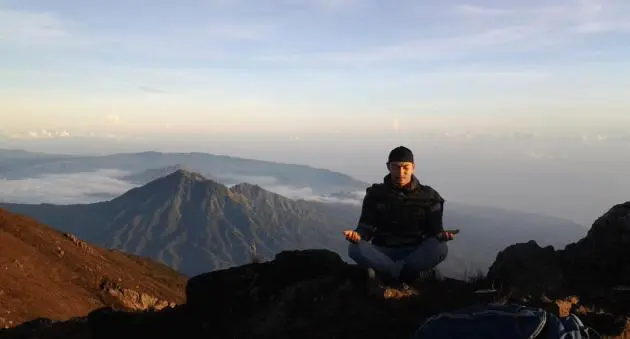
At the peak, a clear day puts you eye-to-eye with Lombok’s Mt Rinjani, across the Lombok strait to the east. Behind you, the cities and mountains of Bali fan out towards the distant peaks of East Java – three or more islands in one, haunting turn-of-the-head.
In the figurative shadow of Agung, Batukaru is Bali’s second tallest peak at 2,276 metres. It is also the site of the island’s second largest temple – the Pura Luhur Batukaru.
This eye-leading bell curve also requires some blood-letting – the island’s oldest forests are seething with leeches.
The gorgeous mountain is not a popular hike. The local people of Tabanan will try and dissuade such exertion.
In a hot spring, the locals will warn of tigers – or the “spirits” of tigers, anyway.
The oldest trees on the island tower with near-aggressive musculature along a steepening trail that is lush and overgrown.
Within a few hundred metres, the buffers break to the southeast, to Medewi beach and the vast blue ocean.
Being forested to the peak, Batukaru makes a great shady day hike.
Four to five hours and you will find not only has the trail been well trodden, there is even a small temple marking the peak.
The flat, grassy top is a vantage point extraordinaire; you’ll want to run circles before the three-hour trip down – perhaps.
Tempted to try Batukaru? Long pants, sleeves, and proper shoes are, again, recommended.
And while the leeches are small and can be easily plucked off, either the flame of a lighter or some salt works to make these pests release their prey.
