
Endless possibilities


Human rights issues link many award winners in Thai Short 17
THE STORY of a forest encounter between a border-patrol officer and a villager was among the top award winners at the 17th Thai Short Film and Video Festival, which wrapped up last Sunday at the Bangkok Art and Culture Centre.
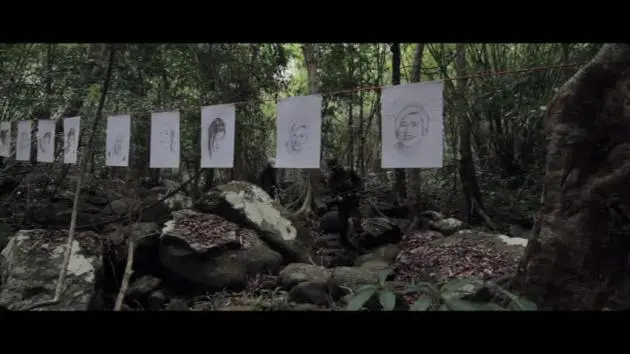
“Endless Realm” by Eakalak Maleetipawan, in which a guitar-strumming artist hangs up sketches on a clothesline in the forest and breaks up the monotonous routine of a border guard, won the top-prize RD Pestonji Award in the category for general filmmakers. The prize is named after Thailand’s pioneering auteur, Ratana Pestonji. “Endless Realm” also won the BACC Award from the Bangkok Art and Culture Centre.
Rights issues were a theme that linked many of the entries in the festival, including another big winner, “Fate”, by veteran filmmaker Boonsong Nakphoo. It follows a man as he’s released after seven years in prison in a southern Thailand border town. He aims to catch first train back home to Isaan, but there are delays because of a bombing on the line. Idling about waiting, the cops are suspicious, and he’s detained. “Fate” won the Pirabkhao Award from the 14 October 1973 Memorial Foundation for films that express freedom and equality issues and also earned a special mention in the Pestonji category.
Two runner-up winners were also strong human-interest stories, “Oriole” by Kaenipa Phanakorn, about a garment-worker mother struggling to care for her troublesome teenage son who has Asperger’s Syndrome, and “The Sweatshop” by New York University film student Chin Tangsakulsathaporn, a fact-based account of a trafficked immigrant girl’s escape from an illegal garment factory in the US.
Another winner was “Ta” by Kunlakan Chanakan Mamber, the story of a young girl scared by a ghost under her bed. Her mother assures her there’s nothing to be afraid of but then tells her a scary story about how she accompanied the girl’s late ghostbusting granddaddy to a job that really puts the pee in the Thai word for ghost. The richly told tale won the popular-vote Audience Award.
Two Pestonji entries were among the four winners of Vichitmatra Award for “distinctive achievements in filmmaking”. “Kai Jik Dek Tai Bon Pak Ong” by Chulayarnon Siriphol was the tale of an elderly grocery shop owner coping with knee-replacement surgery. The other was a smashing music-video entry by sound-and-vision sorcerer Taiki Sakpisit, “The Age of Anxiety”. Featuring a guitar-feedback squall by the rock band Moth Drakula, it opens with a long shot of just white fog or clouds but eventually a figure of a guitar player emerges from the mist. The scene then cuts to found footage of an old Thai film which is chopped and overlayed for a stunning, seizure-inducing strobe effect. From viewers still conscious at the end, it got big cheers.
Going home empty handed from the prize ceremony but still noteworthy were two other Pestonji entries that shared the same cast, “All-Powerful!” by Aditya Assarat and “Boonrerm” by Sorayos Prapapan. They both featured Jirawan Saikongkham and Karuna Lukthumtong as maids.
Aditya’s was a sequel to another short, “Six to Six” and his related feature “Hi-So”, reuniting an apartment-building security guard (Graison Chainam) and his co-workers, the young maid played by Jirawan and the older auntie (Karuna). The guard is now selling quack-medicine remedies, and he goes chasing an actual white rabbit. Aditya himself portrays the homeowner.
“Boonrerm”, which has been well-travelled on the festival circuit this year, has Jirawan again as a maid. She endures demeaning, inhumane treatment by her “crazy woman” employer. At one point she is locked up in a dog’s cage. She’s then blamed for losing a cookbook and forced her to sift through trash at the dump to find it. Luckily young Boonrerm has a friend, the auntie maid again played by Karuna, who comes to the rescue.
Boonsong doubled down with another well-made entry, “Lamoon the Legend”, about a folksinging granny who makes daily rounds to visit her elderly friends and keep her art alive. She walks the country roads, hunched over, with her little granddaughter following. Then, one day, her friends are no longer there, and perhaps her art won’t survive.
Cult indie filmmaker Ratchapoom Boonbunchachoke offered another of his strange satires on Thai culture with “La Double vie de Maniejan”, which commented on ethnic and gender roles in voiceover narration. Unfortunately, it wasn’t subtitled, so only the Thai-fluent were really in on the joke. Too bad, because Ratchapoom has been doing this for awhile now and he’s ripe for attention beyond our borders.
Other entries were “The Number You Have Dialed Is Not Available In This Time” by Suphisa Kittikunarak, in which a young couple becomes estranged, and “Unknown Territory” by Eakarpon Settasuk, a humorous documentary-style account of three filmmakers investigating a transdimensional portal for extraterrestrials at Kala Mountain.
Sivaroj Kongsakul, who directed the festival’s egg-themed bumper that’s screened before every programme, offered “Homemade”, an extension of the autobiographical themes from his feature debut “Eternity” (“Tee-Rak”). Here, he interviews his schoolteacher mother as she recounts all the places she’s lived and how she’s not yet realised her dream of owning her own property.
The International Competition had an especially strong and accomplished selection this year. The top prize went to “Childhood Has Gone” by China’s Zhao Wei Shou, a wistful ode to a childhood friend moving away. A special mention went to the laugh-out-loud “Welcome and Our Condolences” by Leon Prudovsky, recounting a Russian family’s immigration to Israel that’s complicated when an aunt dies aboard the flight. Another special mention was “Amateur Filmmaker” by Volha Dashuk of Belarus follows the country’s oldest living amateur filmmaker as he shoots betacam video footage of the lives of elderly farmers in the picturesque countryside. And a third mention was “The Living Also Cry” by Basil Da Cunha. The surreal tale is of a Portuguese dockworker who wants to spend his life savings to move to Sweden, but his wife has spent the money on a washing machine.
Other winners included entries in the White Elephant Award competition for college student filmmakers, with the top prize going to the tale of badminton-playing gal pals “She Is “My Best Friend” by Jirassaya Wongsutin. “Wang Ploeng Intersection”, Natpakan Khemkhaw’s story of a poor family hit by a draconian regulation of the 2008 Film and Video Act, was among the runners-up.
There was also a special competition, Jenesys 2.0, to pick films by schoolchildren to take part in this year’s edition of the Japan-East Asia Network of Exchange for Students and Youth.
On the Web:
www.Facebook.com/|ThaiShortFilmVideoFestival
