
Houston, we have a solution
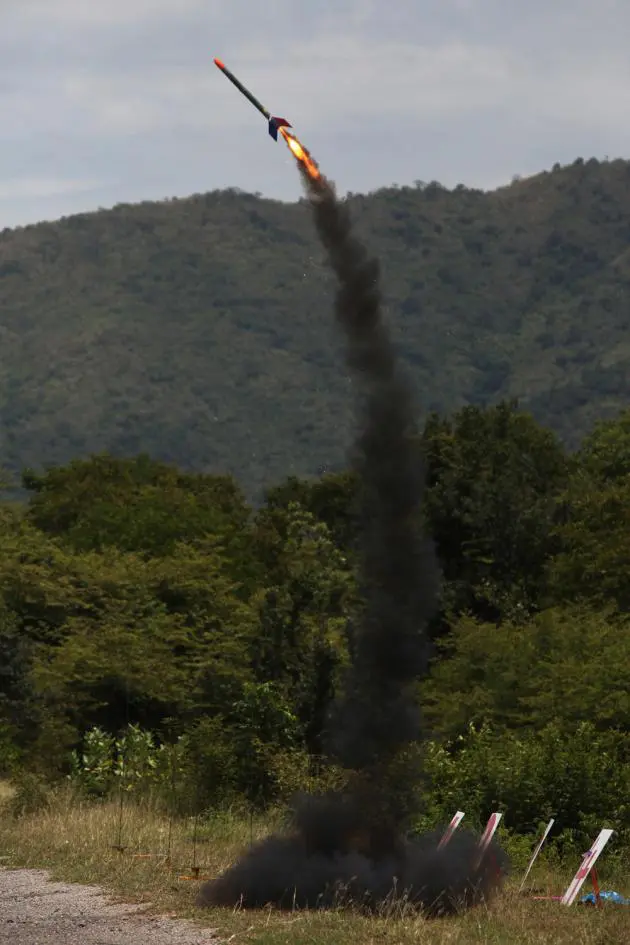


Nasa can take its pick from the young rocket scientists nurtured by the Thai Defence Ministry.
WASSANA BOONHMUN’S rocket, the “Ruammit Galaxy”, shot 373.1 metres into the air. The “.1” is important when altitude wins the day, and Wassana’s team, Black Hole, sucked up the grand prize at a science camp last month that drew 100 youngsters.
“I interested in making rockets because the technology isn’t widely known in Thailand,” the Wattnothaipayap School student said. True enough, given that her kind of missile is quite different from the oversized fireworks that blast off from farmers’ festivals in the Northeast.
“At the camp we’ve learned about the technology and also how to work together. I’ll be taking this knowledge to university, and if the government supports me, I hope to one day work at Nasa.”
The Defence Ministry’s Defence Technology Institute hosted the camp for a second year from August 27 to 30 at the Sirindhorn National Science and Technology Development Agency, while the rocket launches took place at the Fort Phaholyothin Artillery |Centre in Lopburi.
More that 500 Grade 11 and 12 students responded to the institute’s invitations, so a selection committee narrowed the field on the basis of most recent grade-point average and the essays they submitted on using science and technology in the nation’s defence.
“It’s more than just a rocket competition,” institute researcher Paisan Apinhapat told The Nation. “We also inspire the students to pursue the science as a career.”
They certainly got some excellent coaching. Experts from the science agency, the Research and Development Centre for Space and Aeronautical Science and Technology and Kasetsart University taught them the basics on the first day. Day 2 was about designing the fuselage, assembling the engine and using the Aerolab computer program for calculations.
Then the students were assigned to 20 teams and started building rockets, two per team, with the countdown to launch underway.
They used pliable polyurethane for the noses and balsa wood for the tail. PVC tubing formed the body, covered with cardboard and storing a parachute made from a swatch of raincoat plastic and 100 grams of solid propellant. The body tube was bigger than last year, with a diameter between a third and half an inch, and the engines were larger to match.
Rockets take off using liquid or solid fuel or a hybrid. The solid propellant that the students employed was composed of charcoal as the fuel, potassium nitrate as the oxidiser and sulphur as an additive.
At the Fort Phaholyothin artillery range, the kids assembled in a grandstand to watch the launches from a safe distance. Institute staff handled the tricky work from atop five platforms out on the field, using two special cameras to record the altitude reached, one controlled by a computer and the other by a human monitor.
Once the smoke cleared, the cheers subsided and the gaping mouths closed into smiles, the institute’s president, Air Chief Marshal Pongsatorn Buasup, presented certificates to both the winning teams and all of the camp’s participants. For those whose missiles didn’t fly as high as their hopes, there’s always next year.
