
The melancholy of love
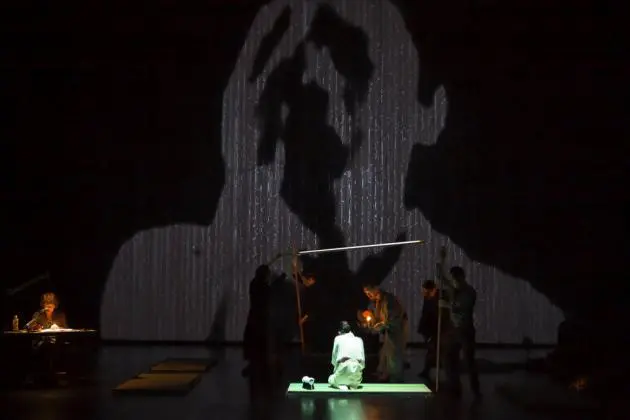


Complicite and Setagaya mesmerise at the Durian with 'Shun Kin'
BRITISH THEATRE company Complicite is celebrating its 30th anniversary; the Singapore Repertory Theatre (SRT) its 20th; and the Esplanade—Theatres on the Bay its 10th. The result of this 3-2-1 countdown was the only Asian city stop on the international tour of “Shun-Kin”, Complicite’s collaboration with Japanese counterpart Setagaya Public Theatre, at the full-capacity Esplanade Theatre last month.
My first experience with internationally acclaimed director Simon McBurney was almost a decade ago when his adaptation of Murakami’s “The Elephant Vanishes”, also a Complicite-Setagaya collaboration, was performed in selected US cities after the Lincoln Centre Festival. My play-going companion back then, a Thai engineering doctoral student, enjoyed it as much as I did and convinced many of his Thai friends to watch it. If the central motif of “The Elephant Vanishes” were lights in modern Japan, then that of “Shun-Kin” was darkness in traditional Japan — and the result was equally astounding.
Lighting designer Paul Anderson deftly painted the stage with different levels of shadows throughout the performance. McBurney decided what and when to reveal and to hide in the almost bare stage filled by 10 performers beautifully portraying various roles as well as bringing in simple yet effective set props.
Thanks in major part to the deft adaptation of Junichiro Tanizaki’s writings, “Shun-Kin” not only told the intriguing 19th century tale of the blind female shamisen master Shun-Kin and her life-long servant, friend and lover Sasuke, but also related it to the contemporary audience through its narrators. These were voice actress Ryoko Tateishi who was recording the play on radio at an NHK studio in the present day and veteran actor Yoshi Oida as old man who was visiting a grave in the 1930s.
This storytelling technique, which never made it too complicated or confusing, not only related the story of another country and another century, but served as a reminder that the relationship between beauty and violence and the thin line between love and obsession were as evident then as they are today.
Equally ingenious was choosing a life-style puppet adapted from the traditional Japanese bunraku tradition, to portray the title character, a teenager.
An actress later replaced the puppet but remained manipulated by a puppeteer. Finally, the puppeteer herself stepped in for the actress, as the latter was pushed to the floor. By contrast, Sasuke was portrayed by a few human actors throughout and Songha was as credible as the teen Sasuke as he was in his adult life.
The question of who was the manipulator and who the manipulated was put forth for our discussion and we quickly came to realise that society was indeed the true manipulator.
The 110-minute play was performed without an intermission and entirely in Japanese, with English supertitles, yet managed to keep the attention of the international audience throughout. A member of the Esplanade’s press relations team suggested I sit in the first circle, not the stalls, and at an angle where I could watch the stage actions and read the supertitles on the sides at the same time. And although I couldn’t see the facial expressions of the actors, I was glued to my seat.
Theatre audiences are now waiting with impatience for the next collaboration between these two powerhouse theatre companies.
The writer would like to thank SRT’s Charlotte Nors and The Esplanade’s Gina Koh for their assistance.
More reasons to visit Singapore
The Esplanade will host its annual “da:ns festival” from October 11 to 20. Visit www.DansFestival.com.
The Esplanade’s collaboration with SRT continues with Yukio Ninagawa’s “Musashi” on November 8 and 9. Details are at www.3TitansofTheatre.com.
Book all tickets at www.sistic.com.sg.
