
Not bad for a tiny little thing


Play
Nikon's new Coolpix doesn't know every trick in the book but can do some heavy lifting
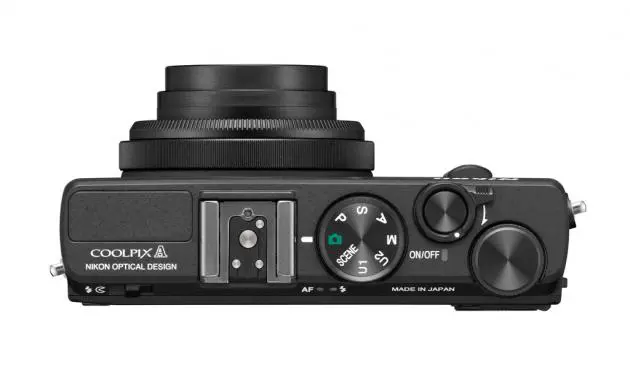
Nikon Coolpix A is a compact camera with good performance and excellent image quality, attributed to by a large image sensor.
Coolpix A uses an APS-C CMOS sensor, which Nikon calls the DX format sensor. APS-C CMOS is normally used in digital SLR cameras, so Coolpix A in its compact body can achieve good image quality like a DSLR.
Coolpix A is pocket friendly at 11cm long and 6.4cm high and weighing less than 300 grams, so it could be your everyday camera, allowing you to capture exciting moments in good image quality.
With its large sensor and bright lens, Coolpix A can easily capture sharp subjects with softly blurred backgrounds and it has good low-light performance.
Coolpix A features 16.2 megapixel resolution and a prime Nikkor glass lens with 28mm equivalent focal length and a bright f/2.8 aperture. It features ISO sensitivity of ISO100 to ISO6400. It uses TFT-LCD with 5-level brightness adjustment so it can be used under bright sunlight and the monitor features 921,000 dots resolution.
It uses a contrast-detect TTL Autofocus system and its AF focus-area is selectable from centre to face priority, subject tracking, normal area and wide area options.
It is convenient that Coolpix A provides a focus ring for you to override focus anytime.
Nikon says Coolpix A features one of the most impressive Nikkor lenses its ever used. The lens is constructed of 7 elements in five groups and has a 18.5mm focal length, which has angle of view equivalent to that of 28mm lens in 35mm photography.
The lens has a fixed focal length so you will have to walk closer to your subject to take nice portraits. But the 28mm focal length can take beautiful landscape shots.
Coolpix A is easy to operate even for new users who can use its full automatic exposure mode or Scene Modes. I tested the camera using full auto mode and it captured sharp and clean photos with accurate exposure in most lighting conditions.
In certain complicated lighting environments, such as backlit portraits or similar subjects, you may need to use other exposure modes that require you to manually tweak the settings. And unfortunately, Coolpix A does not provide a backlit subject/portrait as one of the Scene Modes. But you can overcome this problem by using the Active D-Lighting option in one of advanced exposure modes.
The Scene Modes are fun to use but you have to select the proper mode for the current lighting condition. The modes include Landscape, Portrait, Silhouette, Blossom, Close UP, Night Landscape, Night Portrait, Sports and Sunset.
If you are an advanced user and want to make the most of the camera, try the Programmed Auto, Shutter-priority, Aperture-priority and full manual modes. The camera can memorise two user settings, also selectable from the mode dial.
Coolpix’s command dial is positioned well so that you can conveniently use your thumb to change shooting settings. There are also two function buttons – Fn1 and Fn2 – for quick access to some shooting parameters, both customisable.
And there is also an exposure compensation button at the back for manually adjusting settings in complicated lighting environment.
You can access various settings for making changes quickly by pressing the Information button at the back. It will display a settings panel, on which you use arrow keys to navigate and the OK button to change settings. The panel will display white balance, ISO, shutter release mode, and picture control modes (standard, neutral, vivid, monochrome, portrait and landscape).
I took Coolpix A to test on a Chao Phraya Express Tourist Boat one sunny morning and was impressed in its performance and quality. Its auto focus was fast and managed to capture sharp and clean photos although the boat was speeding.
The camera captured photos in good dynamic range as well. When I got to a pier and shot a nearby park, Coolpix A managed to capture the blue sky, green lawn and trees and shadows.
My shots of the Temple of the Dawn were impressively rendered in terms of the blue sky, white clouds, green water hyacinth, red and yellow roofs of the temple and more. People’s skin tones looked warm and beautiful. All of these were shot in standard picture modes, so the colours could have been further intensified had I used vivid picture control.
Coolpix A took about 1.2 seconds for starting up to take the first shot. Its shutter lag was just 0.3 seconds or unnoticeable and shot-to-shot time was less than a second. It is also capable of shooting four frames per second in a continuous shooting mode.
Coolpix A is also capable of shooting Full HD video at 1920x1080p at 30 fps. But it has no dedicated video button. You must select the movie recording mode from the menu of shutter release mode.
Coolpix A’s functions and performance can be further enhanced with a range of Nikon's DSLR, including flashguns, IR remotes, GPS and Wi-Fi modules. There are also a hot shoe mounting optical viewfinder and an UR-E24 adaptor/lens hood pack that allows the use of 46mm filters, which are designed especially for Coolpix A.
Nikon Coolpix A has a suggested retail price of Bt36,900.
Key specs
_ Effective Pixels: 16.2 million
_ Image Sensor: DX Format (APS-C) CMOS
_ Lens: 1x 18.5mm (28mm equivalent) f/2.8 optical NIKKOR glass lens
_ Autofocus (AF): Contrast-detect TTL AF, Autofocus (AF) Focus-area selection
_ Focus Range: Approx. 1 ft. 8 in. (50 cm.) to infinity; Macro close-up mode: Approx. 4 in. (10 cm.) to infinity
_ Monitor: 3-inch TFT-LCd with 921,000 dots
_ Storage Media: SD, SDHC, SDXC memory card
_ Maximum movie resolution: 1920x1080p / 30fps
_ ISO Sensitivity: ISO 100-3200, expandable to 6400
_ Exposure Metering: Matrix, Center-weighted, Spot
_ Exposure Control: Auto, Scene Modes, P, S, A, M
_ Shutter Speed: 1/2000 – 30 s; bulb and time available in mode M
_ Battery Life (shots per charge): Approx. 230 shots
_ Approx. Dimensions (Width x Height x Depth): 111 mm x 64.3 mm x 40.3 mm
_ Approx. Weight: 299 g
